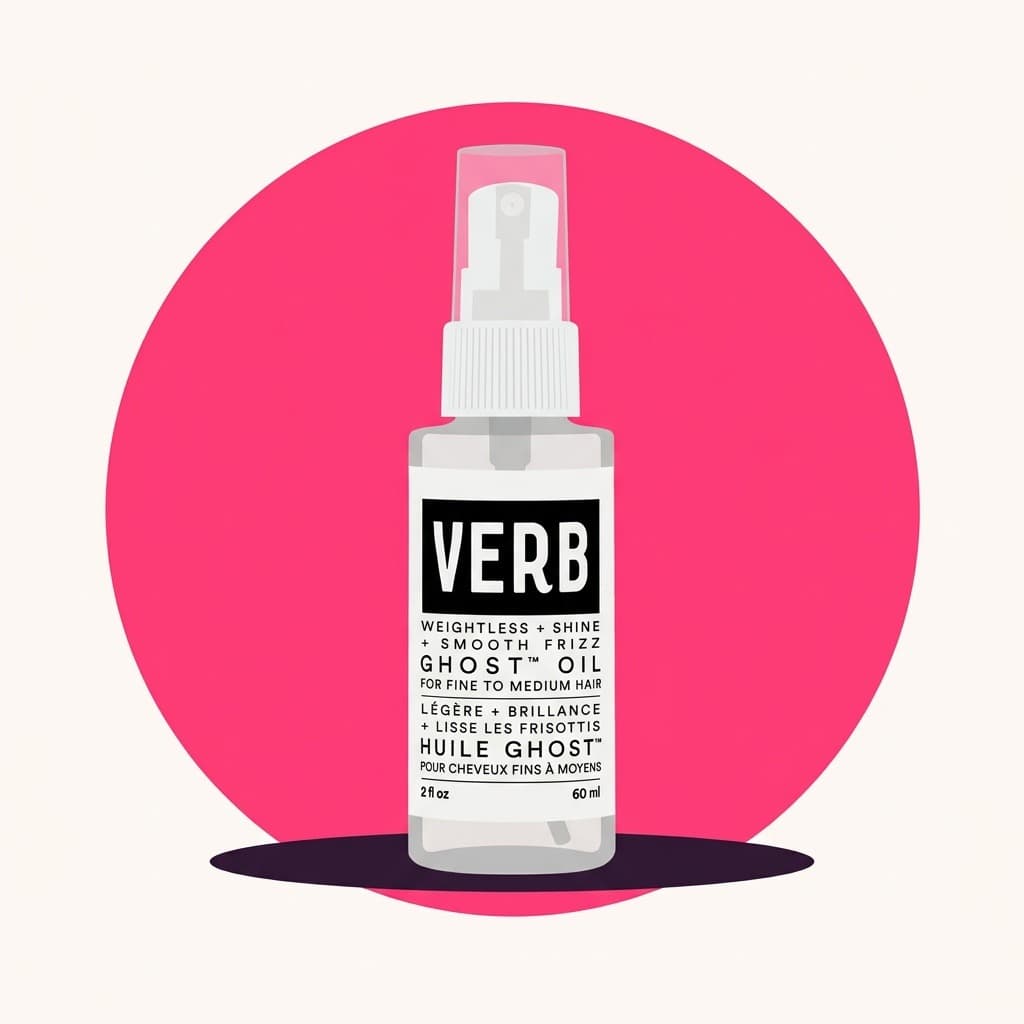
Verb Ghost Oil Review: Is the $22 Hair Oil Worth It?
The Insider Score
Finishing oilsShine for hair that falls flat.
Ghost Oil gives the ends a smoother, glossier finish with a small pump of product. We’d reach for it on fine hair that heavier oils tend to overwhelm.
My ends looked shinier with Ghost Oil, and my hair still felt light.
Insider Beauty tester- Shine and smoothing
- 4.3/5
- Dose control
- 4.8/5
- Value per use
- 4.3/5
How the score adds up
The six Beauty 100 criteria add up to 89 out of 100. Divide by 20 for the five-point rating.
- Shine and smoothing
- 26 / 30 pts
- A light coating adds shine and helps smooth frizz.
- Dose control
- 19 / 20 pts
- The pump makes it easy to start with a small dose.
- Value per use
- 17 / 20 pts
- A little goes a long way on fine-to-medium lengths.
- Support for product claims
- 14 / 15 pts
- What sets it apart
- 8 / 10 pts
- Formula disclosure
- 5 / 5 pts
Our Verb Ghost Oil review checks the current formula, shine and heat claims, published tester reports and US prices against Curl Oil and Olaplex N°.7.
- Rank
- #14
- Current price
- $22.00
- Listed size
- 2 oz
- Updated

Reviewed bySarah ChenBeauty Editor ·
Editor’s cut
At a glance
US$22 for 2 fl oz, or US$11.00 per fl oz, checked October 23, 2026.
A reasonable shortlist choice for a polished finish when heavier oils leave hair flat.
The current formula contains silicones, fragrance and hydrolyzed proteins.
Brand lab claims carry limits; older editor reports may concern an earlier formula.
Evidence-led assessment with no new Insider Beauty wear test.
Header image is an AI-generated editorial illustration based on product packaging.
Community signal
Would you buy it again?
Verdict: a sensible finishing oil for hair that gets weighed down
Verb Ghost Oil is worth considering at US$22 for 2 fl oz if your main problem is a rough-looking finish and heavier oils leave your hair flat. I would shortlist it for fine-to-medium hair before spending more on a prestige finishing oil. I would skip it if you want fragrance-free care, a silicone-free routine or strong styling hold.
Our tester found their ends looked shinier without their hair feeling heavy. That balance is the reason we’d choose Ghost Oil for fine lengths.
What is in the current Ghost Oil formula
The current US ingredient list at Ulta starts with cyclopentasiloxane, dimethiconol, dimethicone, caprylyl methicone and phenyl trimethicone. Those first five ingredients are silicones. Argan, moringa and rice-bran oils follow; the list also contains fragrance and hydrolyzed proteins. Its formula identifier is VGO03-J25.
Calling this a silicone-based finishing serum is more informative than picturing a bottle of pure moringa oil. That is an interpretation of the ingredient list, not a claim about undisclosed percentages. The distinction helps when comparing it with plant-oil blends, even if both products sit on the same hair-oil shelf.
Ulta cautions that the delivered product can differ from its online ingredient list. Check your bottle if you are avoiding a particular ingredient. Neither a familiar product name nor an old review is enough to establish that two bottles have identical formulas. The identifier is useful for comparison; it does not establish a reformulation date.
Why the silicone base matters
Silicones belong in this discussion because they help explain the product's intended job. Dow's hair-conditioning ingredient guide describes cyclopentasiloxane/dimethiconol and dimethicone/dimethiconol blends used for conditioning, easier combing and shine. This is supplier information about ingredients, not a trial of Ghost Oil or evidence that Verb buys those particular blends.
My buying inference is modest: the formula makes sense for someone seeking a polished finish. The presence of a botanical oil further down the list does not, by itself, tell us which ingredient produces the effect, or whether buying that botanical oil separately would reproduce it.
Nor would I choose this on the assumption that more ingredients mean more repair. A finishing product earns its place if it improves your routine at a dose you enjoy. If your existing serum already does that, this ingredient list alone offers no compelling reason to replace it. Compare the finish you need, the ingredients you avoid and the price of a usable bottle.
The shine, frizz and strength claims need context
Verb's product page reports up to 118% greater shine, 70% less frizz and protection against heat up to 450°F/232°C. It also reports hair that is 9.5 times stronger with 89% less breakage, with the latter claims specifically qualified as testing during heat styling. The footnotes describe third-party laboratory testing.
These are brand-reported results. The public page does not provide enough protocol detail to reconstruct the tests or establish how closely they match an individual routine. A lab conducting the work outside the brand does not make this an independent test commissioned by Insider Beauty.
I would not translate those numbers into a promise that your hair will look twice as glossy, that every flyaway will disappear or that existing damage has been reversed. The breakage qualifier is especially relevant: do not detach the impressive percentage from the conditions under which it was measured. Someone who air-dries should not read it as a proven result for their routine.
How it looks on dry hair
A small amount through the ends gives dry hair a glossier finish. On waves, smooth what is left on your palms over the lengths to soften a firm gel cast.
How to use Ghost Oil without overdoing the finish
Ulta's current directions specify two to three pumps through the middle lengths and ends of damp or dry hair, followed by combing for even distribution. That is the manufacturer's starting instruction, not a universal dose for every haircut.
For a first trial focused on appearance, I would keep the rest of the routine familiar:
- Choose one job for the oil that day, such as finishing dry ends. Avoid changing your shampoo, conditioner and styler at the same time.
- Distribute it through your hands before applying, and work deliberately through the area you want to address.
- Assess the result before adding another layer. Check the underside and back as well as the sections nearest your face.
- On the next wash day, adjust the amount or placement based on what happened. If the lengths looked good but the roots went flat, that is more useful information than simply deciding the bottle was too heavy.
For heated styling, follow the instructions on your current bottle. A small finishing dab applied after using a hot tool cannot retroactively protect the hair during that styling session.
Who it is best for, and when I would pass
The strongest case is someone whose haircut already behaves reasonably well but needs a better finish. That could mean reducing the look of flyaways after styling, or making dry-looking lengths appear more polished. The attraction is the possibility of that improvement without committing to a much richer oil treatment.
I would treat it as an optional finishing step for curls, rather than assume it can replace the product that gives the style its shape. If your problem is that waves collapse before lunch, decide whether you need more hold before buying another shine product. Our Odele Air Dry Styler review considers a different styling role and its limitations.
Skip Ghost Oil if avoiding silicones or fragrance is a firm requirement. People who already have a good finishing product should also consider whether there is an unmet need. Buying a second bottle because a percentage sounds impressive can make the routine more expensive without making the comparison any clearer.
Heat protection is not a recommended tool temperature
The temperature in a protection claim is not a target setting. The American Academy of Dermatology's hair-damage guidance advises using the lowest heat setting, reducing how long hot tools contact hair and using them less frequently. It also recommends air-drying when possible.
That practical advice matters more than chasing the highest temperature printed in a product description. It would be a mistake to treat an oil as permission to turn up a straightener or repeatedly pass over the same section. Product application and tool habits are separate parts of the routine.
For someone deciding between air-drying and heat styling, the heat claim is an additional feature to assess, not a reason to start using a hot tool. For someone who already styles with heat, check the current bottle rather than relying on instructions remembered from an older purchase.
Price and alternatives: compare the job as well as the bottle
These are regular US prices checked October 23, 2026, excluding shipping, tax, subscriptions and temporary offers. Ghost Oil costs US$11.00 per labeled fluid ounce. The comparison below uses the sizes stated by each manufacturer rather than treating a 30 ml bottle as equivalent to a 2 fl oz bottle.
| Product | Regular US price and size | Reason to consider it |
|---|---|---|
| Verb Ghost Oil | US$22 for 2 fl oz | A finishing-oil candidate when weight is a concern |
| Verb Curl Oil | US$22 for 3 fl oz | A silicone-free alternative to investigate for curls |
| Olaplex N°.7 Bonding Oil | US$32 for 30 ml | A smaller, higher-priced alternative with its own claims |
Verb Curl Oil is explicitly silicone-free, starts with almond oil and lists fragrance. Its US$7.33 per fluid ounce is about 33% below Ghost Oil's unit price. That makes it worth considering if the formula preference suits you; it does not establish an equivalent finish or a better result on fine hair. A bigger bottle is useful only if you like what is inside it.
Olaplex N°.7 Bonding Oil costs US$32 for 30 ml, or about US$1.07 per ml. Olaplex also makes shine, frizz and heat-protection claims. Its advertised percentages and Verb's should not be ranked against one another without comparable test methods. I would want a specific reason to pay the extra US$10 at checkout, rather than assume the higher price proves superior performance.
Drawbacks that matter before buying
There is also no defensible cost-per-use figure here. Pump output, hair length and application frequency would all need to be known. Unit price is transparent; an invented number of months per bottle would create false precision.
Finally, do not buy it to solve every complaint about your hair at once. If you need stronger hold, a different wash routine or a more substantial conditioning step, set that priority before choosing a finisher. For a narrow shine-and-finish brief, Ghost Oil is a reasonable shortlist choice. For a requirement it does not meet, even an affordable bottle is money poorly spent.
Sources and methodology
Research was checked October 23, 2026. The linked brand and retailer pages support current product details, while Dow supplies ingredient-level context. The dermatology source supports general heat-styling advice. Published editor accounts are dated and attributed; they are not presented as Insider Beauty's experience.
The price comparison uses the labeled sizes. Product and ingredient details were checked against the linked brand, retailer and technical references.
Ghost Oil's position in the Beauty 100 is a separate ranking. This review adds the buying detail needed to judge whether the product fits a particular routine; inclusion does not remove the drawbacks or make the brand's performance claims independently verified.
Useful details
Frequently asked questions
Is Verb Ghost Oil good for fine hair?
It’s a good pick if heavier oils flatten your hair. Start with a small amount through the ends for a smoother, glossier finish.
Does Verb Ghost Oil protect hair from heat?
The current brand page claims protection up to 450°F/232°C from third-party laboratory testing. That is not a recommended tool temperature or a guarantee of damage-free styling; follow your bottle and use the lowest effective heat.
Should Ghost Oil go on wet or dry hair?
The current directions allow damp or dry hair. Apply through the middle lengths and ends, then comb to distribute evenly.
Does Verb Ghost Oil contain silicones?
Yes. The first five ingredients on the current US list are silicones, so it will not fit a silicone-free routine.
Is Verb Ghost Oil fragrance-free or protein-free?
Neither. The current ingredient list includes fragrance and hydrolyzed proteins. Check the packaging if you need to avoid a specific ingredient.
Can Ghost Oil replace a curl gel?
I would not buy it as a substitute for the hold you rely on from a gel. Decide whether you need a better finish or stronger styling support before changing your routine.
Is Verb Curl Oil better value than Ghost Oil?
At the checked regular prices, Curl Oil costs about US$7.33 per fluid ounce versus US$11.00 for Ghost Oil. That is a 33% unit-price saving, but the formulas differ and an equivalent finish has not been established.
Did Insider Beauty test Ghost Oil firsthand?
Yes. Our tester used Ghost Oil on their ends and saw more shine without their hair feeling heavy.