Timeless 20% Vitamin C Serum Review 2026: Worth It?
Our Timeless 20% vitamin C serum review covers its low-pH formula, oxidation, sensitive-skin risk, storage, value and SkinCeuticals comparison.
Evidence-led score using Insider Beauty’s published 100-point editorial rubric. How we score
- Rank
- #4
- Current price
- $27.95
- Listed size
- 1 oz
- Updated

Reviewed bySarah ChenBeauty Editor ·
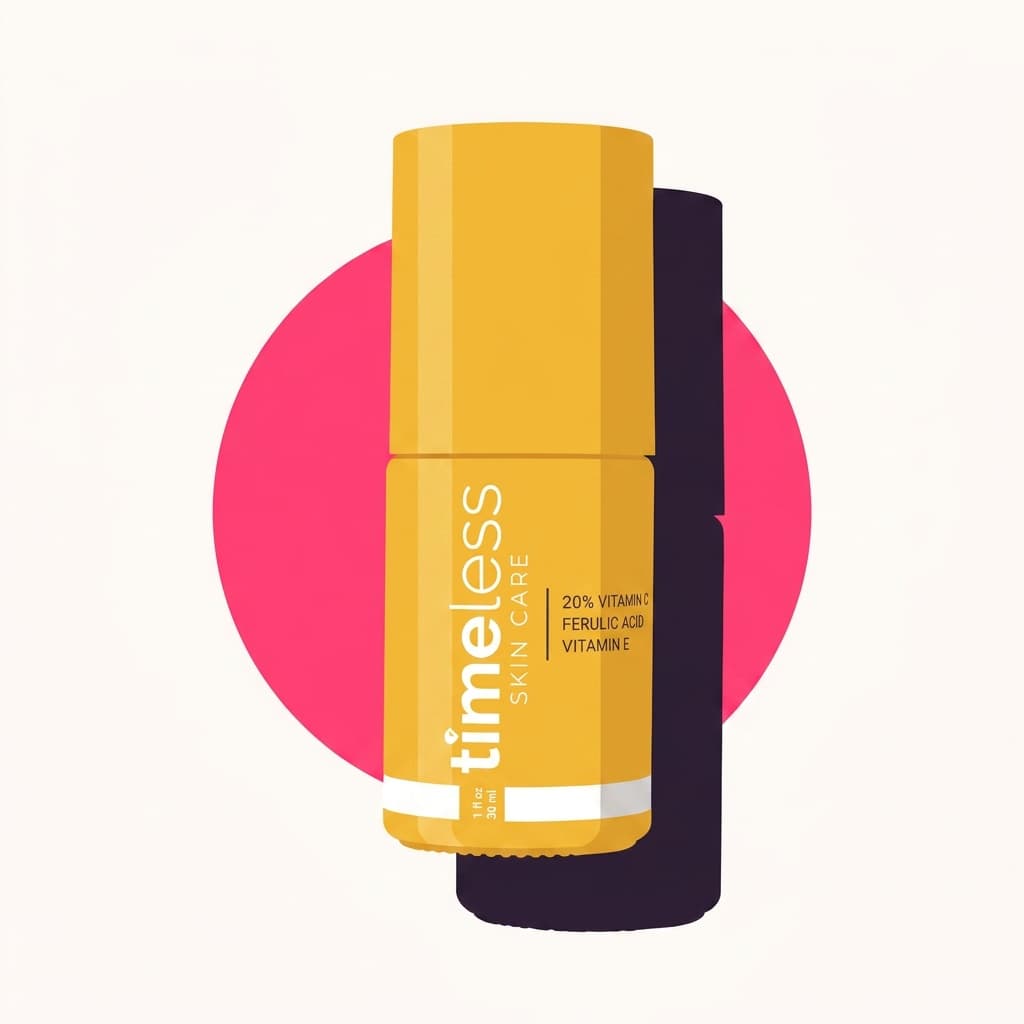
Editorial illustration based on current packaging; not an official product photograph.
Editor’s cut
At a glance
The formula discloses 20% L-ascorbic acid and a brand-reported pH near 2.4 in a current glass pump.
Vitamin E and ferulic acid are present, but their current percentages are not publicly specified.
At $27.95 for one fluid ounce, it offers a similar antioxidant concept to prestige serums at a much lower price.
The low pH and 20% strength make it a better fit for experienced vitamin C users than sensitive beginners.
Refrigeration and attention to freshness are real ownership costs, not footnotes.
Community signal
Would you buy it again?
Verdict
Timeless Skin Care 20% Vitamin C + E Ferulic Acid Serum earns its number-four Beauty 100 rank on value and unusually useful disclosure. The current 1 ounce glass-pump bottle costs $27.95, contains 20% L-ascorbic acid, and has a brand-stated pH of about 2.4. That is a serious vitamin C formula at a price that leaves room for sunscreen and moisturizer.
The evidence has limits. Timeless publishes a small 28-day product test, while the stronger independent research concerns L-ascorbic acid or a specific 15% vitamin C, 1% vitamin E and 0.5% ferulic acid mixture. Timeless does not disclose its vitamin E or ferulic acid percentages. This is an evidence-led editorial review, not a staff use test, so it does not claim a finish, smell or result that Insider Beauty has observed first-hand.
Buy it if proven-form vitamin C, an opaque pump and low price matter more than prestige packaging. Start more cautiously if the skin already stings with acids, retinoids or a damaged barrier. Refrigeration and a short after-opening window also make this less carefree than a stable vitamin C derivative.
What the current glass-pump serum is
The current Timeless product page lists 1 ounce, 1.7 ounce and 4 ounce sizes and says every size now comes in a premium glass bottle. It also describes the container as an opaque pump. Older reviews and photos may show the former airless package, so packaging comments from those reviews do not describe the version ranked here.
Timeless calls the texture water-like and directs users to apply one or two pumps once daily. The formula is fragrance-free and dye-free, and the brand also labels it vegan, cruelty-free, paraben-free and sulfate-free. Those are product facts or brand positions. They do not establish irritation risk or clinical performance.
The 1 ounce bottle was $27.95 on August 29, 2026. Timeless recommends using it soon after delivery, refrigerating it, and finishing it within three to six months of opening. The product is therefore priced like an accessible daily serum but asks to be handled like an oxidation-prone active.
Formula transparency: known and unknown
The current ingredient list is: Water, Ethoxydiglycol, L-Ascorbic Acid, Propylene Glycol, Alpha Tocopherol, Polysorbate 80, Panthenol, Ferulic Acid, Sodium Hyaluronate, Benzylalcohol, Dehydroacetic Acid.
| Formula point | What is disclosed | What remains unknown |
|---|---|---|
| L-ascorbic acid | 20% | Nothing material about concentration |
| Finished-product pH | Approximately 2.4, according to Timeless | Batch range and independent verification |
| Alpha tocopherol, vitamin E | Present | Percentage |
| Ferulic acid | Present | Percentage |
| Panthenol | Present | Percentage |
| Sodium hyaluronate | Present | Percentage and molecular weight |
The approximate pH comes from a Timeless education page, not a certificate for the bottle a customer receives. It is still useful because low pH affects L-ascorbic acid delivery and explains why a 20% serum may sting.
The ingredient order cannot fill the percentage gaps. Under the FDA summary of cosmetic labeling requirements, ingredients generally appear in descending order, but those present at 1% or less may be listed without regard to predominance. Alpha tocopherol appearing before ferulic acid does not reveal either number. Calling this a fully concentration-disclosed C, E and ferulic formula would be inaccurate.
What the vitamin C evidence supports
Timeless uses pure L-ascorbic acid rather than a derivative. A frequently cited 2001 percutaneous absorption study found that L-ascorbic acid needed a pH below 3.5 to enter pig skin and that absorption peaked at a 20% concentration. That study supports the logic behind Timeless's concentration and stated pH. It did not test this finished serum on human faces, and it does not prove that 20% gives better visible results than a well-made 15% product.
The case for adding vitamin E and ferulic acid comes from more specific research. A 2005 study tested a solution containing 15% L-ascorbic acid and 1% alpha tocopherol, then added 0.5% ferulic acid. The addition improved chemical stability and increased protection against solar-simulated irradiation in skin from fourfold to about eightfold by the study's measures. Those results belong to that tested ratio and vehicle. Timeless lists the same three antioxidant names but withholds two of the three percentages.
Visible changes take longer and the literature is smaller than vitamin C marketing suggests. A 2023 systematic review found only seven eligible randomized studies with 139 volunteers in total. The review reported improvement in uneven pigmentation and wrinkled skin, while noting that long-term use may be needed. Formulas and protocols varied, so the result supports topical vitamin C as a category rather than predicting what Timeless will do in four weeks.
One double-blind half-face study found improved photoaging scores after 12 weeks, but it enrolled only 10 people and used a different formula containing 10% L-ascorbic acid plus 7% tetrahexyldecyl ascorbate. It is encouraging context, not product proof.
The Timeless 28-day test
Timeless reports a third-party clinical trial of 21 participants after 28 days. According to the current product page, 81% had an improved overall complexion, 76% had noticeably less dull skin, and 71% found their skin noticeably brighter and smoother.
Those figures are product-specific, which makes them more relevant than an ingredient study. The public summary leaves major questions unanswered. It does not name a control, explain randomization or blinding, separate expert grading from participant responses, show baseline severity, or link to a paper. Twenty-one participants and four weeks also cannot settle longer-term questions about discoloration or lines.
Timeless commissioned a small third-party study that produced favorable short-term signals. The test is not strong enough to support guaranteed results, and it does not establish parity with SkinCeuticals.
Timeless versus SkinCeuticals C E Ferulic
Timeless is often presented as a SkinCeuticals C E Ferulic dupe. The comparison is understandable, but "dupe" needs a narrow definition here. Both are acidic water-based antioxidant serums built around L-ascorbic acid, alpha tocopherol and ferulic acid. They are not the same disclosed formula, and no direct head-to-head trial was found.
| Product | Current disclosed antioxidant formula | Current format and size | Price checked August 29, 2026 |
|---|---|---|---|
| Timeless 20% Vitamin C + E Ferulic Acid Serum | 20% L-ascorbic acid; alpha tocopherol and ferulic acid percentages undisclosed | Opaque glass pump, 1 oz | $27.95 |
| SkinCeuticals C E Ferulic | 15% L-ascorbic acid, 1% alpha tocopherol, 0.5% ferulic acid, plus 0.3% carnosine and 1% Endophytol | 30 ml, 4 to 5 drops per use | $185 |
The current SkinCeuticals page describes an enhanced formula. It retains the classic 15%, 1% and 0.5% antioxidant ratio, then adds 0.3% carnosine and 1% Endophytol. SkinCeuticals discloses more of the antioxidant system and links its positioning to the ratio used in the 2005 research. Timeless uses more L-ascorbic acid, includes panthenol and sodium hyaluronate, and costs $157.05 less for a near-equivalent volume.
Higher vitamin C is not automatically better. Timeless reaches the concentration associated with peak absorption in the pig-skin study, but SkinCeuticals reveals the complete C, E and ferulic ratio and has a larger formula-specific evidence package. Timeless is the much cheaper way to buy the same broad antioxidant architecture. It is not evidence that both products deliver equal stability, penetration, irritation or visible change.
How to use and layer it
Timeless directs one or two pumps onto a freshly cleansed face and neck once daily, followed by time to absorb. Morning is the brand's preferred slot, with moisturizer and sunscreen afterward. It can also be used at night. The brand advises against direct application to the under-eye area.
A simple morning order is cleanser, Timeless serum, moisturizer if needed, then sunscreen. Prequel Gleanser, rank number two is one fragrance-free cleansing option. Beauty of Joseon Relief Sun, rank number three is one current Beauty 100 sunscreen choice. An antioxidant serum supplements sunscreen; it does not replace it.
Timeless says not to layer this high-strength serum with another active serum in the same routine. That is a sensible irritation-control rule, not proof that every active is chemically incompatible. Someone using Differin Gel, rank number one can place vitamin C in the morning and adapalene at night. Introduce one new active at a time so a reaction has an identifiable cause.
Sensitive users are told to begin every other day and work toward daily use. Two or three mornings a week is an even clearer starting schedule if acids already cause stinging. Stop applying to irritated or broken skin, and do not treat persistent burning as evidence that the serum is working.
Oxidation, refrigeration and the pump
L-ascorbic acid is difficult to keep stable in water. Timeless acknowledges that the serum darkens as it oxidizes, asks customers to use it on receipt, recommends refrigeration, and gives a three to six month period after opening. That candor is useful. It also adds a real ownership cost: the bottle needs cool storage and regular attention.
The current opaque glass pump reduces routine light exposure and avoids opening a dropper at every use. It should not be described as proof of zero air exposure. Timeless does not publish finished-product stability curves or a specific color at which the serum should be discarded on the product page.
The page contains inconsistent use estimates. One answer says a 1 ounce bottle typically lasts about one month at one or two pumps daily; another says most users get one to two months. Treat those as rough brand estimates. Buying the 4 ounce size may lower the unit price, but it also increases the chance that one person cannot finish fresh serum within the recommended window.
Who it is best for
This serum best suits normal, combination or oily skin that already tolerates acidic actives and wants a morning antioxidant step. It also makes sense for a price-conscious SkinCeuticals shopper who understands that ingredient architecture and clinical equivalence are different claims.
Dullness, uneven tone and early photoaging are reasonable targets. The systematic review suggests that pigmentation and texture changes need sustained use, not a seven-day transformation. Sunscreen remains the more important purchase if the routine does not already include one.
Dry skin may use the formula, but sodium hyaluronate and panthenol do not make it a moisturizer. Follow with a cream if the skin feels tight. Reactive skin, active rosacea, eczema flares or a recently damaged barrier has less reason to begin with 20% L-ascorbic acid at about pH 2.4. A lower-strength vitamin C formula is the more cautious route.
This is not an acne treatment. Readers trying to clear persistent comedonal or inflammatory acne should assess an acne active separately rather than expecting vitamin C to do both jobs.
Price and value
At $27.95 for 1 ounce, Timeless costs about 15% of the $185 SkinCeuticals price for 30 milliliters. The bottles are close enough in volume for the $157.05 checkout difference to be meaningful without a complicated unit conversion. SkinCeuticals costs about 6.6 times as much at the prices checked.
Value still depends on finishing the serum while it is fresh. If the 1 ounce bottle lasts one month, the product cost is about $0.93 per day. If it lasts two months, that falls to about $0.47. Those figures use Timeless's two conflicting duration estimates and exclude shipping, discounts and wasted oxidized product.
The 1 ounce bottle is the rational first purchase. It tests tolerance and routine fit without turning freshness into a race. Larger sizes make more sense for an established daily user or a household that can finish them within the brand's stated period.
Drawbacks and reasons to skip it
The main drawback is irritation risk. Twenty percent L-ascorbic acid at an approximate pH of 2.4 can be too assertive for skin already managing retinoids, exfoliating acids or barrier damage. A fragrance-free label does not make an acidic serum gentle.
Formula disclosure is incomplete where the SkinCeuticals comparison matters most. Timeless gives the vitamin C percentage but not the vitamin E or ferulic acid percentages. The brand's 28-day test is too briefly reported to audit, and no published Timeless-versus-SkinCeuticals trial supports equal-result claims.
Freshness requires planning. Refrigeration, visible darkening and a three to six month use window are reasonable controls, but some shoppers will prefer a less demanding derivative serum.
Skip it if every low-pH product burns, the refrigerator routine will not happen, or the only acceptable purchase is one with every antioxidant percentage disclosed. Its case is strongest on price, vitamin C form, concentration and packaging. It is weaker on complete formula transparency and finished-product evidence.
Sources and methodology
This review was researched on August 29, 2026. Insider Beauty checked the current glass-pump product page, current price, ingredient list, brand directions, brand-published trial summary, FDA labeling rules, independent clinical literature and the current enhanced SkinCeuticals comparator. It contains no claim of staff wear testing. Brand claims, study results and editorial inferences are kept separate in the text.
Sources used for this review:
- Timeless Skin Care 20% Vitamin C + E Ferulic Acid Serum product page
- Timeless Skin Care pH education page
- FDA summary of cosmetics labeling requirements
- Topical L-ascorbic acid percutaneous absorption study
- Vitamin C, vitamin E and ferulic acid photoprotection study
- 2023 systematic review of topical vitamin C for melasma and photoaging
- Double-blind half-face vitamin C study
- Current SkinCeuticals C E Ferulic product page
Useful details
Frequently asked questions
Is Timeless 20% vitamin C serum worth it?
It is strong value for an experienced L-ascorbic acid user who tolerates low-pH formulas and will manage storage. The $27.95 price is unusually accessible for a 20% formula, but sensitivity or poor freshness habits can erase that advantage.
Is Timeless an exact SkinCeuticals C E Ferulic dupe?
No. The two use different L-ascorbic acid strengths and vehicles. Timeless does not disclose its current vitamin E or ferulic acid percentages, while SkinCeuticals specifies both and changed its formula in 2026. The concepts overlap, but the products are not identical.
What is the pH of Timeless vitamin C serum?
Timeless reports a pH of approximately 2.4. That acidic environment supports L-ascorbic acid delivery, but it also helps explain why the serum can sting or feel too aggressive on sensitive or barrier-impaired skin.
Should Timeless vitamin C serum be refrigerated?
Timeless recommends refrigeration to help preserve freshness. Keep the bottle away from heat and strong light, close it promptly, and avoid buying more than can reasonably be used within the brand's suggested window.
How can you tell whether vitamin C is oxidizing?
The brand says darkening accompanies oxidation, but there is no universal color card that works in every room or package. Track the open date, storage conditions, odor and material color change, and contact the seller if a new bottle arrives questionable.
Is 20% vitamin C too strong for sensitive skin?
It can be. Twenty percent is not automatically better than a lower concentration, and the brand suggests that sensitive users start every other day. Rosacea-prone, barrier-impaired or acid-sensitive skin may be better served by a gentler starting point.
Can Timeless vitamin C be used with retinol?
Both can be irritating, especially alongside other acids. Timeless advises against layering another active serum in the same routine. Many users separate vitamin C and retinoid use by time of day, but a clinician can tailor a reactive routine.
Should Timeless vitamin C be used in the morning or evening?
The brand permits morning or evening use. Morning use pairs the antioxidant step with sunscreen, while evening use may simplify a sensitive routine. Apply one to two pumps before moisturizer and finish with sunscreen during the day.