Beauty of Joseon Relief Sun Review 2026: The US Catch
An evidence-led Beauty of Joseon Relief Sun review covering its filters, SPF tests, white cast, renamed formula, US availability and value.
Evidence-led score using Insider Beauty’s published 100-point editorial rubric. How we score
- Rank
- #3
- Current price
- $31.00
- Listed size
- 1.69 oz
- Updated

Reviewed bySarah ChenBeauty Editor ·
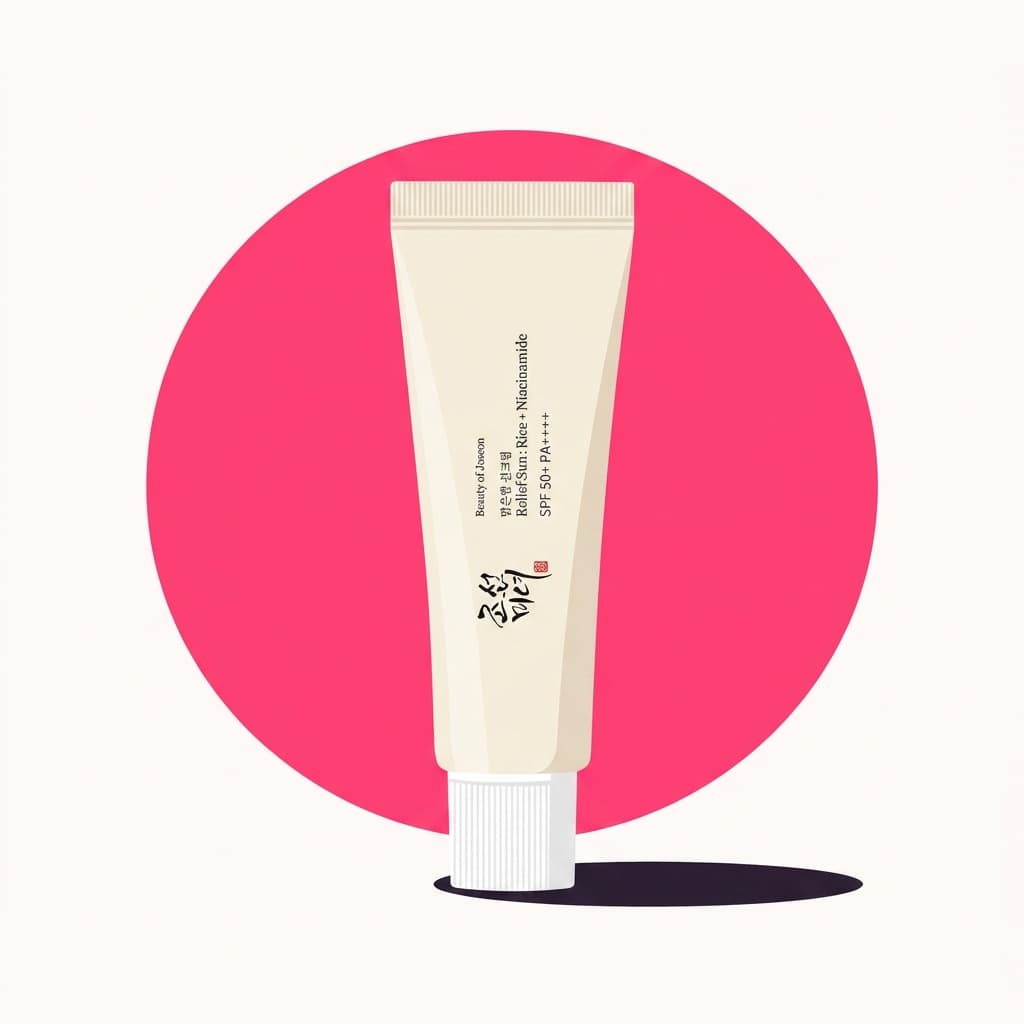
Editorial illustration based on current packaging; not an official product photograph.
Editor’s cut
At a glance
The ranked product is the global SPF 50+ PA++++ formula, not either of Beauty of Joseon's separate US sunscreens.
Beauty of Joseon says the Rice + Probiotics to Rice + Niacinamide rename did not change the formula.
Four modern UV filters and brand-published SPF and UVA tests support the label, with clear evidence limits.
Its moisturizer-like daily-wear brief is not a substitute for a water-resistant sunscreen during swimming or heavy sweating.
The current page no longer verifies the legacy 30% rice claim, so this review does not repeat it as a current fact.
Community signal
Would you buy it again?
Verdict
Beauty of Joseon Relief Sun: Rice + Niacinamide SPF50+ PA++++ earns its number-three Beauty 100 rank by making a full sunscreen application feel closer to a light moisturizer. This review covers the global Korean formula, not either of the brand's U.S. sunscreens. The brand says the name changed from Rice + Probiotics without a formula change. Its four UV filters and product-specific SPF tests are persuasive. The lack of water resistance is the catch.
Relief Sun makes the most sense for normal, dry or dehydrated skin and an ordinary day of commuting, errands or office time. The brand describes a creamy, nonsticky formula with a dewy finish and no visible cast. Recent user reports often agree about comfort, but they also include excess shine, pilling, eye discomfort and breakouts. Those reports are anecdotes, not measured rates, and Insider Beauty has not wear-tested this tube.
This is not the sunscreen to choose for swimming, outdoor sport or heavy sweating. Beauty of Joseon tells users to choose a water-resistant sunscreen for those situations. A product can be pleasant enough to encourage daily use and still be the wrong tool for a beach day.
Which Relief Sun this review covers
The brand's current sunscreen listing calls the product Relief Sun: Rice + Niacinamide SPF50+ PA++++, although its URL retains the former Rice + Probiotics name. The tube contains 50 milliliters, or 1.69 fluid ounces. Beauty of Joseon says the rename did not alter the formula, ingredients or size. Old and new packaging may therefore appear at the same time.
The distinction matters because three different Beauty of Joseon sunscreens can now appear in English-language search results. The ranked product is the global Relief Sun formula. Day Dew SPF50 and Daily Relief SPF40 are separate products made for the U.S. sunscreen market. Their active ingredients, label format, water-resistance claims and prices should not be folded into a Relief Sun review.
The 30% rice claim creates a second version problem. Older official pages state that Relief Sun contains 30% rice extract. The current product page does not make that claim, and rice extract now appears much lower in the displayed ingredient list than it did in the older list. The brand says the formula is unchanged, but it does not publish an updated raw-material explanation. We therefore do not treat 30% rice as a verified claim for the current tube.
The current formula and UV filters
The current ingredient list begins with water, dibutyl adipate and propanediol. These form the fluid base around four UV filters. Niacinamide is eighth. Glycerin and several glycols add humectancy, while emollients and texture agents account for the moisturizer-like positioning.
| UV filter | Main role in the formula |
|---|---|
| Diethylamino Hydroxybenzoyl Hexyl Benzoate, also called Uvinul A Plus | Photostable UVA filter |
| Ethylhexyl Triazone, also called Uvinul T 150 | Highly efficient UVB filter |
| Methylene Bis-Benzotriazolyl Tetramethylbutylphenol (Nano), also called Tinosorb M | Particulate broad-spectrum UVA and UVB filter |
| Diethylhexyl Butamido Triazone, also called Iscotrizinol | Photostable filter focused mainly on UVB |
BASF's technical pages describe Uvinul A Plus as a photostable UVA filter, Uvinul T 150 as a photostable UVB absorber and Tinosorb M as a photostable broad-spectrum particulate filter. Beauty of Joseon does not disclose the concentration of any filter, so the ingredient list alone cannot verify the finished SPF.
The full current INCI is: Aqua, Dibutyl Adipate, Propanediol, Diethylamino Hydroxybenzoyl Hexyl Benzoate, Polymethylsilsesquioxane, Ethylhexyl Triazone, Methylene Bis-Benzotriazolyl Tetramethylbutylphenol (Nano), Niacinamide, Coco-Caprylate/Caprate, Caprylyl Methicone, Diethylhexyl Butamido Triazone, Glycerin, 1,2-Hexanediol, Butylene Glycol, Pentylene Glycol, Behenyl Alcohol, Poly C10-30 Alkyl Acrylate, Polyglyceryl-3 Methylglucose Distearate, Decyl Glucoside, Oryza Sativa (Rice) Extract, Tromethamine, Carbomer, Acrylates/C10-30 Alkyl Acrylate Crosspolymer, Sodium Stearoyl Glutamate, Polyacrylate Crosspolymer-6, Ethylhexylglycerin, Adenosine, Xanthan Gum, T-Butyl Alcohol, Tocopherol, Oryza Sativa (Rice) Germ Extract, Camellia Sinensis Leaf Extract, Saccharum Officinarum (Sugarcane) Extract, Macrocystis Pyrifera (Kelp) Extract, Lactobacillus/Pumpkin Ferment Extract, Bacillus/Soybean Ferment Extract, Aspergillus Ferment, Cocos Nucifera (Coconut) Fruit Extract, Panax Ginseng Root Extract, Monascus/Rice Ferment, Lactobacillus/Rice Ferment and Saccharomyces/Rice Ferment Filtrate.
The brand calls Relief Sun alcohol-free. More precisely, the current list contains no ethanol or Alcohol Denat., but it does contain t-butyl alcohol near the end. Readers avoiding ethanol have a clear answer. Someone avoiding every ingredient with alcohol in its chemical name should read the package carefully.
What the SPF testing supports
Beauty of Joseon publishes two sets of finished-product results on its official All Day Sun Duo page. A Korean laboratory recorded SPF 52.5 plus or minus 5.8 and UVA protection factor 16.1 plus or minus 2.4. A Spanish laboratory recorded SPF 63.1 plus or minus 0.6 and UVA protection factor 19. Both results are consistent with the SPF50+ PA++++ label.
These numbers are more relevant than assigning protection from the ingredient list. They are still brand-published results. The page does not provide participant numbers, complete protocols, raw data or a peer-reviewed paper. We can say the brand commissioned testing in two countries and published passing figures. We cannot describe the work as an independent clinical publication.
The current product page also reports a 24-hour moisture result from 22 participants and soothing or sensitive-skin results from 32 participants. The full methods and complete outcome sets are not linked. These small tests support the product's positioning, but they do not prove that every person with sensitive skin will tolerate it.
Rice, niacinamide and ferment claims
Niacinamide appears eighth in the current list, but Beauty of Joseon does not give its percentage. Two studies help define what cannot be transferred to this product. A 2002 niacinamide study reported pigmentation changes with formulas containing 2% or 5% niacinamide after four weeks. A 12-week split-face study tested a 5% formula in 50 women and reported improvements in several visible aging measures. Neither paper tested Relief Sun, and neither lets us assume that its undisclosed concentration produces the same result.
Rice extract, rice germ extract and several rice or plant ferments appear later. Their presence can be stated from the INCI. Claims that rice is responsible for the sunscreen's hydration, calming effect or SPF cannot be separated from the rest of the formula.
The old word "probiotics" also needs care. Relief Sun contains ferment extracts and filtrates. The ingredient list does not establish that live probiotic organisms remain in the finished sunscreen. The current Rice + Niacinamide name is less likely to create that misunderstanding.
Finish, white cast and makeup
Beauty of Joseon describes a creamy sunscreen that spreads like a light moisturizer, settles to a dewy finish and leaves no visible cast. The emollient base and high placement of several slip agents fit that description on paper. They do not prove how the sunscreen will sit on a specific face, in a specific climate or over a particular skincare routine.
Tinosorb M is a particulate filter, so "no white cast" should remain an attributed brand claim rather than a promise for every skin tone. A recent community discussion includes favorable reports about comfort and low cast alongside individual concerns about shine and wear. These comments cannot supply a cast rate or replace trials across a representative range of skin tones.
Pilling is similarly dependent on amount, rubbing and the products underneath. Let watery layers settle, avoid an unnecessarily thick moisturizer if Relief Sun already supplies enough comfort, and press makeup on after the film has had time to set. Those are routine adjustments, not proof that every foundation will work over it.
How to use Relief Sun
Apply Relief Sun as the final morning skincare step. Beauty of Joseon says to spread it generously and evenly, then reapply at least every two hours. Its older product guidance uses two finger-lengths for the face and neck. Ears, hairline and the sides of the neck are easy to miss.
The American Academy of Dermatology application guide also advises applying sunscreen before going outdoors, using enough to cover exposed skin and reapplying about every two hours or after swimming or sweating. Relief Sun is not labelled water-resistant, so reapplication does not turn it into a swimming sunscreen. Choose a tested water-resistant product instead.
Dry skin may still want moisturizer underneath. Oily skin may prefer to skip a separate morning moisturizer, which is also Beauty of Joseon's suggestion. Anyone using Differin Gel, rank number one or another retinoid needs a sunscreen routine they can repeat, but sunscreen does not cancel irritation from overusing actives.
Who it is best for
Normal, dry and dehydrated skin have the clearest reason to shortlist Relief Sun. Its moisturizing base may also suit combination skin during cooler weather. People who avoid fragrance can note that parfum and fragrance do not appear in the current INCI.
Oily skin is the main finish question. Skipping moisturizer can make the formula more manageable, but hot and humid weather may still leave more shine than desired. Acne-prone users should treat the brand's non-comedogenic claim as product positioning, not a guarantee against blocked pores or breakouts.
Sensitive skin has some encouraging product-specific brand testing, no listed fragrance and no ethanol. UV filters, niacinamide and any supporting ingredient can still cause individual irritation. Eye-sensitive users have an additional reason to test carefully around, rather than inside, the orbital area.
It is a weaker match for outdoor athletes, swimmers and anyone who needs a matte or tinted sunscreen. The formula contains no tint or iron oxides, so anyone specifically shopping for a tinted sunscreen will need another product.
U.S. status, Day Dew and Daily Relief
Sunscreen is regulated as an over-the-counter drug in the United States. The FDA's sunscreen requirements page explains the Drug Facts label, broad-spectrum testing and water-resistance rules used for U.S. products. The global Relief Sun tube is not one of Beauty of Joseon's U.S. OTC sunscreen formulas.
Day Dew SPF50 is a separate U.S. product. Its Drug Facts panel lists avobenzone 3%, homosalate 7%, octisalate 5% and octocrylene 5%, and it carries an 80-minute water-resistance claim. Daily Relief SPF40, no longer listed on the brand's site, is another separate U.S. formula. Neither is the current name for Rice + Niacinamide.
Beauty of Joseon's general authenticity and retailer FAQ advises buying through its official shop or authorized retailers. This matters when packaging names overlap and marketplace listings preserve old photos. Check the product name, active ingredients and Drug Facts panel rather than relying on a seller's use of "U.S. version."
Price, value and drawbacks
The founding Beauty 100 records Relief Sun at $31 for 50 milliliters on August 29, 2026. That is $0.62 per milliliter. Official-site pricing can change with locale, promotion and bundles, so a live merchant price should be dated separately.
Its value comes from usability rather than the lowest unit price. A comfortable sunscreen can be worth more if it makes the correct application amount easier to repeat. We do not calculate cost per day because sunscreen use changes with face area, neck application and reapplication frequency.
There is no water-resistance claim. The dewy finish may look oily in humidity. White cast, pilling, eye comfort and breakouts vary by person, despite reassuring brand claims. U.S. shoppers must also distinguish the global tube from Day Dew and Daily Relief. Finally, the current page's silence on the old 30% rice claim leaves a disclosure gap that the brand could resolve.
Sources and methodology
This is an evidence-led editorial review, not a staff hands-on test. Insider Beauty checked the current global formula, brand-published finished-product tests, U.S. product pages, FDA and AAD guidance, ingredient research and recent community discussion. Brand claims remain attributed. Ingredient studies are not treated as trials of the finished sunscreen. Product facts and prices were checked on August 29, 2026.
Sources used for this review:
- Beauty of Joseon sunscreen range (official site)
- Beauty of Joseon All Day Sun Duo testing page
- BASF Uvinul A Plus technical page
- BASF Uvinul T 150 technical page
- BASF Tinosorb M technical page
- 2002 niacinamide pigmentation study
- 2008 niacinamide split-face study
- American Academy of Dermatology sunscreen application guide
- FDA questions and answers on OTC sunscreen requirements
- Beauty of Joseon Day Dew SPF50 product page
- Beauty of Joseon retailer and authenticity FAQ
- Recent Relief Sun community discussion
Useful details
Frequently asked questions
Did Beauty of Joseon change the Relief Sun formula?
Beauty of Joseon says the move from Rice + Probiotics to Rice + Niacinamide was a label and highlighted-ingredient update. The brand says the formula, ingredient list and 50 milliliter size did not change.
Is Rice + Probiotics the same as Rice + Niacinamide?
They belong to the same global Relief Sun formula lineage according to the brand. A legacy tube may carry the old name, while current packaging highlights niacinamide. Check the ingredient list when buying from older stock.
Is this the US version of Relief Sun?
No. The ranked tube is the global Korean SPF 50+ PA++++ formula. Day Dew SPF50 and Daily Relief SPF40 are separate US products with different UV-filter systems. Replacing one with another would change the product being reviewed.
Is Beauty of Joseon Relief Sun FDA approved?
The global formula is not marketed as a US over-the-counter sunscreen using the US active-filter monograph. That is a regulatory and market distinction, not proof that the Korean product lacks protection. Its label relies on non-US sunscreen testing.
Which UV filters does Relief Sun use?
The current list contains Uvinul A Plus, Uvinul T 150, Tinosorb M and iscotrizinol. Together they cover UVA and UVB wavelengths. The finished formula's individual filter percentages are not publicly disclosed.
Is Beauty of Joseon Relief Sun water-resistant?
The brand does not claim water resistance and recommends a water-resistant sunscreen for swimming or heavy perspiration. Relief Sun makes more sense for ordinary daily wear than outdoor sport, beach days or sustained sweating.
Does Relief Sun leave a white cast?
The brand claims no visible cast, and many community reports describe little or none. Tone, amount, layering and its particulate Tinosorb M filter can affect the result. No universal invisible-finish promise is credible.
Is the current Relief Sun still 30% rice?
Legacy pages repeat a 30% rice claim, but the current official product page does not verify it and the current ingredient order differs from older lists. This review does not present 30% as a confirmed current-tube fact.