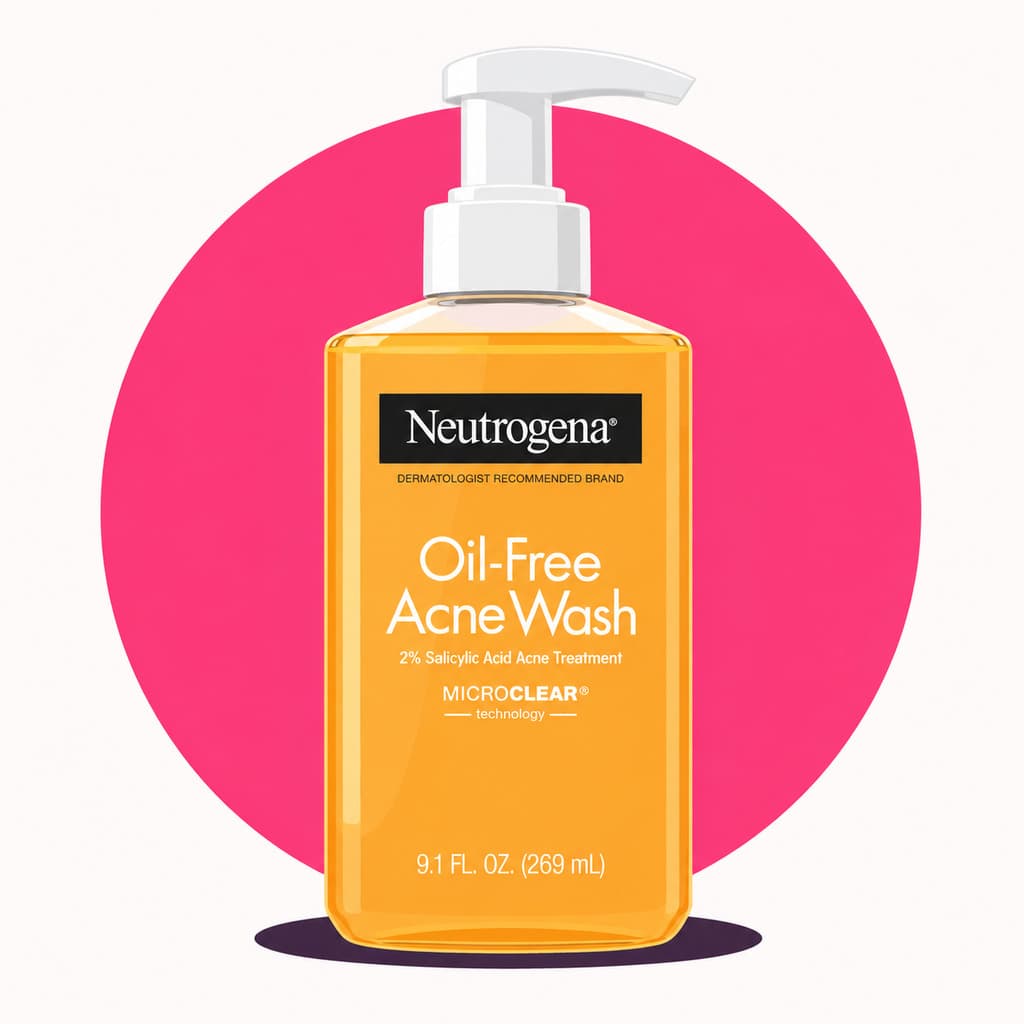
Neutrogena Oil-Free Acne Wash Review 2026: Does It Work?
Our Neutrogena Oil-Free Acne Wash review checks the 2% salicylic acid label, the trial evidence, dryness reports, the Fragrance Free version, price and value.
- Rank
- Not ranked
- Current price
- $8.99
- Listed size
- 6 oz
- Updated

Reviewed byDr. Lisa ParkContributing Dermatologist ·
Editor’s cut
At a glance
The active is salicylic acid 2%, the maximum OTC monograph strength, on a Kenvue Drug Facts label whose ingredient list is unchanged across ten DailyMed versions from July 2022 to May 2026.
At $8.99 for 9.1 fl oz at Target and Amazon on September 2, 2026, it costs $0.99 per fluid ounce, the lowest of any drug-labeled 2% salicylic acid cleanser in our comparison.
Direct evidence is a Johnson & Johnson poster abstract (30 per group, eight weeks, no percentages published) and a 1989 crossover of 30 patients; the AAD rates salicylic acid conditional against strong for benzoyl peroxide and retinoids.
The base is a sodium C14-16 olefin sulfonate foam with fragrance, Yellow 5 and Red 40, and glycerin sits twelfth on the list, which explains why dryness is the most frequent complaint in the Acne.org reviews we read.
Retailer ratings run 4.1 to 4.7 out of 5, but Acne.org's 717 reviewers average 3.0, with one in five giving one star.
The $9.99 Fragrance Free version keeps the 2% salicylic acid and drops the fragrance, dyes and olefin sulfonate; combination or sensitive skin should start there.
Verdict
Neutrogena Oil-Free Acne Wash is worth $8.99 if your skin is oily, your acne is mostly blackheads and small surface breakouts, and fragranced cleansers have never made you sting. That buys the 9.1 fl oz (269 mL) pump bottle at Target and Amazon on September 2, 2026, or $0.99 per fluid ounce, the lowest of any drug-labeled 2% salicylic acid cleanser in our comparison set. The caveat is the base it comes in: a strong-foaming sulfonate surfactant, fragrance and two dyes, with almost nothing added back. Dryness is the most frequent complaint in the Acne.org reviews we read, and the ingredient order explains why.
The active is salicylic acid 2%, the top of the range the FDA acne monograph allows without a prescription. In a cleanser it is on the skin for seconds before it rinses away, so the effective dose is lower than the same 2% in a leave-on liquid. The evidence matches that. A Johnson & Johnson poster abstract reports significant lesion reductions from a 2% salicylic acid cleanser over eight weeks without publishing the numbers, one 1989 crossover of 30 patients found a 2% salicylic acid cleanser reduced comedones, and the American Academy of Dermatology gives topical salicylic acid a conditional recommendation while benzoyl peroxide and adapalene get strong ones.
Read it as a sound first cleanser for oily, mildly acne-prone skin, not as the treatment. If breakouts are inflamed, deep or persistent, the cleanser is the least important step, and the money is better spent on a benzoyl peroxide wash or Differin with a plain cleanser underneath. Combination, dry or sensitive skin should start with the $9.99 Fragrance Free version, which keeps the active and drops the fragrance, dyes and olefin sulfonate.
What the Drug Facts label says
This is an over-the-counter drug, so the label follows the FDA Drug Facts format. The current DailyMed record, version 10, dated May 2026, lists one active ingredient, salicylic acid 2%, with the purpose "acne treatment" and one use, "for the treatment of acne." The labeler is Kenvue Brands LLC, the consumer-health company separated from Johnson & Johnson; the older DailyMed record names Johnson & Johnson Consumer Inc. as distributor.
The directions are short. Cleanse twice a day. Wet the face, apply the wash to the hands, add water and work into a lather, massage the face gently, rinse thoroughly. The warnings are the monograph set: external use only, avoid the eyes and flush with water if contact occurs, and expect more irritation and dryness if another topical acne medication is used at the same time. If irritation occurs, use only one. That last line is the one most shoppers skip, and it applies to anyone pairing this wash with benzoyl peroxide, adapalene or a leave-on acid.
Two claims sit on the packaging. "MicroClear technology" appears on the current label, neutrogena.com and the Target listing. It is a trade name for the salicylic acid delivery system; the nearest published data are a Neutrogena-supported 2007 JAAD poster abstract in which a "salicylic acid microgel complex" cleanser beat its vehicle over eight weeks, though the abstract never uses the MicroClear name. The May 2026 label reads "dermatologist recommended brand" beside "clears breakouts and unclogs pores." A second DailyMed record for the same product, opened in July 2020 and last revised in January 2026, still prints "#1 dermatologist recommended" on its package panel. Neither record, the brand product page nor Kenvue's healthcare-professional page attaches a footnote or survey to either claim.
Label history answers the reformulation question. DailyMed holds ten versions of this label between July 2022 and May 2026, and the inactive-ingredient list is identical in the first and the latest; the older record reaches back to July 2020 and carries the same list. The revisions are label edits, not formula changes.
The full ingredient list
After water, the label lists, in order: Sodium C14-16 Olefin Sulfonate, Cocamidopropyl Betaine, Sodium Chloride, PEG-80 Sorbitan Laurate, Citric Acid, Disodium EDTA, C12-15 Alkyl Lactate, Benzalkonium Chloride, Fragrance, Cocamidopropyl PG-Dimonium Chloride Phosphate, Glycerin, Aloe Barbadensis Leaf Extract, Chamomilla Recutita (Matricaria) Flower Extract, Propylene Glycol, Sodium Hydroxide, Yellow 5 and Red 40. The same list appears on neutrogena.com, on Target and in every DailyMed version.
Sodium C14-16 olefin sulfonate is the primary cleanser. It is a sulfonate rather than a sulfate, which is why Target can tag the product "sulfate-free," but functionally it is a strong anionic foaming surfactant doing the job sodium laureth sulfate does elsewhere. The Cosmetic Ingredient Review panel concluded that sodium alpha-olefin sulfonates are safe as used in rinse-off products. Safe and gentle are different claims. Cocamidopropyl betaine, the second surfactant, is milder and partly buffers the first.
Glycerin, the only humectant of note, sits twelfth, behind the preservative and the fragrance. Aloe and chamomile extracts sit near the end at trace levels and are not doing measurable work. Fragrance, benzalkonium chloride and two dyes, Yellow 5 and Red 40, are all present. That is the short list a fragrance-sensitive or dermatitis-prone reader should weigh before buying.
The pH is not disclosed anywhere we could find. Citric acid and sodium hydroxide are the adjusters, but the target is not public. It matters because salicylic acid exfoliates only when enough of it is in its free acid form, which needs a low pH. Michelle Wong of Lab Muffin puts the working range at pH below 3.5 and 1 to 2% concentration, and adds that she is not convinced low-concentration rinse-off acid products work that well, though they can suit very sensitive skin. A monograph acne cleanser has to contain 0.5 to 2% salicylic acid; it does not have to hit any pH.
Does Neutrogena Oil-Free Acne Wash work?
The mechanism is sound. Salicylic acid is oil-soluble, so unlike glycolic or lactic acid it can move into the sebum-filled follicle rather than staying on the surface, and it loosens the dead cells lining the pore. The open question is dose, and a rinse-off product delivers less of it than a leave-on.
The manufacturer's abstracts are the closest thing to direct evidence. Besides the 2007 microgel poster above, Woodruff and Appa, of Johnson & Johnson Consumer Companies and Neutrogena Corporation, presented a double-blind, placebo-controlled evaluation of a 2% salicylic acid cleanser as a JAAD poster abstract: 30 people per group, ages 12 to 30, mild to moderate acne, eight weeks, expert lesion counts plus follicular biopsies at two weeks to measure how much salicylic acid reached the follicle. The abstract says the cleanser was well tolerated and "provided significant reductions in acne lesion counts throughout the entire product usage interval." It gives no percentages and does not name the product. It is very likely this wash; that is an inference, not a fact from the abstract.
Independent evidence is older and thinner. Shalita's 1989 crossover study in Clinical Therapeutics put 30 patients through a four-week crossover of a 2% salicylic acid cleanser and a 10% benzoyl peroxide wash, two weeks on each. Only the salicylic acid cleanser produced a significant reduction in comedones, which fits salicylic acid's strength against blackheads and whiteheads rather than inflamed lesions. The brand is not stated, and a 30-patient crossover from 1989 cannot carry a product claim on its own.
One newer paper should not be counted for this bottle. A 2025 Journal of Drugs in Dermatology study by Kenvue authors, on a 2% salicylic acid cleanser with polymeric cleansing technology, reported lesion reductions from week 4 of a 12-week facial study in 35 people; a separate five-day arm-wash test in 33 people showed less water loss and redness than benchmark cleansers. The product is unnamed, and the barrier framing matches Neutrogena's newer BarrierClear Fragrance Free wash, not the classic formula reviewed here. Neutrogena's own line, "in clinical testing, users saw clearer skin in just 1 week," comes with no participant count, design or endpoint that we could locate. Treat it as marketing until the data are published.
The chemists agree with the trials. Paula's Choice's ingredient dictionary notes that rinse-off salicylic acid formulas have brief contact and usually a higher pH, so they offer little exfoliation, though they may still calm skin. Lab Muffin is a little more generous: salicylic acid and benzoyl peroxide are among the few actives peer-reviewed work has shown a cleanser can deliver, and the practical advice is to leave an active cleanser on for as long as the label says. This label sets no contact time.
The honest answer is that it works modestly, for the kind of acne salicylic acid is good at. Expect help with oiliness, blackheads and small clogged pores over several weeks of twice-daily use. Do not expect it to clear cystic or persistent inflammatory acne, because no evidence suggests a rinse-off 2% salicylic acid product can.
Is Neutrogena acne wash good compared with benzoyl peroxide and adapalene?
The 2024 American Academy of Dermatology acne guideline is the yardstick. Its published summary gives benzoyl peroxide and topical retinoids, meaning adapalene, tretinoin, tazarotene and trifarotene, strong recommendations. Topical salicylic acid receives a conditional recommendation, described as helping to unclog pores and exfoliate the skin. Conditional means weaker evidence or a smaller benefit, not a useless ingredient.
For the cleanser slot, benzoyl peroxide is the better-supported active, and a wash is a sensible place for it because most rinses away before it can bleach towels. Lab Muffin's affordable acne routine makes the same call, putting benzoyl peroxide in the cleanser and salicylic acid in a leave-on. Our benzoyl peroxide guide covers strengths and contact time. At Target on September 2, 2026, PanOxyl's 4% Acne Creamy Wash was $10.19 for 6 oz and its 10% Acne Foaming Wash $10.19 for 5.5 oz, which is $1.70 to $1.85 per ounce against Neutrogena's $0.99.
For the leave-on slot, adapalene is the OTC drug the AAD rates above salicylic acid; our Differin Gel review covers its label and trials. The same AAD guideline recommends combining topical treatments and rates benzoyl peroxide with a retinoid as a strong-recommendation pairing, which leaves the cleanser slot for a plain wash. A 2% salicylic acid wash is then the gentler, cheaper option for skin that mainly produces oil and blackheads, or a step down for skin that will not tolerate benzoyl peroxide in a cleanser. It is the wrong thing to add on top of Differin or a benzoyl peroxide wash without a reason.
How to use Neutrogena Oil-Free Acne Wash
Follow the label: twice a day, wet face, a small amount lathered in wet hands, gentle massage with the fingertips, thorough rinse. The AAD's acne skin-care tips add what the box leaves out: fingertips rather than a washcloth or brush, no scrubbing, alcohol-free products, and results judged over weeks to months.
Contact time is the lever most people ignore. Salicylic acid can only act while it is on the skin, so a wash rinsed in ten seconds delivers less than one massaged for half a minute. The label sets no time; 30 to 60 seconds of gentle massage is a reasonable compromise between giving the acid some contact and stripping the skin.
Start once daily, in the evening, if your skin is combination, sensitive or new to salicylic acid, and move to twice daily only if there is no tightness after a week. Tightness that persists after moisturizer is the signal to drop back. A non-medicated cleanser in the morning is a common pairing; the Prequel Gleanser is the one we recommend beside Differin.
Follow with a moisturizer every time. The formula has almost no humectant and no emollient, and the surfactant load is high. Neutrogena's own Hydro Boost Water Gel is the obvious same-brand pairing for oily skin. The label carries no sun warning, but daily sunscreen is standard advice during any acne treatment. Anyone on a prescription acne treatment should ask the prescriber before adding a salicylic acid product.
Dryness, irritation and the fragrance
Community ratings split by who is doing the rating. At retailers the wash scores 4.11 out of 5 across 6,864 reviews on Target, 4.7 across 4,402 ratings on Amazon and 4.1 across 6,703 reviews on neutrogena.com. On Acne.org, where reviewers are self-selected people with persistent acne, it scores 3.0 out of 5 across 717 reviews: 14.6% give five stars and 20.8% give one. The gap is the finding. Casual buyers with oily skin like it; people with stubborn acne are split down the middle.
The positive reviews share a profile: oily skin, mild breakouts, shine under control, a habit that began in the teenage years. One Acne.org reviewer sums it up as a cleanser for very oily skin and light breakouts.
Dryness is the complaint that recurs most often in the Acne.org reviews, and reviewers say outright that the wash does not suit dry or combination skin. That matches a formula that pairs a strong sulfonate surfactant with almost nothing that replaces what it removes.
Sensitive-skin reports go past dryness to redness, stinging and a fragrance several reviewers call strong. One Acne.org reviewer reports that it caused redness and made acne worse. These are individual accounts, not a rate, but the ingredients that most often provoke them, fragrance and dyes, are present here and absent from the Fragrance Free version.
The last theme is that it does not reach deeper acne and, for some, seems to stop working over time. Both fit a rinse-off product delivering a modest dose to surface comedones. A cleanser that has reached its ceiling looks a lot like one that has stopped working.
Who it is best for
Oily skin with blackheads, small whiteheads and the occasional inflamed spot is the target, and the match is good. Teenagers and adults in that group get a drug-labeled active for $0.99 an ounce at Target, Amazon and Walmart.
Normal skin can use it, ideally once a day with a plain cleanser at the other end of the day. Combination skin should expect the cheeks to object before the T-zone benefits, and is better served by the Fragrance Free version.
Dry, sensitive, rosacea-prone or eczema-prone skin should skip the classic formula. The fragrance, the dyes and the strong surfactant are three separate risks, and the label's warning about stacking topical acne medications means it does not belong in a routine already built on benzoyl peroxide or adapalene unless a clinician has agreed.
It does not suit someone with painful nodules, jawline acne that flares monthly, or acne that has not moved after two months of any over-the-counter routine. Those are reasons to see a dermatologist, and no wash changes that.
Classic wash versus the Fragrance Free version
Neutrogena sells two washes with nearly the same name, and search results blur them. The classic Oil-Free Acne Wash, reviewed here, carries "MicroClear technology" and the ingredient list above. The Oil-Free Acne Wash Fragrance Free, whose DailyMed label first posted in July 2024, is sold on neutrogena.com under the "BarrierClear technology" name and uses a different base led by cocamidopropyl hydroxysultaine and sodium methyl cocoyl taurate, with the same conditioning phosphate and benzalkonium chloride preservative.
Three things change. The olefin sulfonate is gone, replaced by two milder surfactants. Glycerin moves from twelfth to fourth and panthenol is added. Fragrance, Yellow 5 and Red 40 are removed; benzalkonium chloride stays. The active is the same 2% salicylic acid. Target sold the Fragrance Free version for $9.99 per 9.1 fl oz on September 2, 2026, one dollar more than the classic, rated 4.5 across 572 reviews against the classic's 4.1 across 6,864.
It is a sibling, not a replacement; both are in distribution. For most readers weighing the classic, the extra dollar is the better buy, and the 2025 Kenvue barrier study, which does not name its product, is the likelier match for this newer formula than for the classic.
The rest of the family, Pink Grapefruit, Cream Cleanser, Daily Scrub and Stress Control, all carry 2% salicylic acid in different bases. Neutrogena's adult line, Evenly Clear, launched in February 2026 with a 2% salicylic acid cleanser that sold for $14.99 at Target and $19.99 for 9.1 fl oz at Ulta on September 2, 2026. Ulta does not currently carry the classic wash.
Cheaper and pricier alternatives
At $0.99 per fluid ounce the classic wash is the floor for a drug-labeled 2% salicylic acid cleanser in our comparison set; the non-medicated options at similar prices are in our best cleanser list. Amazon shows the classic at $8.99 against a $10.85 list price, so paying less means catching a discount, not choosing a different product.
Stepping up, the Fragrance Free version at $9.99 is the swap most people should make. PanOxyl's benzoyl peroxide washes at $10.19 buy the stronger guideline recommendation for $1.20 more per bottle, in a smaller size.
CeraVe's Renewing SA Cleanser was $12.99 for 8 oz at Target, or $1.62 per ounce. It is a cosmetic rather than a drug, the salicylic acid percentage is undisclosed, and it adds ceramides, hyaluronic acid and niacinamide; it is the gentler choice when the aim is texture rather than an acne claim. Cetaphil's Gentle Clear Pore Cleansing Face Wash also carries 2% salicylic acid, at the same $12.99 for 8 oz at Target.
La Roche-Posay's Effaclar Medicated Gel Cleanser was $18.99 for 6.76 oz, or $2.81 per ounce, nearly three times Neutrogena's rate, and pairs 2% salicylic acid with lipohydroxy acid. L'Oreal has published an open-label, single-arm study of an Effaclar salicylic acid gel on truncal acne, 35 completers over 84 days, with total lesions down 56.3% at day 84. That is the comparable's own sponsored evidence, not evidence for Neutrogena, and a single-arm study cannot separate the product from time.
At the top, Paula's Choice CLEAR Pore Normalizing Cleanser lists at $28 for 6 oz on paulaschoice.com, or $4.67 per ounce, on sale at $22.40 on the same date, with 0.5% salicylic acid. Paula's Choice itself says rinse-off salicylic acid does little exfoliating; the price buys a gentle base, not a stronger dose.
Price, value and drawbacks
At $8.99 for 9.1 fl oz (269 mL) at Target and Amazon on September 2, 2026, the wash costs $0.99 per fluid ounce, about $0.033 per milliliter. Walmart's listing sat behind a bot check on the same date, so no Walmart price is quoted here, and neutrogena.com did not display a price on the pages we could reach. Target lists it as HSA and FSA eligible, which follows from its drug status.
Value holds only if this is the right product. The moment a reader needs the Fragrance Free version for their cheeks, the classic's one-dollar advantage disappears. The moment acne is inflamed enough to need benzoyl peroxide or adapalene, the cleanser becomes the least consequential line in the routine, and a plain non-medicated cleanser would serve as well.
The drawbacks are consistent across the label, the formula and the reviews. Dryness leads the complaints, and the ingredient order explains it. Fragrance and two dyes are present. The active is a rinse-off dose, which the AAD, Paula's Choice and Lab Muffin all place below leave-on salicylic acid and well below benzoyl peroxide and retinoids. The pH is undisclosed, the one-week claim comes with no published design, the dermatologist-recommended claim is unfootnoted, and no independent trial of this exact product exists. None of that makes it a bad cleanser. It makes it an $8.99 cleanser with a 2% active and a strong foam, which is how it should be judged.
Sources and methodology
This is an evidence-led editorial review, not a staff use test. Insider Beauty checked the current DailyMed Drug Facts label and its version history, the brand's product page and claims, the manufacturer's trial abstracts, independent clinical literature on 2% salicylic acid cleansers, the American Academy of Dermatology's 2024 guideline and skin-care advice, chemist commentary on rinse-off actives, and community ratings on Target, Amazon, neutrogena.com and Acne.org. Prices, sizes and ratings were checked on September 2, 2026. Brand claims are labeled as such, and industry-funded studies are identified. Reddit could not be retrieved for this review and is not cited.
Sources used for this review:
- DailyMed label, classic wash
- Neutrogena product page, 9.1 fl oz
- Target listing, classic wash
- Amazon listing, classic wash
- CIR summary, sodium C14-16 olefin sulfonate
- Lab Muffin, chemical exfoliants
- Woodruff and Appa, JAAD abstract
- Chen 2007, JAAD poster abstract
- Shalita 1989, Clinical Therapeutics
- Hussain 2025, Journal of Drugs in Dermatology
- Paula's Choice, salicylic acid
- Lab Muffin, cleanser myths
- Lab Muffin, affordable acne routine
- AAD 2024 acne guideline summary
- AAD acne skin-care tips
- Acne.org reviews
- DailyMed label, Fragrance Free wash
- Target search, Neutrogena acne wash prices
- Kenvue, Evenly Clear launch
- Target search, PanOxyl prices
- Target listing, CeraVe Renewing SA Cleanser
- Target listing, Effaclar Medicated Gel Cleanser
- Effaclar gel truncal acne study, PMC
- Paula's Choice CLEAR Pore Normalizing Cleanser
Useful details
Frequently asked questions
Does Neutrogena Oil-Free Acne Wash work?
It works modestly for oily skin with blackheads and small breakouts, and the evidence does not support more than that. A Johnson & Johnson poster abstract reported significant lesion reductions from a 2% salicylic acid cleanser over eight weeks without publishing figures, and a 1989 crossover of 30 patients found a 2% salicylic acid cleanser reduced comedones. The American Academy of Dermatology gives topical salicylic acid a conditional recommendation, below benzoyl peroxide and retinoids. Give it six to eight weeks of twice-daily use before judging.
Is Neutrogena Oil-Free Acne Wash good for sensitive skin?
No, the classic formula is a poor choice for sensitive skin. It contains fragrance, Yellow 5, Red 40 and a strong sodium C14-16 olefin sulfonate surfactant, and sensitive-skin reviewers on Acne.org report stinging and redness. The Fragrance Free version, $9.99 for 9.1 fl oz at Target on September 2, 2026, keeps the 2% salicylic acid and removes the fragrance, dyes and olefin sulfonate, so start there.
Is Neutrogena Oil-Free Acne Wash drying?
Yes, dryness is the most frequent complaint in the Acne.org reviews we read, and reviewers there say it does not suit dry or combination skin. The formula explains it: a strong foaming surfactant leads the list, glycerin sits twelfth, and there are no emollients. Oily skin tolerates it best. Combination or dry skin should use it once daily, follow with a moisturizer every time, and switch to the Fragrance Free version if tightness persists.
How long does Neutrogena Oil-Free Acne Wash take to work?
Allow six to eight weeks of consistent twice-daily use before judging it. The manufacturer's eight-week trial reported reductions across the whole usage period, and the American Academy of Dermatology says acne products should be judged over weeks to months. Neutrogena's claim of clearer skin in one week comes with no published participant count, design or endpoint, so it should not set your expectations.
Can you use Neutrogena Oil-Free Acne Wash twice a day?
Yes, the Drug Facts directions say to cleanse twice a day, wet the face, lather the wash in your hands, massage gently and rinse thoroughly. Twice daily suits oily skin. Anyone with combination, sensitive or acid-naive skin should start once daily in the evening and add the morning wash only if there is no tightness after a week.
Can Neutrogena Oil-Free Acne Wash be used with Differin or benzoyl peroxide?
It can, but the label warns that irritation and dryness are more likely when another topical acne medication is used at the same time, and says to use only one if irritation occurs. Adapalene and benzoyl peroxide both carry stronger guideline recommendations than salicylic acid, so if you use either, a plain non-medicated cleanser is usually the better partner. Add the salicylic acid wash only if a clinician sees a reason.
What is the difference between Neutrogena Oil-Free Acne Wash and the Fragrance Free version?
Both contain 2% salicylic acid, but the bases differ. The classic wash uses sodium C14-16 olefin sulfonate and cocamidopropyl betaine with fragrance, Yellow 5 and Red 40, branded MicroClear. The Fragrance Free version, branded BarrierClear and first labeled in July 2024, uses cocamidopropyl hydroxysultaine and sodium methyl cocoyl taurate, moves glycerin to fourth place, adds panthenol, and drops the fragrance and dyes. It costs $9.99 against $8.99 for 9.1 fl oz at Target.
Has Neutrogena Oil-Free Acne Wash been reformulated?
No evidence of a reformulation exists in the public record. DailyMed holds ten label versions between July 2022 and May 2026, and the inactive-ingredient list is identical in the first and the latest; an older record for the same product reaches back to July 2020. The Fragrance Free wash with BarrierClear technology is a separate product sold alongside the classic, not a replacement for it.
Is Neutrogena Oil-Free Acne Wash worth $8.99?
Yes, for oily, mildly acne-prone skin that tolerates fragrance, it is the cheapest drug-labeled 2% salicylic acid cleanser in our comparison at $0.99 per fluid ounce, against $1.10 for the Fragrance Free version, $1.62 for CeraVe's SA cleanser and $2.81 for La Roche-Posay's Effaclar gel cleanser at Target on September 2, 2026. It is not worth it for dry or sensitive skin, or for inflamed acne that needs benzoyl peroxide or adapalene.