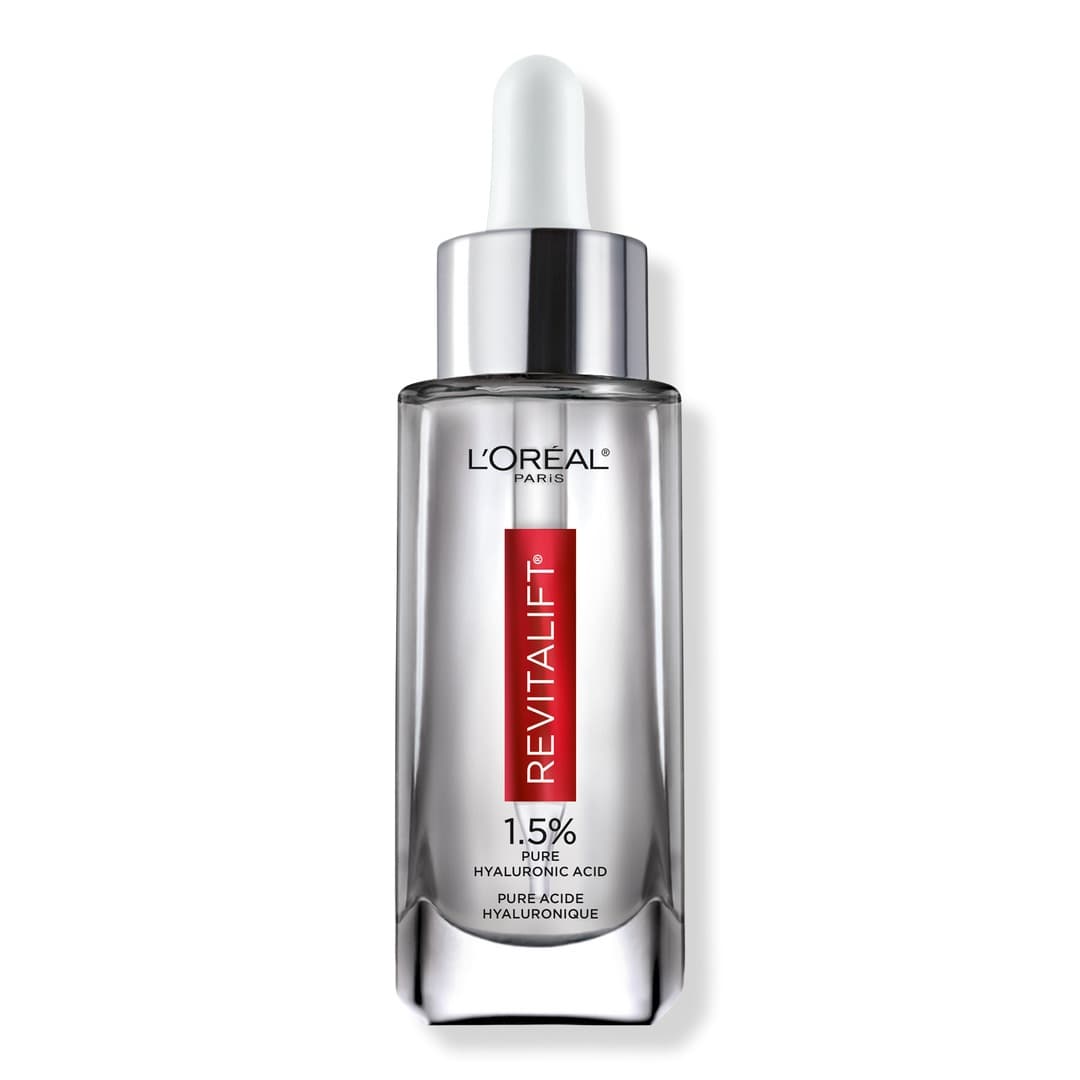
L'Oréal Revitalift 1.5% Hyaluronic Acid Serum Review 2026
L'Oréal Revitalift 1.5% Hyaluronic Acid Serum review: the 13-ingredient formula, the borrowed 47% wrinkle claim, $22 to $36 prices and who should buy it.
- Rank
- Not ranked
- Current price
- $23.99
- Listed size
- 1 oz
- Updated

Reviewed bySarah ChenBeauty Editor ·
Editor’s cut
At a glance
The 13-ingredient formula lists sodium hyaluronate fourth and splits its 1.5% into 1% low molecular weight and 0.5% high molecular weight HA; the molecular weights are not published.
On September 2, 2026 the 1 fl oz bottle cost $35.99 at Ulta, $32.99 on the brand site and $27.99 at Target, with an Amazon search listing at $22.40.
The product page's only figure, a 47% wrinkle reduction after 6 weeks, is footnoted as a simulation of an 8-week study of Revitalift Filler, a different European serum.
Ulta's 13,828 reviews average 4.6 out of 5 and 89% mention a lightweight texture; the minority complaints are tackiness, tightness and clogged pores.
It is fragrance-free, alcohol-free and silicone-free, comes in clear glass, and at the brand's two to three drops twice daily the 30 mL bottle works out to 14 to 21 weeks of use.
The Ordinary's 2% HA serum costs $9.90 per 30 mL and SkinCeuticals' 1.3% serum costs $120 per fl oz, which shows concentration is not what sets the price.
Verdict
Buy it under $28, skip it at $36. L'Oréal Paris Revitalift Derm Intensives 1.5% Pure Hyaluronic Acid Serum comes in a single 1 fl oz (30 mL) bottle, and on September 2, 2026 that bottle cost $35.99 at Ulta, $32.99 on the L'Oréal Paris site and $27.99 at Target, while an Amazon search listing showed $22.40. At the low end of that spread it is one of the better fragrance-free hydrating serums sold in a drugstore. At full price it sits at Neutrogena Hydro Boost's price for the same 1 fl oz and loses on size to Vichy Minéral 89's 50 mL.
It suits dry or dehydrated skin that wants a thin, watery layer under moisturizer with no fragrance, alcohol or silicone in it. Roughly 14,000 Ulta and brand-site reviews average 4.6 out of 5, and they describe the same experience: the serum feels like water, sinks in within a minute and leaves no greasy film. Short-term plumping is the effect people most consistently confirm.
The caveat is the marketing. The only figure on the product page, "-47% wrinkles after 6 weeks", is footnoted as a simulation based on an 8-week study of Revitalift Filler, a different L'Oréal serum sold in Europe. No product-specific test data for this bottle is published anywhere on the brand site. Treat it as a good hydrator with an undisclosed peptide and vitamin C derivative along for the ride, not as a wrinkle treatment.
If $33 feels steep, The Ordinary Hyaluronic Acid 2% + B5 does the core job for $9.90 per 30 mL. If you want a more considered texture and are happy to pay $38, Glow Recipe Plum Plump is the step up. The Revitalift sits between them and earns its place only when discounted.
What is in the 1.5% Pure Hyaluronic Acid Serum
The L'Oréal Paris product page lists 13 ingredients in this order: Water, Glycerin, Hydroxyethylpiperazine Ethane Sulfonic Acid, Sodium Hyaluronate, PEG-60 Hydrogenated Castor Oil, Secale Cereale Seed Extract (rye seed extract), Calcium Pantothenate, Dipeptide Diaminobutyroyl Benzylamide Diacetate, Ascorbyl Glucoside, Disodium EDTA, Pentylene Glycol, Phenoxyethanol and Chlorphenesin.
The hyaluronic acid is sodium hyaluronate, the salt form, and it sits fourth on the list, which is consistent with the stated 1.5%. The product page breaks that figure down as 1% low molecular weight HA (it calls these grades "Micro HA" and "Micro Epidermic HA") plus 0.5% high molecular weight "Macro HA", and the Derm Intensives line page repeats the 1% and 0.5% split. The actual molecular weights in kilodaltons are not published, so there is no way to compare the grades against the ones used in clinical studies.
Glycerin in second place matters more than the label suggests. It is the workhorse humectant in this bottle and probably does as much for the immediate hydration feel as the HA does.
There is no fragrance, no dye, no drying alcohol, no silicone and no mineral oil. Preservation is phenoxyethanol plus chlorphenesin. The SkinSAFE listing for the 1.7 fl oz size shows the identical 13 ingredients, and we found no evidence of a US reformulation since the late 2018 launch, when a December 2018 review priced it at $29.99. That 1.7 fl oz size is absent from the brand site and Ulta, so assume the 1 fl oz bottle is the one you will find.
Is L'Oréal Revitalift serum good? What the evidence says
For hydration, yes. For wrinkle reduction, only modestly and only by inference from studies of other HA products.
The most useful independent study is Pavicic and colleagues, 2011, a randomised, vehicle-controlled trial in 76 women aged 30 to 60. They applied 0.1% hyaluronic acid creams of five molecular weights (50 to 2,000 kDa) around the eyes twice daily for 60 days. Every HA cream improved hydration and elasticity against vehicle. Only the 50 and 130 kDa creams, the low molecular weight ones, significantly reduced wrinkle depth.
Two things follow. First, measurable results appeared at 0.1%, one fifteenth of this serum's 1.5%, so the "1.5% pure" framing tells you about texture and marketing rather than about a dose you should expect to feel. Second, the low molecular weight fraction did the wrinkle work, which is the rationale behind L'Oréal weighting its blend 1% low to 0.5% high. That is a sensible design choice. It is not proof that this product performs like the study creams, because the grades and the vehicle differ.
A smaller 2014 open-label study of 33 women using a "nano" HA regimen for 8 weeks reported hydration gains of up to 96% and wrinkle depth reductions of up to 40%. It was industry-sponsored, had no vehicle arm and tested a three-product regimen at once. Read it as an upper bound, not a benchmark.
Michelle Wong of Lab Muffin explains the mechanism without the hype. HA is a humectant. High molecular weight HA sits on the surface and holds water there, low molecular weight HA reaches the lower epidermis, and neither needs to penetrate deeply to work. She also notes that low molecular weight HA can act as an inflammatory signal, which is worth knowing if your skin is reactive, though she is careful to add that inflammation is not automatically harmful.
The 47% wrinkle claim belongs to a different product
The product page headline says 47% fewer wrinkles after 6 weeks. The footnote beneath it says the figure is a simulation of Revitalift Filler Hyaluronic Acid, based on average results for lines and skin tone evenness in an 8-week clinical study. So the number comes from another formula, the 6-week headline does not match the 8-week footnote, and "simulation" means the before-and-after image is illustrative rather than photographed on someone who used this serum.
Revitalift Filler is the dropper serum L'Oréal sells in the UK and Europe. Trade press reported in July 2026 that it had been relaunched as Revitalift Hyaluronic Acid & PDRN+, and L'Oréal's UK site now lists that serum under its Filler range. The September Boots on-shelf date and the £31.99 per 30 mL price come from consumer press, and the Boots page could not be loaded, so treat them as reported rather than verified. It is not the US Derm Intensives serum, the ingredient lists differ, and the two are easy to confuse in search results. A separate Derm Intensives 1.9% HA Ampoules product from 2020 and a 2.5% HA + Caffeine Eye Serum, whose 2.5% is 1.5% hyaluronic acid plus 1% caffeine, add to the confusion; neither is reviewed here.
For the claims that do belong to this bottle, visible replumping in 1 hour, firmer skin in 1 week and reduced fine lines over time, the brand publishes no participant numbers, duration or method. Its "derm-validated" label refers to an unnamed external panel of dermatologists who reviewed L'Oréal's clinical testing, stability and safety data. That is a review of data you and I cannot see, and the panel is not named.
HEPES, the peptide and the vitamin C derivative
Three ingredients deserve a closer look because they explain both the marketing and some of the complaints.
HEPES (Hydroxyethylpiperazine Ethane Sulfonic Acid) is the third ingredient, above the hyaluronic acid. L'Oréal's own ingredient library describes it as a buffer with a neutral to slightly basic pH of 7.0 to 7.6 that balances acidic ingredients; this serum's own pH is not published. One cosmetic ingredient guide also describes mild exfoliating activity at higher levels, and Paula's Choice rates it "Bad", citing 2004 and 2005 papers on free radical generation in the presence of oxygen and noting that less problematic buffers exist. That rating is a conservative position rather than evidence of harm at cosmetic levels. Still, a buffer this high on the list is an unusual choice for a serum sold as "pure" HA, and there is no published test of whether it contributes to the tight feel a minority of users report.
Dipeptide Diaminobutyroyl Benzylamide Diacetate is SYN-AKE, a DSM peptide. DSM's formulation guidelines recommend 1% to 4% of SYN-AKE in a finished product, but the supplied material is mostly glycerin and water with 0.1% to 1% peptide, so a guideline dose holds 0.001% to 0.04% of the dipeptide. Eighth of 13, below calcium pantothenate, fits that, and L'Oréal discloses no concentration. The supplier's own efficacy data is not independent, and L'Oréal makes no specific claim for the peptide, which tells you how much weight to put on it.
Ascorbyl Glucoside is a vitamin C derivative, ninth on the list, and the reason Target's listing title calls the product a "Vitamin C Facial Treatment". The bottle is clear glass, which would be a fair complaint with pure L-ascorbic acid, but Paula's Choice describes the glucoside as a stable form of vitamin C, which is why brands use it, so the packaging is a minor point. At an undisclosed level that its list position suggests is 1% or less, it is a supporting act here, not a brightening treatment.
One more note, on PEG-60 Hydrogenated Castor Oil, fifth on the list. It is a solubiliser, not castor oil. Reviewers who blame castor oil for their breakouts are misreading the label.
Texture, tackiness and what reviewers report
Ulta's review summary for this serum is unusually consistent. Across 13,828 Ulta reviews averaging 4.6 out of 5, 89% mention "lightweight", 77% "moisturizing" and 76% "non-greasy". The brand site shows the same 4.6 across 13,841 reviews, almost certainly the same syndicated pool, and Target shows 4.58 from 14,165. Amazon search listings show 4.5 from about 49,800 ratings, though that page could not be loaded directly for this review.
Independent bloggers describe a thin, watery serum that spreads easily and sinks in fast. My Women Stuff lands on a fair summary in its 2024 write-up: useful as an affordable hydrator, no miracle. The Pink Velvet Blog reports that the reviewer's dry-skinned mother got on with it far better than the reviewer herself did.
The minority report is tightness and tack. The 2018 Musings of a Muse review gave it 2 out of 5. That reviewer found her skin tight and slightly tacky a few minutes after application, drier over four weeks, with no visible change, and went back to Hada Labo and COSRX. Ulta's low-star reviews cluster around the same complaints, plus small percentages reporting irritation, greasiness or no effect at all. The fix for the tack is simple and the brand says so itself. Put moisturizer over it. As a standalone step on dry skin it will disappoint.
Side effects: breakouts, irritation and who reacts
Hyaluronic acid itself is about as low-risk as skincare ingredients get. Harvard Health, in a piece reviewed by dermatologist Abigail Waldman in August 2026, describes it as safe and non-irritating, says it is not known to cause acne, and adds the sensible caveat that other ingredients in a product can.
That caveat is where this serum's complaints live. The Pink Velvet Blog's reviewer stopped using it because her skin was clogging, and commenters on that post describe small red bumps and worsening acne; others simply saw no result. L'Oréal labels the serum non-comedogenic and suitable for sensitive skin but does not describe how it tested either claim. The formula contains no oils or waxes, so a breakout is more likely an individual reaction to one of the remaining ingredients, or a symptom of adding this alongside several other new products, than a property of hyaluronic acid.
Low molecular weight HA is the other theoretical concern, given Lab Muffin's note that it can act as an inflammatory signal. In practice the reported irritation rate across 14,000 reviews is small. Reactive skin still has a reason to apply it to one side of the jaw for a week before committing the whole face, and to introduce it on its own rather than in the same week as a new acid or retinoid.
How to use L'Oréal Revitalift Hyaluronic Acid Serum
L'Oréal directs two to three drops after cleansing, morning and night, before moisturizer, and suggests applying it to damp skin. Ulta's copy adds a note to avoid the eye area. My Women Stuff's reviewer uses a full dropper each time because she prefers the glide, and at that rate a 30 mL bottle empties far sooner. Start with the brand's dose and add more only if it will not spread.
Follow it with a moisturizer every time. This is the single most consistent piece of advice from happy and unhappy reviewers alike, and it is the difference between a plumped face and a tight one. The serum contains nothing occlusive, so on its own it cannot slow water leaving the skin. In the morning, sunscreen goes on last.
The damp-skin instruction comes from both the brand and Harvard Health, which says damp skin gives the humectant water to hold and an occlusive moisturizer on top stops it evaporating. The damp step is cheap and harmless, but no product-specific test shows it matters, and the moisturizer is the part both sources treat as essential. Do that and treat dampness as optional.
Keep it off a sunny windowsill, since the bottle is clear glass, though the vitamin C derivative inside is the stable kind. None of the reviewers we cite gives a bottle life, so here is the arithmetic. Four to six drops a day at the pharmacy convention of 20 drops per millilitre is 0.2 to 0.3 mL, so 30 mL lasts 14 to 21 weeks, roughly three bottles a year, or $70 to $100 at Target's price and $90 to $130 at Ulta's.
Who it is best for
Dry or dehydrated skin that already owns a good moisturizer gets the most from this serum, and the happiest reviewers are the ones with mature, dry skin. The watery texture layers under anything, there is no fragrance or alcohol to sting, and short-term plumping is the effect reviewers most consistently confirm.
Combination and oily skin can use it too, provided the moisturizer on top is light. It is a sound pick for someone whose retinoid or acid routine has left the skin tight and who wants a hydration step rather than another strong active. The absence of fragrance and drying alcohol also makes it a reasonable first serum for someone who has never used one.
Skip it if you want a proven wrinkle treatment. That is a retinoid, and a hydrating serum layered under one is a supporting act. Skip it too if you are prone to clogged pores and have reacted to L'Oréal serums before, since the brand does not disclose its non-comedogenic test method and community reports of congestion exist. And skip it at $36 if The Ordinary or Vichy is in stock next to it.
Cheaper and pricier alternatives compared
Prices below are US, checked September 2, 2026, for the sizes named.
The Ordinary Hyaluronic Acid 2% + B5 (with Ceramides), 30 mL, $9.90. A higher stated HA percentage, panthenol instead of calcium pantothenate, ceramides added in the current version, and less than a third of the Revitalift's brand-site price. It has no peptide or vitamin C derivative, which is no loss given that L'Oréal discloses no level for either and claims nothing for them. For hydration per dollar it wins outright.
CeraVe Hydrating Hyaluronic Acid Serum, 1 fl oz, $17.29 at Target. A gel-cream with ceramides and an undisclosed HA percentage, rated 4.41 from 1,201 Target reviews. Closer to a light moisturizer than to a watery serum.
Vichy Minéral 89, 50 mL, $29.99 at Dermstore. That is $17.74 per fl oz against the Revitalift's $32.99 per fl oz at brand-site price. Same corporate parent, HA plus polyglutamic acid, and two thirds more product for less money. This is the strongest value argument against paying full price for the Revitalift.
Neutrogena Hydro Boost Hydrating Serum, 1 fl oz, $31.49 at Ulta, with Walmart listings showing $19.97. Priced almost identically to the Revitalift, with the same wide gap between list and street.
Glow Recipe Plum Plump Hyaluronic Serum, 30 mL, $38 on the brand site, rated 4.8 from 2,027 reviews. Multi-weight HA and the nicer bottle. Worth the extra $5 over the Revitalift's brand-site price if texture matters to you, and our review linked above explains where it falls short.
La Roche-Posay Hyalu B5 Serum, 1 fl oz, $42.99 at Ulta, rated 4.3 from 1,666 reviews. Also L'Oréal-owned, built around a "4-HA system" and vitamin B5. Pharmacy-brand pricing for a similar brief.
SkinCeuticals H.A. Intensifier Multi-Glycan, 1 fl oz, $120 at Dermstore. Also L'Oréal-owned, and its stated HA concentration is 1.3%, lower than the Revitalift's 1.5%. If you needed one fact to prove that percentage is not what you pay for in an HA serum, this is it.
Four of those bottles come from the same parent company, and three of them hold the same 30 mL at $22.40 to $120. The Revitalift is L'Oréal's own budget tier, and it reads like one. Our L'Oréal Paris brand guide ranks it against the rest of the drugstore line, and it already appears in our Estée Lauder Advanced Night Repair dupes roundup as the hydration-only budget option next to a $135 bottle that is not really an HA serum at all. For the wider field, our best face serum list is the place to start.
Price, value and drawbacks
At Ulta's $35.99 the Revitalift costs $1.20 per mL. At Target's $27.99 it is $0.93 per mL, and at Amazon's listed $22.40 it is $0.75. That spread is the whole value story. The list price has climbed from $29.99 in December 2018 to $35.99 today, while the Amazon street price sits in the low twenties. The honest way to describe this product's price is an MSRP of $35.99 that most people should never pay, and a typical checkout price of $22 to $28. If you cannot find it under $28, buy Vichy Minéral 89 or The Ordinary instead.
The drawbacks, in order of how much they should bother you. First, no product-specific evidence. Every claim on the page is either generic HA physiology or borrowed from a different serum. Second, tack and tightness on dry skin without a moisturizer over it. Third, undisclosed percentages for the peptide, the vitamin C derivative and HEPES, which make it impossible to say what those three ingredients contribute. Fourth, the running cost: at Ulta's price, three bottles a year is roughly $110 for a hydrator, a job The Ordinary does for about $30.
None of these is disqualifying at $22. Two of them, the evidence gap and the undisclosed percentages, would bother me at $36 from a company that also sells SkinCeuticals.
Sources and methodology
This is an evidence-led editorial review, not a staff use test. Insider Beauty checked the current official ingredient list, size, directions and claims on the L'Oréal Paris site, verified prices on the brand site, Ulta and Target, and took the Amazon figure from a search listing because that page refused to load; treat it as indicative. Walmart's snippets for the same bottle disagreed with one another, so no Walmart price is quoted. Independent studies are cited to set limits around what topical hyaluronic acid can do, not as proof that this formula matches them. Community themes come from Ulta's aggregated review summary and three independent blogs, and are labeled as anecdotal. Product facts and prices were checked on September 2, 2026.
Sources used for this review:
- L'Oréal Paris Revitalift Derm Intensives 1.5% Pure Hyaluronic Acid Serum product page
- L'Oréal Paris Revitalift Derm Intensives line page
- L'Oréal Paris ingredient library entry for HEPES
- L'Oréal Paris Derm Intensives 2.5% Hyaluronic Acid + Caffeine Eye Serum product page
- L'Oréal Paris UK Revitalift Hyaluronic Acid + PDRN+ serum page
- Ulta product page and review summary
- Target product page
- SkinSAFE ingredient listing for the 1.7 fl oz size
- Pavicic et al., 2011, randomised vehicle-controlled trial of HA creams by molecular weight
- Jegasothy et al., 2014, open-label study of a nano-HA regimen
- Lab Muffin on how hyaluronic acid works
- Harvard Health on hyaluronic acid safety and use
- Paula's Choice ingredient dictionary entry for HEPES
- Paula's Choice ingredient dictionary entry for ascorbyl glucoside
- DSM SYN-AKE formulation guidelines
- Musings of a Muse review, December 2018
- The Pink Velvet Blog review and reader comments
- My Women Stuff review, April 2024
- The Ordinary Hyaluronic Acid 2% + B5 product page
- Vichy Minéral 89 at Dermstore
- SkinCeuticals H.A. Intensifier Multi-Glycan at Dermstore
Formula index
Ingredients
10 indexed ingredients
Useful details
Frequently asked questions
Is L'Oréal Revitalift 1.5% Pure Hyaluronic Acid Serum good?
It is a good fragrance-free hydrating serum and a weak wrinkle treatment. Around 14,000 Ulta and brand-site reviews average 4.6 out of 5, and most describe a watery texture that plumps skin quickly under moisturizer. The only wrinkle figure on the product page is borrowed from a different L'Oréal serum, so buy it for hydration, not for lines.
Is L'Oréal Revitalift Hyaluronic Acid Serum worth the price?
At $28 or less, yes; at the $35.99 Ulta list price, no. On September 2, 2026 it cost $32.99 on the brand site, $27.99 at Target and $22.40 in an Amazon search listing. Above $28, Vichy Minéral 89 gives you 50 mL for $29.99 and The Ordinary's 2% HA serum costs $9.90 for the same 30 mL.
What are the side effects of L'Oréal Revitalift Hyaluronic Acid Serum?
The most reported problems are a tight or tacky feel when it is worn without moisturizer, and clogged pores or small red bumps in a minority of acne-prone users. Hyaluronic acid itself is not known to cause acne or irritation, according to Harvard Health, so reactions are more likely to come from another ingredient or from adding too many new products at once. Patch test on the jawline for a week if your skin is reactive.
Does L'Oréal Revitalift Hyaluronic Acid Serum reduce wrinkles?
Not in any way the brand has demonstrated for this product. The 47% figure on the page is a simulation based on an 8-week study of Revitalift Filler, a different European serum. Independent research shows low molecular weight HA at 0.1% can modestly reduce wrinkle depth over 60 days, so a small smoothing effect from hydration is plausible, but a retinoid remains the proven option.
How do you use L'Oréal Revitalift 1.5% Pure Hyaluronic Acid Serum?
Apply two to three drops to clean skin morning and night, then follow with moisturizer and, in the morning, sunscreen. L'Oréal suggests applying it to damp skin and Ulta's copy says to avoid the eye area. The moisturizer step is not optional; the serum has nothing occlusive in it, and skipping that layer is the main reason some users find their skin tighter rather than plumper.
Is L'Oréal Revitalift Hyaluronic Acid Serum the same as Revitalift Filler?
No. The US product is Revitalift Derm Intensives 1.5% Pure Hyaluronic Acid Serum, a 13-ingredient formula sold in a 1 fl oz bottle. Revitalift Filler is the UK and European dropper serum with a different ingredient list; trade press reported in July 2026 that it had been updated as Revitalift Hyaluronic Acid and PDRN+, with UK availability at Boots from September at a reported £31.99 per 30 mL. The US page's 47% wrinkle claim is a simulation borrowed from the Filler's study.
Is L'Oréal Revitalift better than The Ordinary Hyaluronic Acid 2% + B5?
For hydration per dollar, The Ordinary wins; it costs $9.90 for 30 mL against the Revitalift's $32.99 brand-site price and states a higher 2% HA concentration plus ceramides. The L'Oréal adds an undisclosed peptide and vitamin C derivative that the brand makes no specific claims for. Pick the Revitalift only when a discount brings it into the low twenties and you prefer its thinner, watery texture.
Does L'Oréal Revitalift Hyaluronic Acid Serum contain vitamin C?
Yes, in the form of ascorbyl glucoside, a stable vitamin C derivative that sits ninth of 13 ingredients. The percentage is not disclosed and its list position suggests it is 1% or less, so it is a supporting ingredient rather than a brightening treatment. Ascorbyl glucoside is a stable form of vitamin C, so the clear glass bottle is a minor point; keep it out of direct sun as a precaution rather than a necessity.
How long does a bottle of L'Oréal Revitalift Hyaluronic Acid Serum last?
Roughly 14 to 21 weeks at the brand's dose, by arithmetic rather than reviewer reports, since none of the reviewers we cite gives a bottle life. Two to three drops twice a day is four to six drops, and at 20 drops to the millilitre that is 0.2 to 0.3 mL a day from a 30 mL bottle. That works out to about three bottles a year, or roughly $70 to $100 at Target's $27.99 and $90 to $130 at Ulta's $35.99. A full dropper per application will empty it much sooner.