Cicaplast Balm B5+ Review 2026: Does It Work?
Our Cicaplast Balm B5+ review checks its dimethicone active, Tribioma formula, clinical evidence, barrier claims, uses, safety, price and FAQs.
Evidence-led score using Insider Beauty’s published 100-point editorial rubric. How we score
- Rank
- #7
- Current price
- $18.99
- Listed size
- 1.35 oz
- Updated

Reviewed bySarah ChenBeauty Editor ·
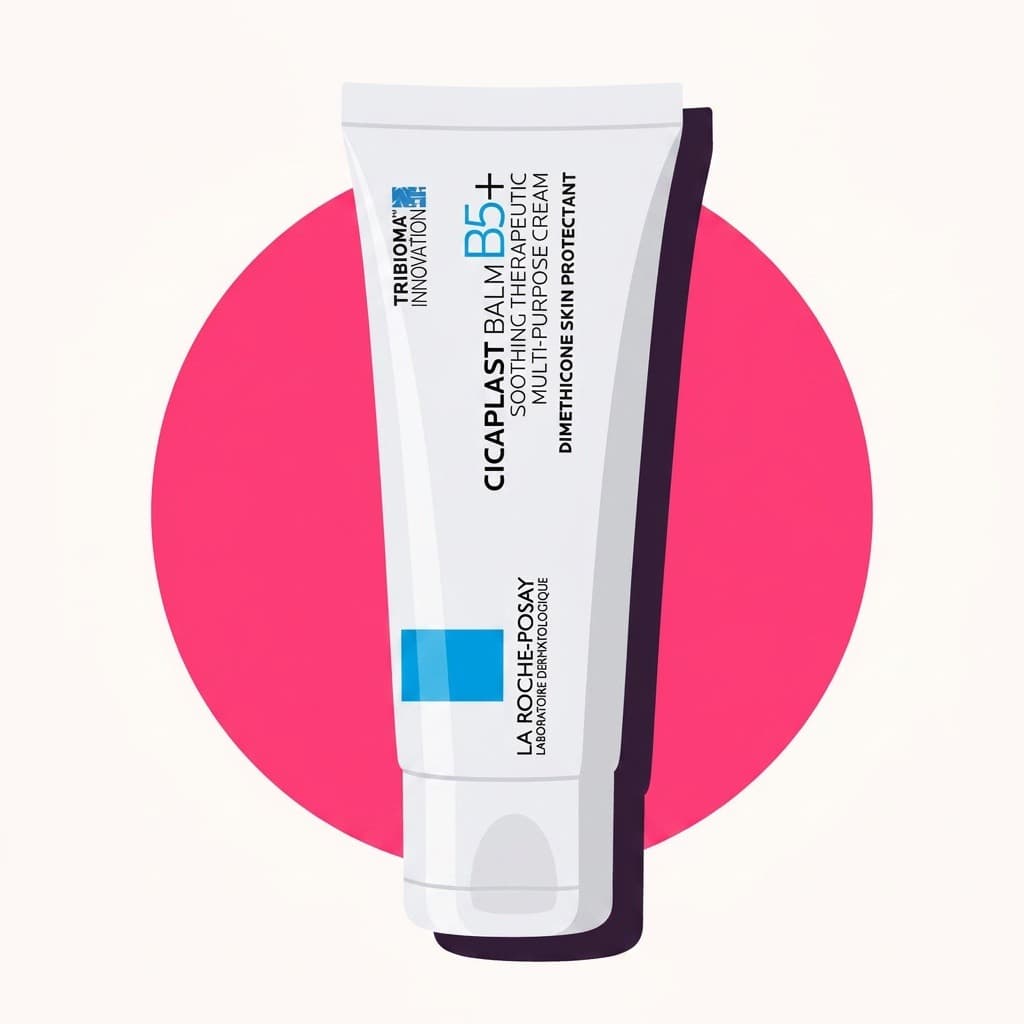
Editorial illustration based on current packaging; not an official product photograph.
Editor’s cut
At a glance
The current U.S. B5+ tube is an OTC skin protectant with 1% dimethicone, not merely a cosmetic moisturizer.
A small randomized post-laser study supports the formula, but its 25-person sample and manufacturer ties limit the result.
A 2,337-person observational study adds useful tolerability data but had no control group and allowed other care measures.
Cicaplast can protect dry, chapped or friction-prone skin; it is not a proven acne, eczema or scar treatment.
The 100 milliliter tube was about 30% cheaper per milliliter than the 40 milliliter tube at the prices checked.
Community signal
Would you buy it again?
Verdict
La Roche-Posay Cicaplast Balm B5+ earns rank seven in the founding Beauty 100 because it does more than borrow the language of barrier repair. The current U.S. tube is an over-the-counter skin protectant with 1% dimethicone. Its Drug Facts label permits specific claims about temporarily protecting and relieving chafed, chapped or cracked skin. There is also direct research on the B5+ formula, including a small randomized post-laser comparison and a much larger observational study.
That evidence does not turn it into a cure-all. Cicaplast is a rich, fragrance-free face-and-body balm for dry, compromised patches, not a treatment for acne, infection, eczema or scars. Its best use is often the least dramatic one: a protective final layer on areas that feel rough, tight or exposed to friction and weather. People with oily skin may prefer it only on dry zones. Anyone treating a fresh procedure site, persistent rash, serious burn or open wound should follow medical advice rather than a social-media routine.
The value is fair rather than exceptional. The 40 milliliter tube was $18.99 when checked, while the 100 milliliter tube was $32.99. That larger tube costs about 30% less per milliliter. Cicaplast is easy to recommend when the brief is precise. It is much harder to defend as an all-purpose answer for every red or unhappy face.
What the current B5+ product is
This review covers the current U.S. Cicaplast Balm B5+ Soothing Therapeutic Multi-Purpose Cream, the version with Tribioma. The ranked product has a 40 milliliter or 1.35 fluid ounce tube and a 100 milliliter option. It is fragrance-free and intended for the face and body.
The version boundary matters. Older Cicaplast Balm B5 reviews can refer to a different ingredient list, a different market or a pre-Tribioma formula. The current La Roche-Posay product page calls out Tribioma, 5% panthenol, madecassoside, shea butter and thermal spring water. The live U.S. ingredient list also includes corn starch, Centella asiatica leaf extract, yacon root juice, alpha-glucan oligosaccharide, mannose, Vitreoscilla ferment and Lactobacillus.
There are several similarly named products. Cicaplast Balm B5 UV is a separate SPF 50 sunscreen and skin protectant. Cicaplast Gel B5 has a lighter gel texture and a different use brief. A review of one cannot be pasted onto another.
The 1% dimethicone active and the rest of the formula
In the United States, dimethicone 1% is the active ingredient. The current DailyMed label identifies the product as an OTC monograph drug under skin-protectant monograph M016. The accepted uses include temporarily protecting and helping relieve chafed, chapped or cracked skin, protecting against drying wind and cold, and helping treat and prevent diaper rash.
An OTC monograph is not an individual FDA approval of every marketing sentence. It sets conditions under which qualifying nonprescription drugs can be marketed. The FDA skin-protectant monograph allows dimethicone at concentrations from 1% to 30% and specifies the permitted labeling framework.
Dimethicone forms a water-resistant surface film and reduces moisture loss. It explains the product's legitimate protectant role more directly than the fashionable ingredients do. Hydrogenated polyisobutene, glycerin, shea butter and several glycols build the emollient and humectant base around it.
Panthenol appears high in the inactive list, and La Roche-Posay states that the formula contains 5%. Madecassoside and the components grouped under the proprietary Tribioma name appear much lower. Ingredient order cannot tell us their exact percentages. It also cannot show how the finished emulsion performs on a particular face. The useful formulation story is the combination: a protectant active, an emollient base and supporting humectant ingredients.
What the direct evidence shows
Both direct papers identify Cicaplast Baume B5+ by name, but neither connects its study supply to the current U.S. NDC or publishes a package-level formula code. The large observational paper also describes copper salts, which do not appear on the current U.S. ingredient list. The results therefore apply to the B5+ product family, with a remaining version caveat, rather than proving that every study tube was ingredient-for-ingredient identical to current U.S. stock.
The most controlled direct study is a randomized, double-blind, split-area trial involving 25 adults after fractional carbon dioxide laser treatment. Each person received Cicaplast Baume B5+ on one treated area and another repairing dermocosmetic cream on the comparison area. Complete healing was reached in a raw mean 13.5 days with Cicaplast and 15.8 days with the comparator, a difference of 2.3 days. The model-adjusted treatment difference was 2.771 days, with a 95% confidence interval from 0.741 to 4.801 days. The Cicaplast side also had higher wound-healing scores at several time points.
The design is stronger than a before-and-after consumer survey because each participant acted as their own control. The sample was small, the setting was a specific supervised laser procedure, and 22 of the 25 participants had phototype III skin. Two authors were La Roche-Posay employees, and La Roche-Posay funded the research. Those details appear in the PubMed record and the open full text. The result supports a post-procedure role under professional direction. It does not prove that the balm will repair an over-exfoliated face in a fixed number of days.
A separate 2025 study followed 2,337 adults and children with superficial wounds, irritant dermatitis or skin needing care after a procedure or irritating treatment. At the follow-up visit, at least 64.9% improved by one grade across each assessed clinical sign, and at least 81.2% improved by one grade across each discomfort measure. Quality-of-life scores also fell substantially.
The size and range of ages make that study informative for tolerability. Its design is much weaker for causation. There was no untreated or comparator group, doctors chose application frequency and follow-up at 15 or 28 days, and other measures such as sunscreen and avoiding sun exposure were frequently recommended. Natural recovery could explain part of the change. The authors identify the missing control, short duration and lack of instrumental measurements as limitations in the full European Journal of Dermatology paper. The PubMed abstract records the main outcomes. L'Oreal Dermatological Beauty Greece and La Roche-Posay sponsored the study.
Together, the studies are more useful than ingredient folklore but less definitive than their headline percentages can sound. They support a protective, soothing adjunct. They do not make Cicaplast a substitute for diagnosis or wound care.
What it can and cannot reasonably do
The strongest everyday case is dry, chapped or friction-prone skin. The dimethicone active helps seal out irritants and limit water loss, while the cream base makes rough areas feel more comfortable. The label also supports diaper-rash use when its specific directions are followed.
"Barrier repair" is a useful shorthand only if it stays modest. Cicaplast can support the conditions in which the outer skin barrier recovers. It cannot identify why the barrier is impaired, remove an allergen, cure dermatitis or treat an infection. A reaction that keeps returning needs more than another layer of balm.
La Roche-Posay explicitly says the product has not been tested to prevent or reduce scars. It also contains no acne medicine. Madecassoside and panthenol research does not convert the complete tube into a proven acne-mark or scar treatment. The white balm may visually mute redness for a while, but that is not the same as changing pigmentation.
Texture, finish and routine fit
The brand describes Cicaplast as rich, non-greasy and quickly absorbed. Those terms are subjective. The formula contains several film-forming and powdery materials, including dimethicone, hydrogenated polyisobutene, shea butter, corn starch, silica and titanium dioxide. That construction explains why users can experience it as both protective and slightly pasty.
It works most predictably as the last moisturizing step on a limited area. A thin layer over dry cheeks, the sides of the nose or chafed skin interferes less with sunscreen and makeup than a heavy full-face coat. The balm has no SPF, despite titanium dioxide appearing in its inactive list. Titanium dioxide only counts as sunscreen protection when the finished product is tested and labeled for that purpose.
The separate UV version illustrates the difference. Its 2026 DailyMed label lists four sunscreen actives alongside dimethicone and carries broad-spectrum SPF 50 directions. Standard Cicaplast Balm B5+ does not. Daytime use still needs a properly labeled sunscreen on exposed skin.
How to use Cicaplast Balm B5+
For ordinary dry or chapped skin, apply a thin layer to clean, dry skin as needed. La Roche-Posay suggests once or twice daily and permits either targeted or all-over moisturizer use. Avoid the eye area. Applying more creates a thicker film, not a faster result.
When layering a routine, use cleanser first, then any treatment that has been medically recommended, then moisturizer and Cicaplast over the driest area. Put sunscreen over the completed skincare routine in the morning. If the balm makes sunscreen pill, reduce the amount or reserve it for night rather than sacrificing the labeled sunscreen dose.
The Drug Facts label has separate diaper-rash instructions: change wet or soiled diapers promptly, cleanse and dry the area, then apply liberally with each change, especially at bedtime or before prolonged exposure to a wet diaper.
Post-procedure use should follow the clinician's instructions. The brand's retail page refers to testing after non-ablative laser, while the small published trial studied fractional carbon dioxide laser care under controlled conditions. Neither is permission to apply the balm to every fresh wound or procedure site without asking the treating professional.
Who it is best for
Cicaplast is a good match for dry to very dry skin, rough patches, winter chapping and friction around the nose, hands or body. It can also make sense as a temporary final layer when a prescribed acne or retinoid routine leaves specific areas dry, provided the treatment clinician has no objection.
Combination and oily skin do not automatically need to avoid it. Targeted application is often more sensible than coating areas that already feel comfortable. The label and brand call it non-comedogenic, but that does not guarantee that every acne-prone person will like a rich film-forming balm.
Sensitive skin may appreciate the lack of added fragrance. Sensitivity is not one diagnosis, however. A fragrance-free product can still irritate, and a recurring rash can be allergic, irritant, infectious or inflammatory. Cicaplast is supporting care, not a way to skip that distinction.
Drawbacks and safety boundaries
The texture is the obvious compromise. A balm that stays put on chapped skin can feel too dense under makeup, leave a pale residue on deeper skin tones when overapplied, or pill beside a silicone-heavy sunscreen. The tube also becomes expensive when used as a daily whole-body moisturizer.
The evidence has conflicts that deserve space. Both direct papers were manufacturer sponsored or included brand employees. The randomized trial was small and procedure-specific. The larger study lacked a control group. The product still has better direct support than many barrier balms, but a ranking should not hide those limits.
Follow the Drug Facts warnings. Do not use it on deep or puncture wounds, animal bites or serious burns. Keep it out of the eyes and out of children's reach. Stop use and ask a doctor if the condition worsens, lasts more than seven days, or clears and returns within a few days. Suspected infection, spreading redness, warmth, pus, severe pain or fever needs medical assessment.
Price and value
At the prices checked on August 29, 2026, 40 milliliters cost $18.99, or about $0.47 per milliliter. The 100 milliliter tube cost $32.99, or about $0.33 per milliliter. The larger size is about 30% cheaper per milliliter and makes sense for established face-and-body use. The small tube is the better first purchase when texture and tolerance are unknown.
The closest value comparison is not a luxury recovery cream. It is another fragrance-free OTC skin protectant or plain occlusive moisturizer. Cicaplast charges extra for a more elaborate emulsion and its supporting ingredient blend. That premium is reasonable for someone who prefers its finish and versatility. The dimethicone claim itself is not unique.
Sources and methodology
This is an evidence-led editorial review, not a claim of staff wear testing. Insider Beauty verified the frozen founding-edition product version against its current U.S. label and product page, then reviewed direct finished-product studies, their designs, funding and stated limitations. Brand claims are described as brand claims. Results from supervised post-procedure research are not generalized to unsupervised wound treatment.
Sources used for this review:
- La Roche-Posay Cicaplast Balm B5+ official U.S. product page
- DailyMed Cicaplast Balm B5 dimethicone 1% label
- FDA OTC Monograph M016 for skin protectants
- Randomized post-laser Cicaplast B5+ study on PubMed
- Open full text of the randomized post-laser study
- Large observational Cicaplast B5+ study on PubMed
- Full European Journal of Dermatology observational study
- DailyMed Cicaplast Balm B5 UV SPF 50 label
Useful details
Frequently asked questions
Is Cicaplast Balm B5+ a moisturizer?
It can be used as a targeted balm or an all-over moisturizer. Its 1% dimethicone active temporarily protects chafed, chapped or cracked skin, while glycerin, shea butter and other supporting ingredients build the moisturizing base.
Does Cicaplast Balm B5+ repair the skin barrier?
It can support barrier recovery by reducing water loss and protecting dry skin. Direct studies are encouraging, including one small randomized post-laser trial. It cannot diagnose the cause of barrier damage or replace treatment for infection, eczema or another persistent condition.
Can Cicaplast Balm B5+ be used every day?
The brand permits once- or twice-daily moisturizer use, and the Drug Facts label says to apply as needed. A thin targeted layer is often more practical than a heavy full-face coat. Stop and seek advice if irritation worsens or keeps returning.
Is Cicaplast Balm B5+ good for acne-prone or oily skin?
It can be applied to isolated dry patches on oily or acne-prone skin, but it contains no acne medicine. The rich film may feel excessive as an all-over layer. Non-comedogenic labeling does not guarantee that every person will tolerate it.
Can Cicaplast Balm B5+ be used with tretinoin or retinoids?
It may be used as a protective final layer on dry areas in a retinoid routine, provided the prescriber has no objection. It does not prevent every retinoid reaction. Persistent burning, swelling or dermatitis needs professional advice.
Does Cicaplast Balm B5+ reduce scars or acne marks?
La Roche-Posay says the balm has not been tested to prevent or reduce scars. Research on madecassoside or post-procedure recovery does not prove that the complete tube fades acne marks or changes an established scar.
Is Cicaplast Balm B5+ the same as the old Cicaplast Balm B5?
No. This review covers the current U.S. B5+ formula with Tribioma. Older regional or pre-Tribioma ingredient lists should not be treated as interchangeable with the ranked product.
Does Cicaplast Balm B5+ contain SPF?
No. Standard Cicaplast Balm B5+ has no labeled sun protection. Cicaplast Balm B5 UV SPF 50 is a separate product with sunscreen actives and different directions.
When should Cicaplast Balm B5+ not be used?
The Drug Facts label says not to use it on deep or puncture wounds, animal bites or serious burns. Avoid the eyes. Ask a doctor if the condition worsens, lasts more than seven days, or clears and returns within a few days.