La Roche-Posay Anthelios Melt-In Milk SPF 60 Review 2026
Our Anthelios Melt-In Milk SPF 60 review checks the Drug Facts label, water resistance, finish, application amount, price, value and common drawbacks.
Evidence-led score using Insider Beauty’s published 100-point editorial rubric. How we score
- Rank
- #5
- Current price
- $37.99
- Listed size
- 5 oz
- Updated

Reviewed bySarah ChenBeauty Editor ·
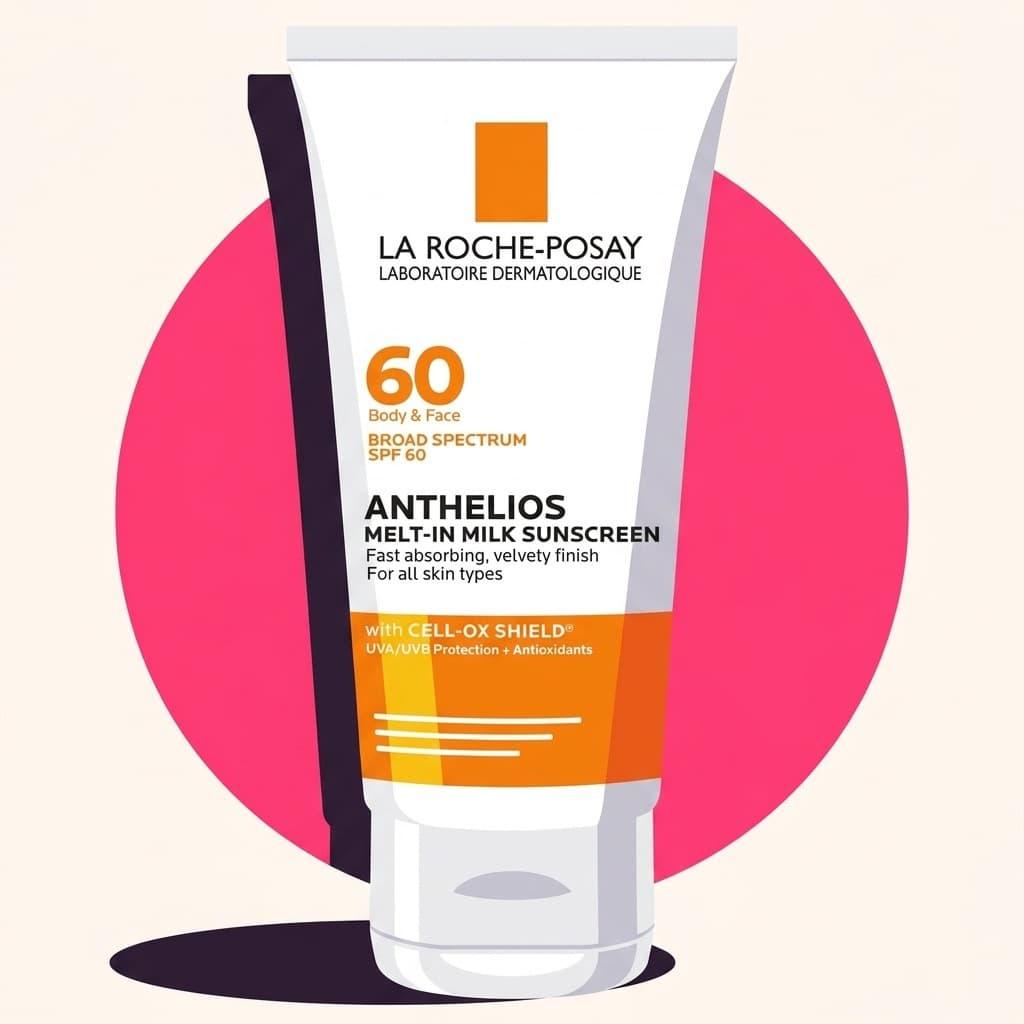
Editorial illustration based on current packaging; not an official product photograph.
Editor’s cut
At a glance
The finished lotion carries broad-spectrum SPF 60 and an 80-minute water-resistance claim under the U.S. over-the-counter sunscreen framework.
Its four active filters are avobenzone 3%, homosalate 10%, octisalate 5% and octocrylene 7%.
The ranked 150 milliliter tube costs $37.99, about $0.25 per milliliter and roughly 12% less per milliliter than the 90 milliliter tube.
La Roche-Posay calls the finish fast absorbing and non-greasy, while individual users also report pilling, residue and a heavier facial film.
Correct amount and reapplication matter more than the high SPF number, especially during swimming, sweating or full-body use.
Community signal
Would you buy it again?
Verdict
La Roche-Posay Anthelios Melt-In Milk SPF 60 earns its number-five Beauty 100 rank by covering an unusually practical sunscreen brief. It is a broad-spectrum SPF 60 lotion for face and body, the 150 milliliter tube is large enough for body application, and the Drug Facts label states 80 minutes of water resistance. The current U.S. formula is also free of oxybenzone, octinoxate and added fragrance.
The reason to buy it is outdoor utility, not cosmetic invisibility at any cost. La Roche-Posay describes a fast-absorbing, non-greasy, velvety finish, but the formula contains film formers and silicone powders that help create an even, water-resistant layer. Some faces will find that layer more noticeable than the word "melt-in" suggests. Insider Beauty has not wear-tested this tube, so finish, eye comfort and cast remain attributed claims or user reports rather than staff observations.
At $37.99 for 150 milliliters, this is not a low-cost body sunscreen. It is more convincing for someone who wants one high-SPF lotion for everyday face use and active days than for a shopper who already has a separate facial sunscreen and needs to cover several people at the beach.
The exact version ranked here
This review covers the 150 milliliter, or 5 fluid ounce, U.S. Anthelios Melt-In Milk Sunscreen SPF 60. The founding Beauty 100 froze product ID 378, product version 1 and a price of $37.99 on August 29, 2026. The current La Roche-Posay product page lists both a 90 milliliter tube for $25.99 and a 150 milliliter tube for $37.99. The larger tube is the ranked version.
Anthelios is a family name, not one formula. Melt-In Milk SPF 100, Anthelios Clear Skin SPF 60, UV Correct SPF 70 and the various mineral fluids have different active ingredients, package sizes and finishes. Their reviews cannot be used as evidence for this product. Even the SPF 60 DailyMed record has several package codes, so the product name, SPF and Drug Facts panel matter more than a photo of an orange stripe.
The current official page shows a 4.5 out of 5 average from 2,130 reviews and explicitly says that the average includes incentivized reviews. That number shows reach, but it is not a controlled measure of protection or tolerability.
What the Drug Facts label establishes
The DailyMed label for Melt-In Milk SPF 60 identifies it as an over-the-counter sunscreen lotion under monograph M020. Its four active ingredients are avobenzone 3%, homosalate 10%, octisalate 5% and octocrylene 7%.
| Active filter | Main contribution |
|---|---|
| Avobenzone 3% | UVA absorption |
| Homosalate 10% | UVB absorption |
| Octisalate 5% | UVB absorption |
| Octocrylene 7% | Primarily UVB and short-UVA absorption, with support for avobenzone stability |
The finished product carries a broad-spectrum SPF 60 label. That is more useful than trying to calculate protection from the four percentages. SPF testing is performed on the finished formula, where filter combination, film uniformity and application amount all affect the result. "Broad spectrum" means the product also passed the required UVA test. It does not mean UVA protection equals the SPF number.
The label also states water resistance for 80 minutes. The FDA sunscreen testing and labeling guide explains that a water-resistance claim reflects standardized immersion testing and must specify either 40 or 80 minutes. It does not mean waterproof, all-day or exempt from reapplication.
Formula, finish and white cast
The inactive formula begins with water, styrene/acrylates copolymer, dimethicone, polymethylsilsesquioxane, butyloctyl salicylate, glycerin and alcohol denat. Film formers help the sunscreen create a coherent layer. Dimethicone, caprylyl methicone and trisiloxane add slip. Glycerin is a humectant, while polymethylsilsesquioxane can give a powdery feel. Tocopherol and cassia alata leaf extract sit much lower in the list.
There are no mineral UV filters or tint pigments in the displayed formula. That reduces the obvious white residue associated with some zinc oxide and titanium dioxide sunscreens, but it does not guarantee an invisible finish on every skin tone. A lotion can still leave residue where it gathers in brows, hairlines or dry patches.
La Roche-Posay calls the lotion fast absorbing, velvety and non-greasy. Those are brand claims. A SkincareAddiction discussion about this SPF 60 includes individual reports of pilling, graininess and visible cast, including one person who found it smoother on the body than the face. The thread is anecdotal, small and older than this edition. It is useful as a warning about routine compatibility, not as a failure rate.
Why application amount matters more than the high number
SPF 60 is measured at a specified application density. In a study of 148 European students, detailed measurements from 124 participants found a median real-world application thickness of 0.39 milligrams per square centimeter. The laboratory reference was 2 milligrams per square centimeter. The published application study concerned SPF 10 and SPF 30 products, not Anthelios, but it demonstrates why a thin, sporadic layer does not deliver the protection printed on a bottle.
The American Academy of Dermatology application guide says most adults need about 1 fluid ounce to cover exposed skin, with the amount adjusted for body size. Its current facial guidance uses at least 1 teaspoon for the face, a quantity the guide compares with the length of the index and middle fingers. Ears, neck, hairline, feet and the backs of hands are common gaps.
A 150 milliliter tube is about five fluid ounces. At roughly one fluid ounce per full exposed-body application, it is not a season-long supply. That is not poor product yield. It is the ordinary consequence of applying a body sunscreen at the quantity used to establish the label.
How to use Anthelios Melt-In Milk
Apply it generously 15 minutes before sun exposure. The Drug Facts directions say to reapply after 80 minutes of swimming or sweating, immediately after towel drying, and at least every two hours. Reapply sooner if clothing, sand or rubbing removes the film.
For the face, spread a full measured amount across several points rather than trying to force one thick mound over a small area. Let moisturizer settle first. If the lotion rolls into pills, test it on clean skin and reduce the number of heavy silicone or polymer layers underneath. Do not solve pilling by using less sunscreen.
Keep it out of the eyes and rinse with water if it gets in. The label says not to use it on damaged or broken skin and to stop and ask a doctor if a rash occurs. Ask a doctor before using sunscreen on a child younger than six months. Store the tube away from excessive heat and direct sun.
Sunscreen is one part of protection. The label also advises limiting time in direct sun, particularly from 10 a.m. to 2 p.m., and using clothing, hats and sunglasses.
Who it is best for
This is a strong fit for adults who want one face-and-body sunscreen for walking, outdoor exercise, travel or swimming. At the tested application density, SPF 60 filters a higher share of sunburn-causing radiation than SPF 30. It cannot compensate for missed spots or a thin layer. The 80-minute water-resistance claim is more relevant to active use than a facial sunscreen with no water-resistance claim.
Normal and dry skin have the clearest route to liking the lotion format. The brand positions it for all skin types and sensitive skin, and the current formula has no listed fragrance. Anyone who prefers a moisturized, softly set finish may find it easier to spread than a very dry fluid.
Oily skin, a fringe that touches the forehead or a routine with several leave-on layers raises the chance that the film will feel heavy or pill. Eyes that react to organic UV filters also warrant a cautious trial. A dedicated facial sunscreen may be the better choice if makeup compatibility and a weightless finish matter more than face-and-body versatility.
Price and value
The 150 milliliter tube costs about $0.25 per milliliter at the researched $37.99 price. The 90 milliliter tube at $25.99 costs about $0.29 per milliliter. Buying the larger tube saves roughly 12% per milliliter and provides 67% more product for $12 more.
That comparison only matters if the tube will be used before its label date and stored correctly. A smaller tube can still be better value for occasional use or a traveler working within liquid limits. Promotions and subscriptions change the checkout total, so the Beauty 100 keeps the standard one-time price as its reproducible reference.
The larger economic question is application. A cheap sunscreen that feels unpleasant can be poor value if it stays in the cabinet. A premium lotion is also poor value when its price encourages a thin layer. Anthelios makes sense when the face-and-body format removes the need to buy two products and the buyer is comfortable using the required amount.
Drawbacks and trade-offs
The first drawback is cost across large areas. Five fluid ounces can disappear quickly during regular outdoor use, especially when more than one person shares the tube.
Alcohol denat. appears seventh in the inactive list. It can help a sunscreen spread and set, but some people with very dry, reactive or freshly irritated skin prefer to avoid it. The label's sensitive-skin positioning does not guarantee individual comfort.
The product has no tint or iron oxides. It is therefore not designed to add visible-light protection for someone managing pigment concerns. Organic filters can also sting some eyes. Pilling and residue appear in user reports even though the brand describes a fast-absorbing, non-greasy finish.
Finally, the similar Anthelios names invite ordering mistakes. SPF 60 and SPF 100 Melt-In Milk listings have different Drug Facts records. Check the front SPF, active percentages, package size and seller before buying or replacing an old tube.
Sources and methodology
This is an evidence-led editorial review, not a staff wear test. Insider Beauty checked the frozen Beauty 100 product identity against the current U.S. product page, the exact SPF 60 DailyMed label, FDA labeling rules, dermatology application guidance, application research and an attributed community discussion. The product page and price were checked on August 29, 2026. Brand finish and safety claims remain attributed. User comments are treated as anecdotes, not rates.
Sources used for this review:
- La Roche-Posay Anthelios Melt-In Milk SPF 60 product page
- DailyMed Anthelios Melt-In Milk SPF 60 Drug Facts
- FDA sunscreen labeling and effectiveness testing guide
- American Academy of Dermatology sunscreen application guide
- Study of sunscreen quantity used under practical conditions
- Community discussion of pilling and residue
Useful details
Frequently asked questions
Does Anthelios Melt-In Milk SPF 60 protect against UVA and UVB?
Yes. The finished product is labeled broad-spectrum SPF 60. SPF primarily describes sunburn protection, while the broad-spectrum designation means the formula also passed the required UVA test. It does not mean its UVA protection factor is 60.
Can Anthelios Melt-In Milk SPF 60 be used on the face?
Yes. La Roche-Posay sells it for face and body. Its water-resistant lotion film may feel heavier than a dedicated facial fluid, and routine compatibility varies. Keep it out of the eyes and do not reduce the application amount to make the finish lighter.
Is Anthelios Melt-In Milk SPF 60 a mineral sunscreen?
No. Its Drug Facts panel lists four organic filters: avobenzone 3%, homosalate 10%, octisalate 5% and octocrylene 7%. It does not list zinc oxide or titanium dioxide as active ingredients.
Is Anthelios Melt-In Milk SPF 60 waterproof?
No sunscreen is labeled waterproof under current U.S. rules. This formula is water resistant for 80 minutes. Reapply after 80 minutes of swimming or sweating, immediately after towel drying and at least every two hours.
Does Anthelios Melt-In Milk SPF 60 leave a white cast?
The formula has no mineral UV filters or tint, and the brand positions it as a sheer lotion. That does not guarantee zero residue on every complexion. User reports include both successful wear and visible buildup around dry areas or facial hair.
How much Anthelios Melt-In Milk should be applied?
Apply it generously to every exposed area 15 minutes before sun exposure. The American Academy of Dermatology says most adults need about one fluid ounce for exposed body skin, adjusted for body size, and at least one teaspoon for the face.
Is Anthelios Melt-In Milk SPF 60 suitable for sensitive skin?
The brand says it is tested for sensitive skin and the current ingredient list has no fragrance. Alcohol denat. appears in the formula, and any sunscreen can irritate an individual. Stop use and ask a doctor if the label's listed rash warning applies.
Is Anthelios Melt-In Milk SPF 100 the same product?
No. Melt-In Milk SPF 100 is a separate sunscreen with its own Drug Facts record and active percentages. Check the front SPF, package size and active ingredient panel so reviews or replacement orders do not mix the two versions.