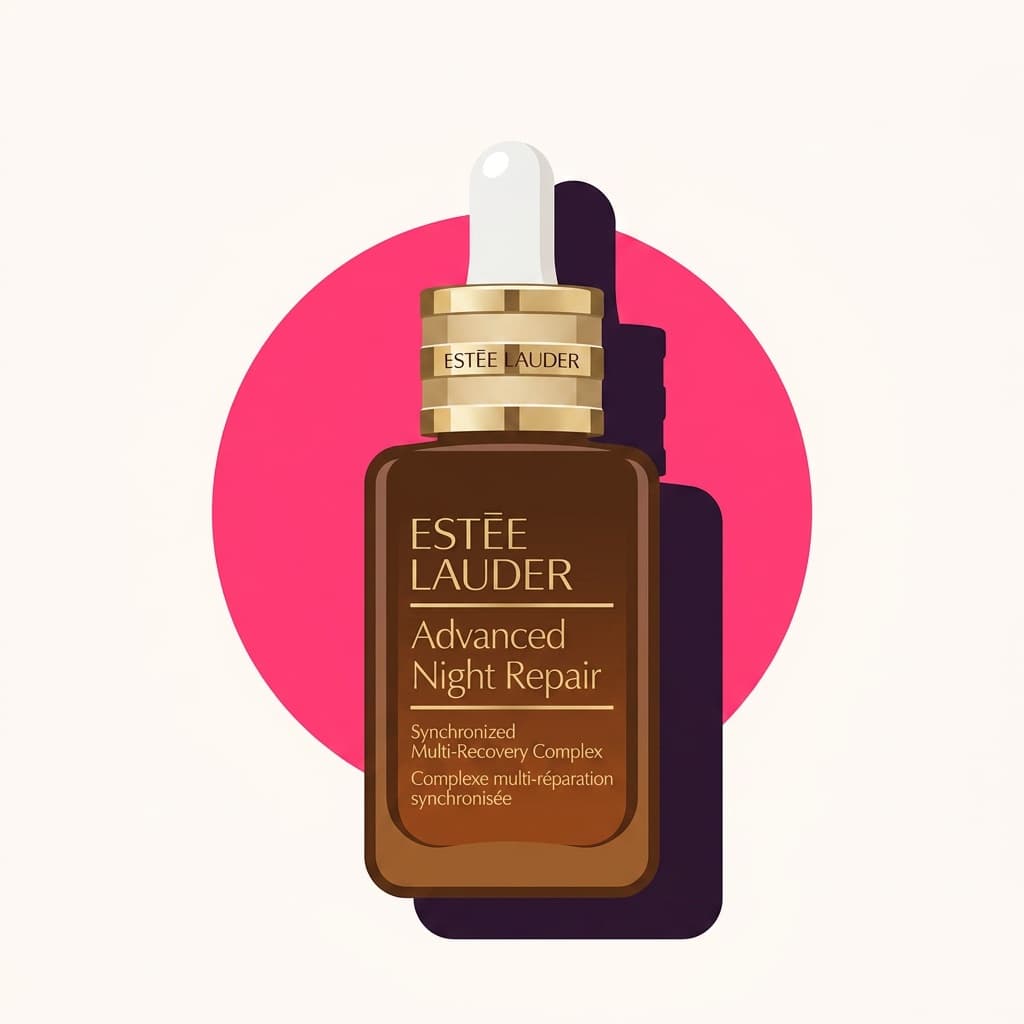
Estée Lauder Advanced Night Repair Review: Worth $135?
Advanced Night Repair costs $135/50ml. A first-rate barrier serum, not the anti-aging fix it is sold as: no retinoid, and two dyes it does not need.
Evidence-led score using Insider Beauty’s published 100-point editorial rubric. How we score
- Rank
- #95
- Current price
- $135.00
- Listed size
- 1 oz
- Updated

Reviewed bySarah ChenBeauty Editor
Editor’s cut
At a glance
$135 for 50ml at Ulta (checked 26 August 2026), alongside 7ml/$20, 20ml/$55, 30ml/$88 and 115ml/$258. The 50ml works out at $2.70 per ml; the 30ml is the worst value at $2.93.
Bifida Ferment Lysate is the second ingredient, straight after water and ahead of every solvent in the formula. Estée Lauder publishes no percentage for it.
Tripeptide-32, the peptide the marketing leans on, sits eleventh, below seven solvents and humectants, so it is present below 1%.
No retinoid, vitamin C, niacinamide or exfoliating acid, so it does not correct lines. The last two ingredients are Red 4 and Yellow 5, dyes added purely for the amber color.
Best for dehydrated or post-procedure skin that needs a comfort layer over actives. 4.5/5 from 22,159 Ulta reviews, 94% recommend.
Community signal
Would you buy it again?
Live retailer check
Where to buy
Insider Beauty may earn a commission on purchases made through links in this article. See our disclosure.
| Retailer | Price | Status | Purchase link |
|---|---|---|---|
| Sephora | $82.00 | In stock | Shop |
Estée Lauder Advanced Night Repair Multi-Recovery Complex costs $135 for 50ml at Ulta (checked 26 August 2026). It is an excellent barrier and hydration serum sold with anti-aging language it cannot back. Skin looks plumper and calmer by morning. Lines are a different job, and this bottle lacks the ingredients that do it. Worth buying for overnight comfort, not for correction.
What is Estée Lauder Advanced Night Repair?
Advanced Night Repair is the amber serum in the dropper bottle, sold now as the Multi-Recovery Complex and used after cleansing, before moisturizer. Ulta's listing credits it to 40 years of night-science research and states the formula is patented until 2033. It anchors the rest of the Estée Lauder skincare range, from an eye gel-cream to an overnight moisturizer, a treatment essence and two Advanced Night cleansers.
Strip the story away and it is a water-based humectant serum built on a fermented bacterial filtrate, with one peptide and sodium hyaluronate. Estée Lauder lists it for all skin types, and there is no Parfum or Fragrance entry in the ingredient list.
What are the key ingredients in Advanced Night Repair?
The published INCI list opens: Water, Bifida Ferment Lysate, PEG-8, Propanediol, Bis-PEG-18 Methyl Ether Dimethyl Silane, Methyl Gluceth-20, Glycereth-26, PEG-75, Butylene Glycol, Adansonia Digitata Seed Extract, Tripeptide-32, Sodium Hyaluronate. After that come yeast extract, lactobacillus ferment and botanical extracts, then Caffeine at nineteen, Bisabolol, Squalane, Glycerin, a block of solubilizers, Tocopheryl Acetate, preservatives and two dyes.
Bifida Ferment Lysate sits second, directly after water. That is a high placement for an active in a prestige serum, and the one genuinely distinctive thing in the bottle.
Positions three through nine are all solvent, humectant or texture. Tripeptide-32, the night peptide the advertising leans on, only appears at eleven, below all of that, which puts it comfortably under 1%. Sodium hyaluronate follows at twelve. Squalane and glycerin land at twenty-three and twenty-four, trace amounts rather than the moisturizing engine.
The heavy load of PEG and oleth solubilizers (Oleth-3 Phosphate, Oleth-3, Oleth-5, Choleth-24, Ceteth-24) is why it absorbs so fast. The final two ingredients are CI 14700 and CI 19140, better known as Red 4 and Yellow 5, there purely to make the serum amber. A $135 product marketed to reactive skin does not need two synthetic dyes for looks.
Does the bifida ferment lysate research hold up?
Partly. A 2023 paper in the Journal of Cosmetic Dermatology (Wang et al., PubMed 37218728) reported that bifida ferment lysate upregulated FLG, LOR and IVL, the genes behind filaggrin, loricrin and involucrin, in HaCaT keratinocytes, and cut IL-8 and TNF-alpha secretion in stimulated macrophages.
The caveat is in the paper's title. The work was in vitro, on cell lines, and did not test this or any finished product. Gene expression in a dish is a plausible mechanism, not proof of a visible result on your face in eight weeks.
There is also a disclosure gap. Second position tells you the running order, not the dose, and Estée Lauder publishes no percentage for the ingredient on the Ulta listing. Below 1% an INCI list can be written in any order, so from Tripeptide-32 down nothing is rankable either.
What do the clinical claims actually prove?
Read the footnotes on the Ulta listing and the claims split in two.
Instrument-measured: +128% immediate moisture (clinical test, 148 women, after one application), +22% barrier repair in two hours (clinical test, 23 women, after one application).
Self-reported: 91% said skin looks more rested after three weeks, 89% said skin feels firmer after four weeks, 90% said it absorbed quickly (consumer tests, 543 women).
The big quotable percentages are opinion surveys of women who knew they were using Estée Lauder. The moisture figure is solid. The barrier claim rests on 23 people. And the only two numbers that speak to aging, -14% fine lines and +10% elasticity, both carry footnote (2), which is missing from the footnote list. Footnotes 1 and 3 through 8 are all printed. The single most important claim on the page is the one with no method attached.
How does Advanced Night Repair perform?
Ulta shows 4.5 out of 5 from 22,159 reviews, with 94% recommending it (checked 26 August 2026). At this volume that is a strong, stable score. Read it as a comfort score rather than a results score.
The ingredient list delivers what the instrument data supports: immediate hydration, faster barrier recovery and a base that layers. What it cannot deliver is line correction, because there is no retinoid, vitamin C, niacinamide or exfoliating acid in the formula to do it. Buying this for wrinkles means buying against the INCI.
The variable to test yourself is pilling. The solubilizer load that makes this absorb so fast is the usual cause of a serum rolling up under sunscreen. I have not run a controlled pilling test here, so treat that as a prediction and settle it on the $20 size.
How much does Advanced Night Repair cost?
Prices at Ulta, checked 26 August 2026:
- 7ml (0.24 oz): $20, or $2.86 per ml
- 20ml (0.67 oz): $55, or $2.75 per ml
- 30ml (1.0 oz): $88, or $2.93 per ml
- 50ml (1.7 oz): $135, or $2.70 per ml
- 115ml (3.9 oz): $258, or $2.24 per ml
The 30ml is the trap. At $2.93 per ml it is the worst value of the five, dearer per drop than the $20 travel bottle and 31% dearer than the 115ml.
Is Advanced Night Repair worth the price?
For hydration and barrier support alone, no. Those are the cheapest things to buy in skincare. The Ordinary's Hyaluronic Acid 2% + B5 with Ceramides costs $9.90 for 30ml (theordinary.com, checked 26 August 2026), $0.33 per ml against $2.70 here, and it gives comparable next-morning plumpness. If the price is the sticking point, our Advanced Night Repair dupes guide sets out which cheaper serums genuinely overlap on ingredients and by how much.
The honest case for $135 is narrower than the counter staff will tell you. You are paying for one ingredient placed higher than rivals place theirs, in a base that layers unusually well. A drugstore retinol under $30 will do more for lines in twelve weeks than this will in a year.
Pros and cons
Pros: bifida ferment lysate at position two, ahead of every solvent in the formula; absorbs fast; no fragrance, alcohol denat or essential oil in the list; tested as safe 24 hours after IPL in a two-week study on 32 panelists; 4.5/5 across 22,159 Ulta reviews.
Cons: $2.70 per ml for hydration available at $0.33 per ml; no retinoid, vitamin C, niacinamide or acid, so no line correction; Tripeptide-32 present below 1%; two synthetic dyes added for color alone; no percentage published for the hero ingredient; the -14% fine lines claim carries a footnote marker with no footnote.
Who should buy Advanced Night Repair?
Buy it if your skin runs dehydrated or reactive and you want a comfort layer that plays well with actives. It pairs unusually well with a retinoid: apply the retinoid, then this on top to support the barrier. The IPL study is more post-procedure evidence than most serums publish, so skin recovering from over-exfoliation, a tretinoin ramp-up or an in-clinic treatment gains most.
Who should skip it?
Skip it if the anti-aging framing is what sold you. Nothing here resurfaces skin, fades pigment or builds collagen at a rate you will notice, and using it in a retinoid's place is the costliest way to buy it.
Skip it if your skin is oily and already comfortable. Skip it if you have reacted to synthetic dyes, since Red 4 and Yellow 5 are here for no functional reason. Skip it if products routinely pill under your sunscreen, unless you test the $20 size first. And skip it if $135 is a stretch, because the gap between this and a $10 hyaluronic acid serum is real but small.
My final call
Advanced Night Repair is at once one of the few prestige serums whose hero ingredient sits at the top of the list and one of the most oversold products in its category. Judge it as a barrier serum priced like a treatment serum and it holds up. Start with the 7ml at $20 to see how it behaves under your sunscreen; if it earns a place in your routine, buy the 115ml and never the 30ml.
Formula index
Ingredients
18 indexed ingredients
Useful details
Frequently asked questions
Is Estée Lauder Advanced Night Repair worth the money?
It is worth it as a barrier and hydration serum and not worth it as an anti-aging treatment. At $135 for 50ml (Ulta, 26 August 2026) you are paying for bifida ferment lysate at second position on the ingredient list, ahead of every solvent in the formula, plus a base that layers under sunscreen and makeup unusually well. What you are not buying is line correction, because the formula contains no retinoid, vitamin C, niacinamide or exfoliating acid.
Does Advanced Night Repair get rid of wrinkles?
No, and Estée Lauder's own data does not really claim it does. The only aging-related figures the brand publishes are -14% fine lines and +10% elasticity, and both carry a footnote marker that has no matching footnote on the Ulta listing, so there is no stated sample size or timeframe. The headline numbers people quote (89% firmer, 91% more rested) are self-reported opinions from a 543-woman consumer survey. Hydrated skin looks smoother temporarily, which is what most users are seeing. For actual wrinkle change, a retinoid does the work.
Can you use Advanced Night Repair with retinol or vitamin C?
Yes, and the retinol pairing is one of the better reasons to own it. The formula has no acids, no retinoids and no ascorbic acid to clash with, so it will not destabilize or over-exfoliate anything you layer it with. Apply your active first, then Advanced Night Repair on top to buffer the barrier. Give each layer a moment to absorb, as the solubilizer load in this serum can cause pilling if you rush.
Is Advanced Night Repair good for sensitive skin?
Mostly yes, with one avoidable caveat. There is no added fragrance, no alcohol denat and no essential oil in the list, bisabolol and bifida ferment lysate both lean soothing, and the brand states it was tested on sensitive skin and shown safe 24 hours after an IPL treatment in a two-week study on 32 panelists. The caveat is the last two ingredients, CI 14700 and CI 19140 (Red 4 and Yellow 5), which are there only to color the serum amber. If dyes have caused you problems before, this is a genuine reason to look elsewhere.
Why might Advanced Night Repair pill under sunscreen?
The high PEG and oleth solubilizer content is the most likely cause. Oleth-3 Phosphate, Oleth-3, Oleth-5, Choleth-24 and Ceteth-24 all appear in the second half of the ingredient list, and combinations like these are known to roll up when layered with film-forming products such as sunscreens and silicone primers. Using fewer drops and waiting a full minute before the next layer helps. Buying the $20 7ml size to test it before spending $135 helps more.
Which size of Advanced Night Repair is the best value?
The 115ml at $258, which works out at $2.24 per ml (Ulta, 26 August 2026). The 50ml at $135 is $2.70 per ml, the 20ml at $55 is $2.75, the 7ml at $20 is $2.86, and the 30ml at $88 is the worst of the five at $2.93 per ml, dearer per drop than the travel bottle. Estée Lauder directs you to use one dropper morning and night, so the difference between the cheapest and dearest per-ml size compounds fast. Test on the 7ml, then size up rather than repurchasing the 30ml.