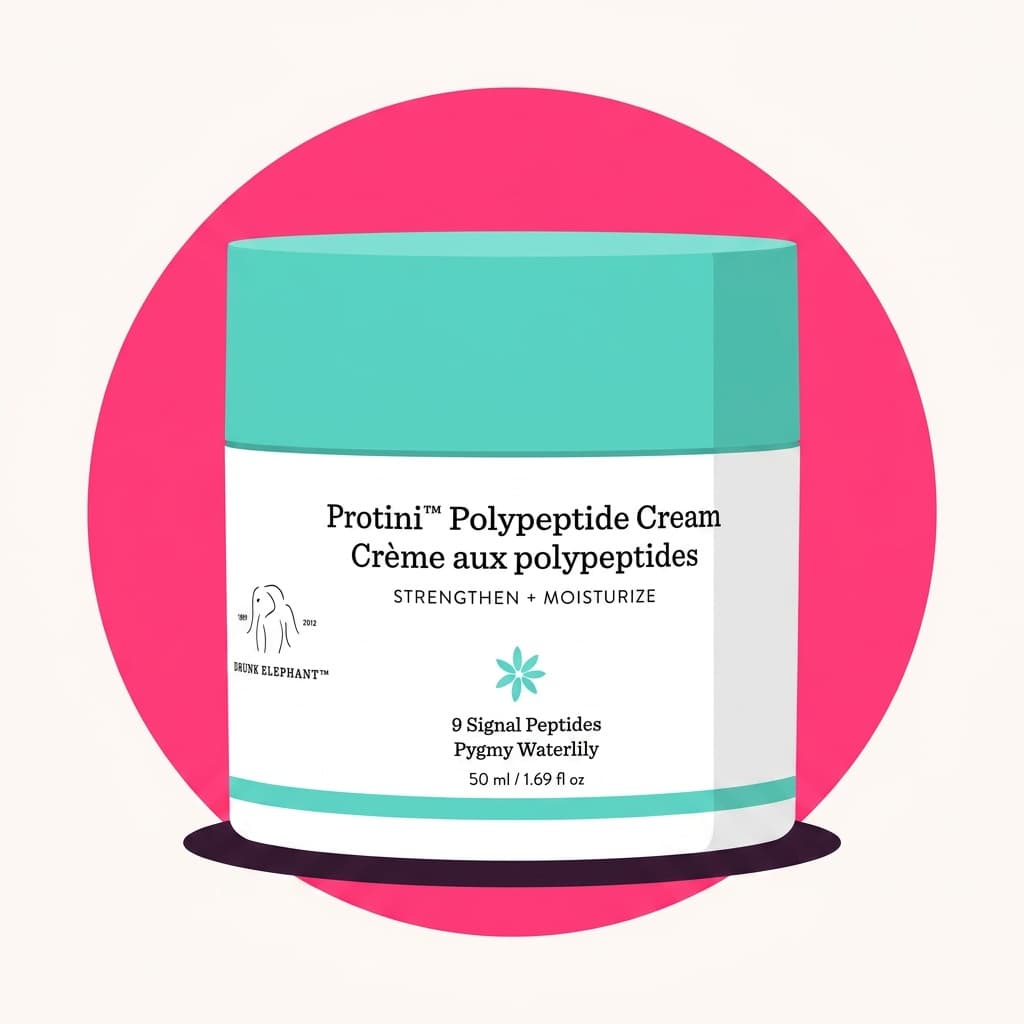
Drunk Elephant Protini Review: 9 Peptides, $72 Jar
Drunk Elephant Protini is $72 for 50ml. Nine real peptides sit high in the list, but marula oil outranks them and only 71% of reviewers recommend it.
Evidence-led score using Insider Beauty’s published 100-point editorial rubric. How we score
- Rank
- #91
- Current price
- $72.00
- Listed size
- 1.69 oz
- Updated

Reviewed bySarah ChenBeauty Editor
Editor’s cut
At a glance
$72.00 for 50 ml on drunkelephant.com (checked 26 August 2026), or $1.44 per ml. The 100 ml jar lists at $99.00, or $0.99 per ml, and is the only size that prices sensibly.
Nine named peptides occupy positions 10 to 18 of the 58-ingredient list, including copper palmitoyl heptapeptide-14 and the palmitoyl tripeptide-1 / tetrapeptide-7 pair.
Marula (Sclerocarya birrea) seed oil sits at position seven, above every peptide. Published fatty-acid profiles put it around 70-78% oleic acid, the profile most linked to congestion.
The efficacy claim rests on a 31-person, 8-week brand study with no published method. Drunkelephant.com shows 4.5 out of 5 from 3,484 reviews, but only 71% of reviewers would recommend it.
Best for normal to combination skin that will buy the 100 ml jar. Half the one-star reviews are about the refill pod failing to fit, so buy the jar rather than the refill.
Community signal
Would you buy it again?
Drunk Elephant's Protini Polypeptide Cream costs $72.00 for 50 ml on the brand's own site (checked 26 August 2026), and the formula justifies maybe two-thirds of that. The nine peptides are real, named, and sit unusually high in the ingredient list. The trouble is what sits higher: marula oil is the seventh ingredient, ahead of every peptide in a product named for its peptides.
What is Drunk Elephant Protini Polypeptide Cream?
A fragrance-free gel-cream moisturiser built on signal peptides and free amino acids, sold in a squat plastic jar with a replaceable inner pod. The brand now lists it as Protini Polypeptide Firming Refillable Moisturizer in four sizes: 15 ml at $24.00, 50 ml at $72.00, a 100 ml "big" jar at $99.00, and a 50 ml refill pod at $63.00, all checked 26 August 2026.
Texture is what people actually buy it for. Across reviews on the brand's product page, "light" and "not greasy" recur more than anything else, usually from people wearing it under makeup. It is not a barrier balm and does not pretend to be.
What are the key ingredients in Protini?
Count the nine peptides on the label yourself: sh-Oligopeptide-1, sh-Oligopeptide-2, sh-Polypeptide-1, sh-Polypeptide-9, sh-Polypeptide-11, copper palmitoyl heptapeptide-14, heptapeptide-15 palmitate, palmitoyl tetrapeptide-7 and palmitoyl tripeptide-1. They run consecutively through positions 10 to 18 of the 58-ingredient list on drunkelephant.com. Positions 19 to 29 are free amino acids (alanine, arginine, glycine, histidine, isoleucine, phenylalanine, proline, serine, threonine, valine) plus acetyl glutamine.
That block is unusual at any price. Palmitoyl tripeptide-1 with palmitoyl tetrapeptide-7 is the pair sold commercially as Matrixyl 3000, and copper palmitoyl heptapeptide-14 is a copper peptide most brands bottle separately. Sodium hyaluronate turns up at 32, lecithin at 36.
Two caveats. INCI order stops being informative below 1%, so position 10 tells you the peptides beat the preservatives and nothing about dose. And the richest oil in the jar outranks all nine of them: Sclerocarya birrea seed oil at position seven, which published fatty-acid profiles put at roughly 70-78% oleic acid.
Does the "Suspicious 6" marketing hold up?
Drunk Elephant built its identity on excluding six categories: essential oils, drying alcohols, silicones, chemical sunscreens, fragrance and dyes, and SLS. On Protini the exclusions are genuine, with no fragrance, no denatured alcohol and no dimethicone or cyclopentasiloxane on the list.
What the ban does not do is remove the job silicones were doing. Positions 30 and 31 are coconut alkanes and coco-caprylate/caprate, the plant-ester slip system chemists use when a brief says no silicone. The skin-feel is rebuilt from different molecules: competent formulation, far weaker safety argument.
Cetearyl alcohol at position four confuses people every time. It is a fatty alcohol that thickens and conditions, unrelated to the drying alcohol the brand campaigns against. Polyvinyl alcohol at 38 is a film former. Neither breaks the rule.
The bigger gap is what the list omits. Marula oil is not one of the Suspicious 6, and for acne-prone skin it is the riskiest thing in this jar.
How does Protini perform?
The efficacy evidence is thin. The product page says the cream is clinically proven to firm, then footnotes its headline figures, 96% improvement in tone, radiance and luminosity, 93% in texture and 90% in hydration, to "a clinical study with 31 people after 8 weeks". No protocol, control arm or measurement method is published, and nothing says whether those percentages were measured or self-reported. At that sample size, read them as marketing.
Ratings are more useful, and they pull in two directions. Drunkelephant.com shows 4.5 out of 5 from 3,484 reviews (checked 26 August 2026), but its review platform puts the share who would recommend it at 71%, low for a 4.5-star average.
The one-star reviews explain the gap, and the complaint is mostly not the cream. Half of the 50 lowest-rated reviews on the brand's page are about the refill system: the pod not seating in the jar, the lid refusing to close over it, cream spilling during the swap. Packaging is the most complained-about part of this product.
Is Protini good for oily or acne-prone skin?
Oily skin does well here. The base is light and fragrance-free, with none of the shea or petrolatum that makes peptide creams feel like a mistake by lunchtime.
Acne-prone skin is a different question, and the answer is marula. Oleic-rich plant oils are a documented congestion trigger for a subset of acne-prone users, and nine of those 50 one-star reviews describe breakouts or new acne, several from people who say they almost never break out. Anecdote rather than data, but the ingredient position supports it. If rosehip or avocado oil has congested you before, skip this.
How much does Protini cost?
List prices on drunkelephant.com, checked 26 August 2026:
- 15 ml jar: $24.00, or $1.60 per ml
- 50 ml / 1.69 fl oz jar: $72.00, or $1.44 per ml
- 100 ml / 3.3 fl oz "big" jar: $99.00, or $0.99 per ml
- 50 ml refill pod: $63.00, or $1.26 per ml
Two conclusions fall out of that. The 100 ml jar costs 31% less per millilitre, so nobody committing to this cream should buy the 50 ml. And the refill saves $9.00 on $72.00, or 12.5%, for skipping a jar you already own plus the fiddly transfer those reviews describe. Refill systems elsewhere routinely cut 20-30%.
On the day of checking the 15 ml and 100 ml were discounted 10%, taking the big jar to $89.10, or $0.89 per ml. The 50 ml and the refill were not.
Is Protini worth the price?
At $1.44 per ml it is not, unless the nine-peptide list is what you are after and you have checked whether anyone sells the same peptides for less. Someone does. Our Protini dupes guide found Acure's Radically Rejuvenating Whipped Night Cream at $21.99 carrying all nine of Protini's named peptides in a heavier base, plus Naturium's Multi-Peptide Moisturizer at $20.00 for the same 50 ml if your skin is oily. Naturium works out at $0.40 per ml, a shade over a quarter of what Protini charges.
At $0.99 per ml on the 100 ml jar the arithmetic changes. That is normal money for a well-built peptide moisturiser, and this one is better assembled than most rivals at that figure. The rest of the range sits at our Drunk Elephant brand hub.
Pros and cons
Pros
- Nine named peptides at positions 10-18, including a copper peptide and the Matrixyl 3000 pair
- Fragrance-free and dye-free, with no essential oils, rare in this category
- Light enough for oily and combination skin to wear under makeup
- A 100 ml size that cuts the cost per millilitre by 31%
Cons
- Marula oil at position seven, above every peptide, and a real congestion risk
- $1.44 per ml at the standard size, against $0.40 per ml for Naturium's 50 ml peptide cream
- The refill saves only 12.5%, and half the one-star reviews say the pod does not fit
- Efficacy evidence is 31 people over eight weeks with no published method
- Only 71% of reviewers on the brand's own site would recommend it
Who should buy Protini?
Normal to combination skin that wants peptides without fragrance, tolerates plant oils, and will buy the 100 ml jar. It suits fragrance-reactive skin too, since few peptide creams are this clean on the allergen front. Buy the jar, not the refill pod.
Who should skip it?
Skip it if you are acne-prone and have congested from oleic-heavy oils. Skip it if your skin is genuinely dry, since several one-star reviewers bought it for dryness and said it did not moisturise enough alone. Skip it if the clinical claims sold you, because they rest on 31 participants and an unpublished method. And skip it if $72.00 for 50 ml would make you resent the jar, because the same peptide list exists for under a third of the money.
My final call
Protini is a well-formulated peptide cream sold at a price its evidence cannot support, wrapped in a purity story that means less than it sounds. Buy the 100 ml jar or do not buy it, and skip the refill until the pod fits. The 15 ml at $24.00 will tell you inside a month whether peptides do anything for your face.
Formula index
Ingredients
17 indexed ingredients
Useful details
Frequently asked questions
How much is Drunk Elephant Protini Polypeptide Cream?
It is $72.00 for the 50 ml / 1.69 fl oz jar on drunkelephant.com, checked 26 August 2026. The 15 ml is $24.00, the 100 ml jar is $99.00 and the 50 ml refill pod is $63.00. Per millilitre that is $1.60, $1.44, $0.99 and $1.26, so the 100 ml jar is the only size that prices sensibly. The refill saves $9.00, or 12.5%, and half the one-star reviews on the brand's site say the pod does not seat properly in the jar.
Does Protini cause breakouts?
It can, and marula oil is the likely reason. Sclerocarya birrea seed oil is the seventh ingredient, ahead of all nine peptides, and published fatty-acid profiles put it around 70-78% oleic acid, the profile most often associated with congestion in acne-prone skin. Nine of the 50 lowest-rated reviews on drunkelephant.com describe breakouts or new acne. If oleic-rich oils have congested you before, patch test along the jawline for two weeks.
How many peptides are in Protini?
Nine, and they are all named on the label: sh-Oligopeptide-1, sh-Oligopeptide-2, sh-Polypeptide-1, sh-Polypeptide-9, sh-Polypeptide-11, copper palmitoyl heptapeptide-14, heptapeptide-15 palmitate, palmitoyl tetrapeptide-7 and palmitoyl tripeptide-1. They sit at positions 10 to 18 of the 58-ingredient list, followed by ten free amino acids and acetyl glutamine.
Is Protini good for dry skin?
Not on its own in cold weather. The base is a light gel-cream with no shea butter, petrolatum or heavy occlusives, and several one-star reviewers on drunkelephant.com bought it for dryness and said it did not moisturise enough. Dry skin should treat Protini as a peptide treatment step and seal it with something richer, which means paying for two products.
Is there a cheaper alternative to Protini?
Yes. Acure's Radically Rejuvenating Whipped Night Cream at $21.99 carries all nine of Protini's named peptides in a heavier base. Naturium's Multi-Peptide Moisturizer is $20.00 for the same 50 ml if your skin is oily, and cocokind's Resurrection Polypeptide Cream is $27.00 if it is dry. Our Protini dupes guide compares seven alternatives on peptide overlap, texture and price.
What is Drunk Elephant's Suspicious 6?
It is the brand's list of six ingredient categories it refuses to formulate with: essential oils, drying alcohols, silicones, chemical sunscreens, fragrance and dyes, and SLS. Protini genuinely contains none of them. It rebuilds silicone slip with coconut alkanes and coco-caprylate/caprate at positions 30 and 31 instead, and the list says nothing about oleic-rich plant oils like the marula it does contain.