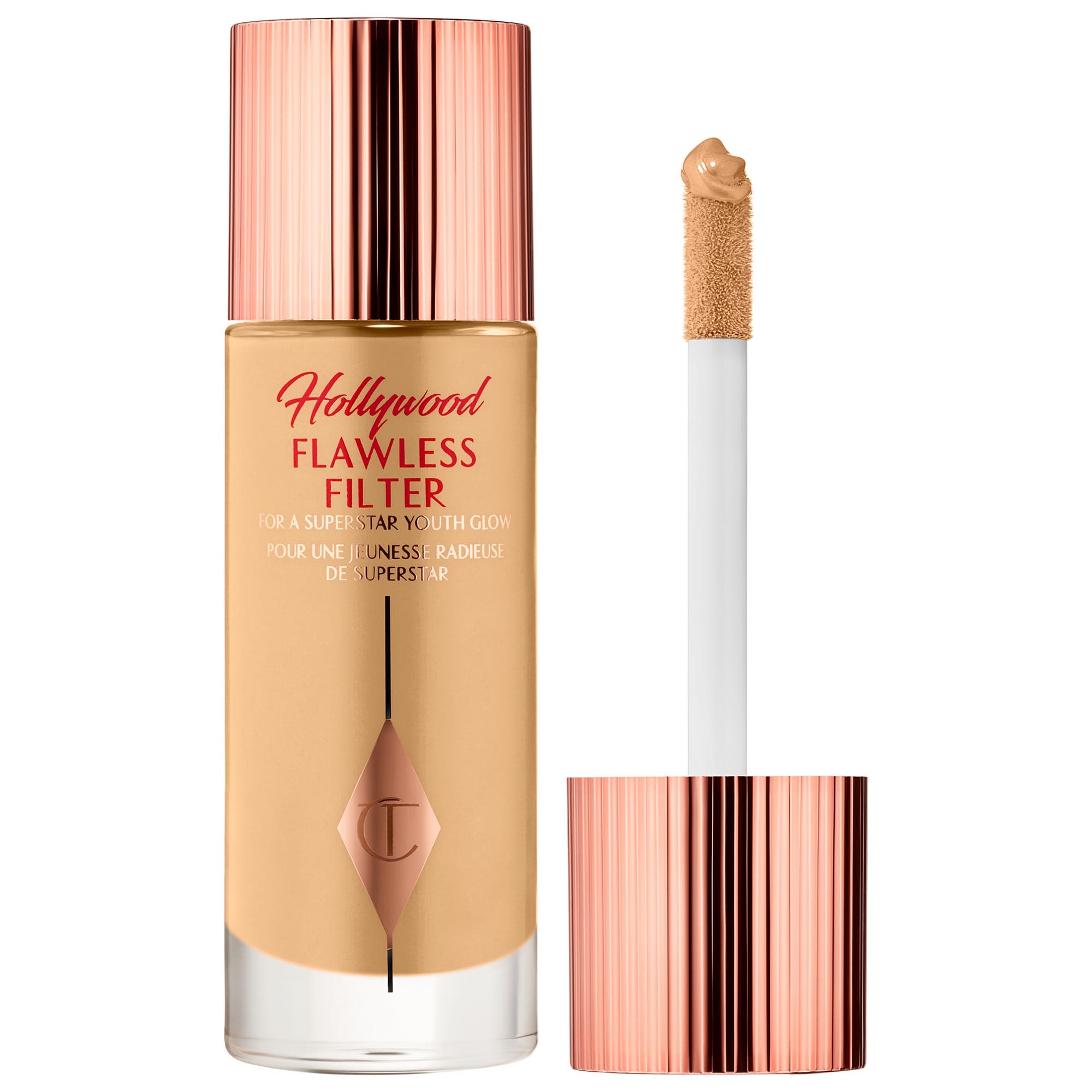
Charlotte Tilbury Hollywood Flawless Filter Review
Charlotte Tilbury Hollywood Flawless Filter is $50 for 30ml: a real glow, sheer coverage, no pore-blurring. Here is when it beats the $15 e.l.f.
Evidence-led score using Insider Beauty’s published 100-point editorial rubric. How we score
- Rank
- #54
- Current price
- $50.00
- Listed size
- 1 oz
- Updated

Reviewed bySarah ChenBeauty Editor
Editor’s cut
At a glance
$50 for 30ml on charlottetilbury.com (checked 26 August 2026), or $16.67 per 10ml; the 5.5ml mini at $19 works out at more than twice that per millilitre.
The INCI list contains no silica, elastomer or starch, which is exactly why it glows but does not blur pores.
Mica sits third and squalane sixth: the finish is reflective pigment plus real hydration, not coverage.
Main flaw is the blurring claim. The brand sells "smoothing AIRbrush polymers" and pore-blurring powders; the ingredient list has neither, and wear on oily skin is short without powder.
Best for dry or mature skin worn daily. e.l.f. Halo Glow Liquid Filter is $15 for 31.5ml and shares the same emollient backbone.
Community signal
Would you buy it again?
Charlotte Tilbury Hollywood Flawless Filter is worth $50 for 30ml if what you want is a glow that reads as skin, and a poor buy at that price if you expected the "filter" in the name to mean blurred pores. It is a sheer tinted illuminator sold as primer, highlighter and foundation mixer. The formula is good and slightly unusual. The pricing, sitting next to a $15 rival built on the same backbone, is the part that needs defending.
Key points
- $50 for 30ml on charlottetilbury.com, checked 26 August 2026, in 12 shades.
- No silica, elastomer, starch or fragrance in the INCI. Mica sits third, squalane sixth.
- It glows and hydrates. It cannot blur pores, and nothing in the formula grips through an oily afternoon.
- e.l.f. Halo Glow Liquid Filter is $15 for 31.5ml on a related base, about a third of the price per millilitre.
What is Charlotte Tilbury Hollywood Flawless Filter?
A sheer tinted fluid in a glass bottle with a wand applicator, used three ways: under foundation as a primer, over it as a highlighter, or stirred into a matte base to loosen it. Coverage is closer to a tinted moisturiser diluted by half. The tint exists to stop the shimmer reading grey on your depth of skin, not to even out tone.
Charlotte Tilbury's own claim testing puts 96% of 300 users agreeing to a "real-life filter effect" after a week. Read that as an agreement score from a brand-run panel, on a question about appearance. The 24-hour hydration claim rests on 16 testers, small enough to set aside.
What are the key ingredients in Hollywood Flawless Filter?
The list on charlottetilbury.com opens: water, hydrogenated didecene, mica, glycerin, propanediol, squalane, cetyl PEG/PPG-10/1 dimethicone, isoamyl laurate, hydrogenated styrene/isoprene copolymer.
Three things in there matter. Hydrogenated didecene at position two is the emollient doing all the slip, and it is a hydrocarbon rather than a silicone, which is why the film feels light and faintly wet instead of powdery. Mica at position three tells you the glow is reflective pigment sitting high in the formula, not an optical trick. And there is no silica, no elastomer and no starch anywhere in the list, which is the formulation reason this cannot blur texture the way a silicone primer does. Cetyl PEG/PPG-10/1 dimethicone is an emulsifier used at low levels, not a filling agent.
Glycerin fourth and squalane sixth are real hydration rather than garnish. Hoya lacunosa flower extract, the "porcelain flower" of the marketing copy, sits below the preservative system of hydroxyacetophenone, 1,2-hexanediol and caprylyl glycol, so it is present at a fraction of a percent. Bismuth oxychloride appears in the may-contain colorant list, which is worth knowing if pearlised mineral makeup has caused you trouble before. Nothing in the list is a fragrance.
How does Hollywood Flawless Filter perform?
Worn alone on clean skin it looks like skin that slept well. A stripe down each cheekbone blended with fingers gives a wet-looking sheen that photographs without white cast, because the pearl is fine rather than glittery. Under foundation it stops a matte base looking flat, which is the use case where the $50 feels earned.
Where it struggles is staying put. Charlotte Tilbury publishes claim-test figures for glow, youthfulness and 24-hour moisture and none at all for wear time, which is the tell. The only polymer in the list is hydrogenated styrene/isoprene copolymer at position nine, an oil gellant that thickens the base rather than a long-wear film former of the acrylates type. Powder the areas that move and you get most of a day; skip powder and it slides by lunch on anything but dry skin.
The applicator is the other quiet annoyance. Charlotte Tilbury tells you to apply it with the doe-foot Magic Wand, which lays down far more than the two or three drops a face needs, and overdosed the finish tips from lit to greasy. A pump would fix it.
Is Hollywood Flawless Filter good for oily or textured skin?
Not really. On oily skin it adds shine to shine. On visible pores it does the opposite of blurring, because reflective pigment lands in and around the dip and draws the eye. Charlotte Tilbury's own copy promises "smoothing AIRbrush polymers" for a poreless finish and "finely milled powders" to blur lines; the INCI contains neither, and the only powders in it are mica and the pigment colorants. It earns its reputation on dry or mature skin, and combination skin is fine if you keep it off the T-zone.
Is the e.l.f. Halo Glow Liquid Filter actually the same thing?
Close, but not the same. e.l.f.'s version is $15 for 31.5ml and shares the distinctive part of the base: water, hydrogenated didecene, squalane, cetyl PEG/PPG-10/1 dimethicone, polyglyceryl-4 isostearate and isoamyl laurate appear in both lists. That is the same emollient system, not coincidence.
The differences are real but narrow. e.l.f. adds dimethicone, a disteardimonium hectorite thickener and synthetic fluorphlogopite where Tilbury uses mica, which makes it thicker on the finger and slower to blend out. The Tilbury sinks in faster and carries a finer pearl, so the glow is more diffuse at close range. e.l.f. runs 15 shades to Tilbury's 12 and holds a 4.6 average across 9,582 reviews on elfcosmetics.com. Photographed at arm's length, the two are hard to tell apart.
How much does Hollywood Flawless Filter cost?
$50 for 30ml on charlottetilbury.com as of 26 August 2026, which the site itself prices at $16.67 per 10ml. The 5.5ml travel size is $19, or $34.55 per 10ml, so trying it via the mini costs more than twice as much per millilitre as committing to the full bottle. Bluemercury stocks the same 30ml at $50 and shows 4.6 out of 5 across 3,068 reviews. The rest of the range is covered on our Charlotte Tilbury brand page.
If the price is the problem rather than the product, that is a solved problem. Our Hollywood Flawless Filter dupes guide counts about eleven shared ingredients between this and the $15 e.l.f., and ranks three other contenders that all come in under $15.
Is Hollywood Flawless Filter worth the price?
At $1.67 per millilitre against e.l.f.'s $0.48, you pay roughly 3.5 times for a finer pearl, a thinner film and a faster blend. Wear it daily on dry skin and the premium holds up over the months a 30ml bottle lasts. Reach for glow twice a month before dinner and it does not.
Pros and cons
Pros:
- Skin-like sheen from finely milled mica rather than visible glitter
- Glycerin and squalane high in the list, so it hydrates instead of sitting on top
- No fragrance in the list, and no silicone beyond one low-level emulsifier
- Sheer enough that shade matching across the 12 options is forgiving
Cons:
- Does not blur pores despite the name, because there is no elastomer in it
- Nothing in the formula grips, so it needs powder anywhere skin moves or shines
- The wand invites over-application in a way a pump would not
- 3.5 times the per-millilitre price of a near-identical drugstore formula
Who should buy Hollywood Flawless Filter?
Dry or mature skin that finds foundation flattening, and anyone who wears a matte base and wants it to look less like a mask. Also people who tried the e.l.f. version and found the thicker texture irritating to blend, which is the specific complaint the $35 difference answers.
Who should skip it?
Oily skin, unless you will powder over it and accept shorter wear. Anyone whose main complaint is pores or texture, because reflective pigment makes both more visible and a silicone blurring primer is the right tool. Anyone wanting coverage, since this does nothing for redness or dark marks. Anyone who wears glow occasionally rather than daily, where the cost per use never comes down.
My final call on Hollywood Flawless Filter
Buy it if your skin is dry and you will wear it most days. The ingredient list is shorter and cleaner than most illuminators at any price, and the fineness of the pearl is the one thing the cheap versions have not matched. Buy it knowing the name oversells what it does, and that $15 gets you most of the way there.
Useful details
Frequently asked questions
Is Charlotte Tilbury Flawless Filter a primer or a highlighter?
Both, and it works better as a primer. Under foundation it stops a matte base looking flat; over foundation it gives a wide, low-contrast sheen rather than a defined highlight, so if you want a sharp strip on the cheekbone you still need a powder or cream highlighter on top.
Does Hollywood Flawless Filter blur pores?
No. There is no silica, elastomer or starch in the ingredient list, and the mica sitting third reflects light rather than filling texture, so pores often look slightly more visible rather than less. A silicone blurring primer is the correct product for that.
How many shades does Hollywood Flawless Filter come in?
Twelve on the US Charlotte Tilbury site as of 26 August 2026, running 1 Fair to 8 Deep. The tint is sheer enough that a half-shade mismatch does not show, so choose by undertone rather than depth.
Is the e.l.f. Halo Glow Liquid Filter a real dupe?
Yes, for most purposes. At $15 for 31.5ml it shares the emollient backbone with the Tilbury, including hydrogenated didecene, squalane, cetyl PEG/PPG-10/1 dimethicone and isoamyl laurate, but it is thicker, needs more blending and uses synthetic fluorphlogopite instead of mica, so the pearl is a little more obvious up close.
How long does Hollywood Flawless Filter last on the skin?
Most of a day on dry skin with powder over the areas that move, and less than that on oily skin. The only polymer in the formula is hydrogenated styrene/isoprene copolymer, an oil gellant rather than the acrylates-type film former that makes long-wear makeup stay put, so setting powder does most of the work.
Is Hollywood Flawless Filter worth $50?
It is worth it if you wear it most days on dry skin, where a 30ml bottle at $16.67 per 10ml lasts months. For occasional evening glow it is not, because the $15 e.l.f. version gets you a very similar result at roughly a third of the price per millilitre.