Weleda is most convincing when you want richness and enjoy a botanical scent. Skin Food Original explains much of the brand's appeal: one substantial cream for dry areas, with a second life in makeup preparation. It is also the product most likely to disappoint someone expecting an invisible, unscented face lotion. The newer Skin Food formulas broaden the choice, but they have not made Weleda a fragrance-free brand.
A century-old cream still shapes the brand
The green Skin Food tube occupies an unusually large place in Weleda's identity. The US homepage leads with its centenary in 2026, dating the product to 1926. The company itself traces its plant-focused personal care to 1921 in its official FAQ. This is an established natural-cosmetics business whose best introduction may still be one of its earliest products.
The history is useful because Skin Food's appeal makes more sense as a durable preference than as a sudden new discovery. In a December 2017 Allure review, Kaleigh Fasanella praised its thick, oily character for her hands. The same article reported makeup artist Katie Jane Hughes using it beneath full-coverage foundation for a more luminous finish. Those are two different reasons to want the same substantial cream.
That combination is the interesting part of the reputation. A product associated with elbows and hands can also appeal to someone interested in makeup. Richness is doing the work in both cases. It gives the brand a practical identity without confining it to a purely functional corner of the bathroom.
The natural-cosmetics story is equally longstanding. Weleda describes using organic and biodynamic farming principles where possible. That is part of how it chooses and presents its botanical ingredients. It does not tell you whether a particular moisturizer contains animal-derived ingredients, whether you will like its scent or how light it will feel. Those questions still need the individual label.
What people like about Skin Food is also its dividing line
Skin Food Original Ultra-Rich Cream is an unusually clear statement of preference. Its current US ingredient list begins with water, sunflower oil, lanolin, sweet almond oil and beeswax. Glycerin, alcohol, plant extracts and fragrance also appear. It is reasonable to approach that as a rich cream with oils and waxes, rather than expect the feel of a lightweight gel.
The brand positions it for dry areas on face and body, including hands, feet and elbows, and also discusses makeup preparation. This versatility is part of the appeal: you can buy a tube for a specific dry area without treating it as a commitment to a new facial routine. The current 2.5 fl oz size costs US$22.99, which puts it within reach as a selective purchase even if you never explore the rest of the range.
The makeup reputation deserves some discrimination. Hughes' reported use beneath full-coverage foundation is a particular technique and finish preference. It does not mean that every foundation needs a rich layer underneath it. If you prefer a matte result or dislike feeling cream on your skin, that aspect of Skin Food's reputation may have little relevance to you.
Fragrance is the other obvious dividing line. The original lists parfum and scent components including limonene and linalool. The botanical association should not be mistaken for an absence of perfume. If scented body care is part of the pleasure, this may fit. If you want a cream with no added fragrance, its reputation is unlikely to change that requirement.
Our rich moisturizer alternatives guide is useful for comparing this style of cream with other options. The choice is about the formula and finish you want, rather than which product has accumulated the most enthusiastic descriptions.
How one cream became a family
Weleda has expanded Skin Food without abandoning the original name. Allure's December 2018 launch coverage introduced three additions: Light, Body Butter and Lip Butter. That is a useful turning point in the brand's story. A single, very specific cream became a range intended to accommodate more ways of using it.
The name now needs a little interpretation. Skin Food Light is the closest choice for someone who likes the idea of Original but wants a more fluid texture. Weleda describes the current US Light formula as lighter and faster absorbing. It still contains beeswax and lanolin, as well as glycerin, sunflower oil, cocoa butter, shea butter and fragrance. “Light” is a texture distinction, not a vegan or fragrance-free designation.
Body Butter makes more sense when the intended area is large. The current formula uses sunflower oil, cocoa butter and shea butter, with no lanolin or beeswax listed. Weleda labels it vegan-friendly. At US$22.99 for 5 fl oz, it gives twice the labeled volume of Original for the same price. For regular use on arms and legs, that is a more consequential difference than whether a jar feels less portable than a tube.
Face Care Nourishing Day Cream takes a different direction again. The current US product contains squalane and berry wax alongside ingredients such as sunflower oil, glycerin and shea butter. Weleda positions it for normal to dry skin and morning application to face, neck and décolleté, including use under makeup. It is also labeled vegan-friendly, but it has fragrance, described by the brand as mandarin.
The dedicated face cream is therefore a separate formulation choice, not Original in a more expensive jar. At US$27.49 for 1.3 fl oz, it costs considerably more per unit than the original tube. That can be worth considering if you want its particular face-care format. It is harder to justify if the only attraction is getting a more facial-looking version of a cream you already enjoy.
There is also a reassuringly specific packaging detail for returning users. The current US pages describe new aluminum tubes for Original and Light, and a new glass jar for Body Butter, while explicitly saying the formulas remain the same. That applies to those stated packaging changes. It does not establish that every product ever sold under the Skin Food name has an identical formula.
“Natural” and “vegan” answer different questions here
Weleda is a useful reminder to separate those terms. Original and Light contain lanolin and beeswax. Body Butter and the Day Cream are marketed as vegan-friendly; the brand qualifies that they are made in facilities where non-vegan products are also produced. A shopper avoiding animal-derived ingredients has meaningful choices within the range, but cannot select by the Weleda logo alone.
The same care is needed with fragrance language. All five products in our price table list fragrance. A reference to natural fragrance or an absence of synthetic fragrance would not make them unscented. The practical question is whether you want a perfumed product, rather than whether the scent fits the brand's botanical identity.
These are not obscure label details. They explain why two people can be drawn to Weleda's plant-focused presentation and end up choosing different products, or deciding the range does not meet their preferences. Our moisturizer guide offers a broader starting point when fragrance or texture requirements take priority over the brand.
The body oils show another side of Weleda
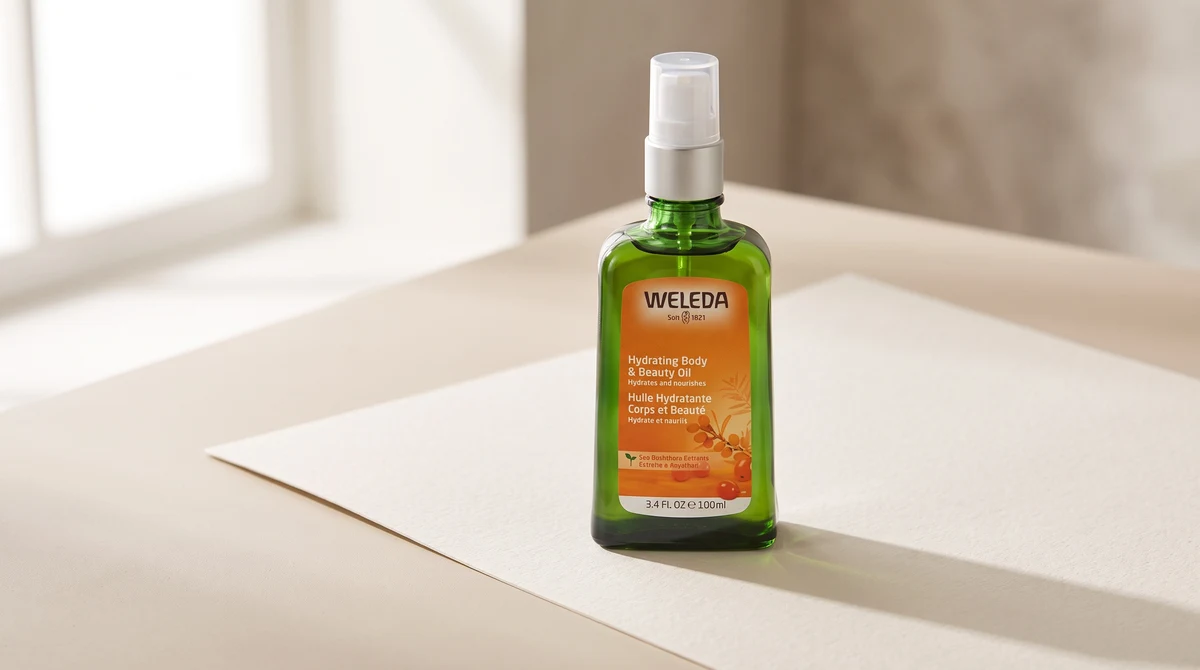
Beyond Skin Food, Hydrating Body & Beauty Oil with Sea Buckthorn is a useful example of the brand's body-care approach. It offers a scented oil massage step rather than another cream. Weleda directs a few drops onto damp skin after a bath or shower.
The name highlights sea buckthorn, but sesame oil is first in the current ingredient list, followed by sea buckthorn oil. Rosemary extract and fragrance are also listed. That makes it a formulated body oil, not a bottle of pure sea buckthorn oil. The difference matters if you arrived through an interest in that particular ingredient.
At US$21.99 for 3.4 fl oz, it sits close to the Skin Food tubes in upfront cost but asks for a different preference in use. Choose it because you enjoy applying an oil to damp skin. If you prefer to dress quickly after a cream or dislike fragranced oils, the brand story gives little reason to add this step. Our body-oil alternatives guide is a useful comparison for that format.
Current US prices, with the formats kept separate
Regular US prices and sizes were checked on 15 October 2026, before tax and shipping. This is a research-based brand guide using current official information and attributed reviews, rather than our own wear test.
The review cards below may show prices from earlier checks. Use the dated prices and sizes in this table for the current comparison.
| Product |
US price and size |
Buying view |
| Skin Food Original |
US$22.99 / 2.5 fl oz |
Rich signature; lanolin and beeswax |
| Skin Food Light |
US$22.99 / 2.5 fl oz |
More fluid; still scented |
| Skin Food Body Butter |
US$22.99 / 5 fl oz |
More for body use; scented |
| Skin Food Day Cream |
US$27.49 / 1.3 fl oz |
Face-care format; smaller amount |
| Sea Buckthorn Oil |
US$21.99 / 3.4 fl oz |
Damp-skin body oil; sesame-based |
For a first purchase, the 1 fl oz Original tube costs US$14.99. The larger size is about 39% cheaper per ounce, but requires another US$8 upfront. Given how much of Skin Food's appeal rests on liking its richness and fragrance, a smaller first purchase is a reasonable choice. The full-size saving becomes more useful once that preference is established.
Frequently Asked Questions
What is Weleda best known for?
Weleda is known for plant-focused skincare and body care, especially the green Skin Food cream introduced in 1926. The original's rich texture has attracted interest for both dry-area care and makeup preparation, and the Skin Food family now includes several distinct formulas.
Is Weleda's popularity mainly a recent trend?
Its reputation predates recent social-media discovery. Allure published a named first-hand Skin Food review in 2017 and covered the range's expansion in 2018. Weleda is marking Skin Food's centenary in 2026, with the original still central to its presentation.
Is Weleda vegan and fragrance-free?
Those are product-specific questions. Skin Food Original and Light contain lanolin and beeswax. Body Butter and the Day Cream are labeled vegan-friendly, with a shared-facility qualification. All five products assessed in this guide contain fragrance.
Who is Weleda most likely to suit?
Weleda is a good brand to explore if you enjoy botanical scents, substantial creams or body oils. Skin Food Original is the signature introduction; Light and Body Butter offer different textures and formats. Shoppers seeking fragrance-free care should look beyond the products assessed here.