
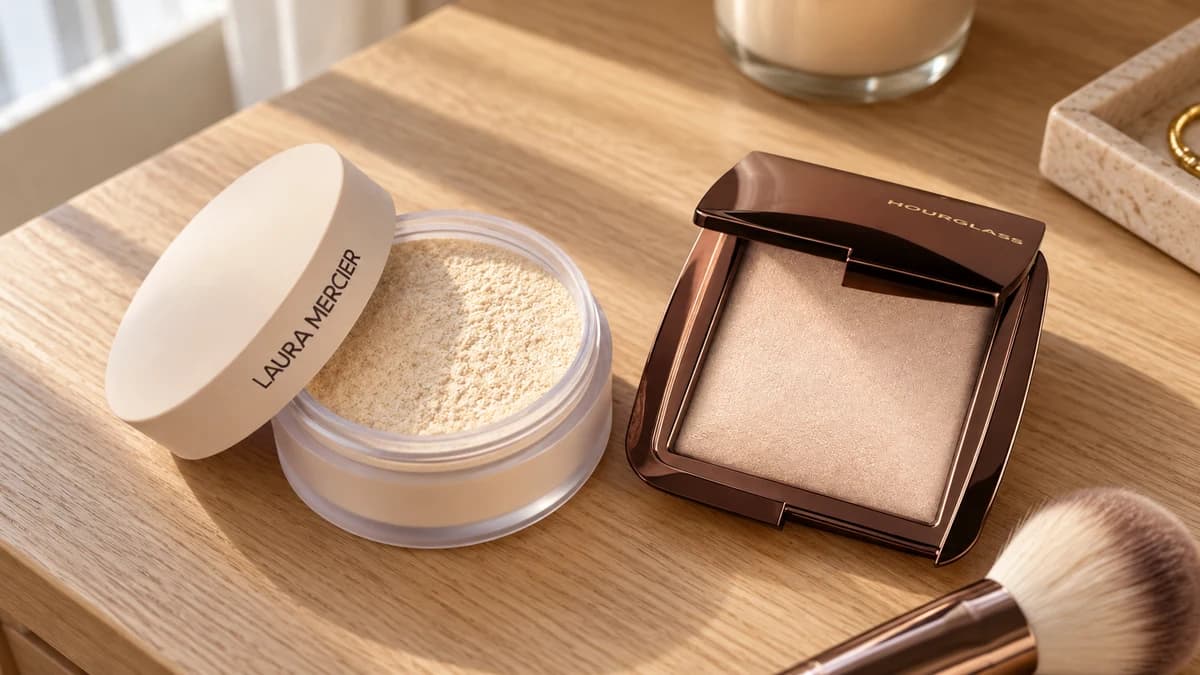
My verdict: I'd buy setting powder first if makeup moves or becomes too shiny. I'd consider finishing powder if the base already wears well but I want a softer, more luminous finish. You may get both effects from one formula. Before adding a second powder, read what the first one promises to do.
Jump to a section
Five quick takeawaysThe difference at a glanceWhat setting powder doesWhat finishing powder doesWhy the names overlapLoose, pressed and translucent mean different thingsHow I'd choose for the makeup in front of meIf you use both, this is the orderFrequently asked questionsThe names make this sound like a compulsory two-step routine. It isn't. A setting powder can blur, a finishing powder can reduce shine, and either can come pressed in a compact. The useful question is what you want to change about your makeup.
I would rather see someone use one well-chosen powder sparingly than spend $100 on two that do much the same thing. Here's how I'd work out which deserves a place in the makeup bag.
Five quick takeaways
- Makeup moving or getting shiny? Start with a setting powder where you need help.
- Happy with wear, unhappy with the finish? A finishing powder can add softness or radiance.
- Loose versus pressed is a separate choice. Packaging doesn't tell you whether a powder sets or finishes.
- Read beyond the name. “Blurring,” “finishing” and “setting” often appear on the same product.
- Two powders are optional. If you use both, set the base first and add a light finishing layer only where it improves the result.
The difference at a glance
| What you want to change | Where I'd start | What to check |
|---|---|---|
| Foundation or concealer moves | Setting powder | Makeup-setting and wear claims |
| The T-zone becomes too shiny | A mattifying setting formula | Oil-control claims, not just “blur” |
| The base looks flat or overly matte | A luminous finishing powder | Sheen level and shade |
| You want a softer-looking finish without glow | A matte blurring powder | Whether it also sets makeup |
| You need easy touch-ups | A pressed formula suited to the job | Finish and coverage, not format alone |
What setting powder does
Setting powder helps liquid and cream makeup stay where you put it and can reduce excess shine. That might mean setting concealer beneath the eyes, taking down shine around the nose, or giving a cream foundation a less tacky surface.
Makeup artist Jonet Williamson tells Marie Claire that setting powder supports wear, while finishing powder changes the completed base's appearance.
I'd start here if the problem appears a few hours after application. If concealer moves into a crease, a light setting layer is a more relevant experiment than buying a powder mainly designed to add radiance. Smooth the concealer first, though. Powder won't undo the crease underneath it.
“Setting” doesn't have to mean a completely matte face. Some formulas leave more light in the skin than others. Our best setting powder guide separates options for oil control, a softer finish, brightening and convenient touch-ups. That is the place to compare individual buys once you've decided setting is the job you need done.
What finishing powder does
A finishing powder adjusts how the final makeup looks. Depending on the formula, that may be a little radiance, a more diffused appearance or a softer transition between the products already on your face. It can be matte or luminous; “finishing” isn't another word for highlighter.
I'd consider it when foundation wears comfortably but looks flatter than I want. The appeal is a subtle change across an area of the face, rather than the concentrated shine I would look for in a cheekbone highlighter.
Hourglass Ambient Lighting Finishing Powder is a clear example. It costs $58 for 10g, and Hourglass directs you to apply it as the final complexion step. The shades differ: Dim Light is neutral peach beige, while Luminous Light is champagne pearl. Those descriptions matter more to my choice than the suggestion that every shade is universally flattering.
I'd assess the color and sheen against the foundation I actually wear. A warm powder that looks lovely across one complexion might change another more than intended. Finishing powders are sheer, but sheer doesn't mean invisible.
Why the names overlap
The tidy distinction becomes less tidy on a shop shelf. That doesn't mean you need an expert to decode every compact. Look at the product description and directions together.
Three current examples show what I mean:
| Product | US regular price / size | What the description tells me |
|---|---|---|
| Laura Mercier Ultra-Blur loose powder | $48 / 20g | Sets makeup, blurs and leaves a natural finish |
| Hourglass Ambient Lighting Finishing Powder | $58 / 10g | Adjusts the finish as the final complexion step |
| Charlotte Tilbury Airbrush Flawless Finish | $50 / 8g | A “finishing” powder with directions to reduce shine |
US prices checked October 29, 2026, before tax. Laura Mercier was temporarily reduced to $36. Sizes refer to full-size products, not minis or refills.
Laura Mercier demonstrates why blurring isn't exclusive to finishing powder. Its talc-free Ultra-Blur is sold as a setting powder, with a natural finish and texture-blurring claims. If that finish is already what you want, there is no automatic reason to add another powder over it.
Charlotte Tilbury shows why the name alone isn't enough. The brand describes Airbrush Flawless Finish as a finishing powder, then instructs you to use it on the T-zone and other areas where you want to minimize shine. Sephora calls the same compact a blurring and setting powder. I would judge it on those combined functions rather than argue it belongs in only one category.
Independent experience can overlap, too. Marie Claire's Ariel Baker reports that Hourglass helped reduce shine while retaining radiance on her oily skin.
My takeaway is to read the actual formula's purpose. I wouldn't assume that every finishing powder controls oil, or that every setting powder leaves skin flat.
Loose, pressed and translucent mean different things
These descriptions answer different questions. Loose or pressed describes the format. Setting or finishing describes the intended job. Translucent describes sheer coverage. None tells you the whole story.
As makeup educator Nechelle Turner explains in jane iredale's powder guide, both setting and finishing powders can be loose or pressed. A compact therefore doesn't become a finishing powder simply because it travels well.
I'd choose pressed powder for a handbag because there's no loose product to tip into a lid. At home, a loose jar is perfectly practical. Neither format gets an automatic advantage for my under-eyes; the amount, shade and finish would decide that.
Translucent still needs a shade check. Laura Mercier, for example, distinguishes Translucent for light to medium skin, Honey for medium skin and Medium Deep for medium to deep skin. I wouldn't choose the palest shade by habit or assume a pink brightening powder should go everywhere.
And powder foundation is another category again. If what you need is coverage, adding more sheer finishing powder is an inefficient way to get there. Our powder foundation guide covers products intended to provide that base.
How I'd choose for the makeup in front of me
For an oily T-zone and comfortable cheeks, I'd set selectively. Start around the nose, forehead or chin, wherever shine is actually bothering you. There is no need to give the cheeks the same finish just for the sake of consistency.
For dry-looking makeup, I'd first check the base and amount of powder. A second powder isn't my first fix for an already powdery face. Reduce the first layer on the next application and see whether the foundation looks better before buying something to restore glow.
For makeup that wears well but looks too matte, I'd try a small amount of luminous finishing powder. Apply to one area, look in daylight and compare it with the rest of the face. If the difference is too subtle to matter to you, keep the money.
For photographs or an event, I'd rehearse the whole combination. Check the foundation, concealer and powders together under the lighting you'll use, including flash if relevant. A promising powder description can't tell you how your complete makeup will photograph.
If you use both, this is the order
Finish blending your liquid and cream base first. Check areas where concealer has collected and smooth them before adding powder.
Next, use a small amount of setting powder on the areas that need it. Tap excess from the brush or puff and press lightly. This is consistent with makeup artist Talias's advice in Who What Wear's setting-powder guide: check for creases, then gently pat powder over the blended base.
After the rest of your complexion makeup, reassess. If you still want the finishing powder's effect, use a light brush application. Keep the first layer small enough that you can judge the change before adding more.
Setting spray is optional, too. If you use one, follow its directions and allow it to dry. Our setting spray versus setting powder guide explains the separate reasons you might use either.
For later touch-ups, I'd blot visible oil first, then decide whether any powder is needed. Repeatedly adding both products every time you check a mirror makes it harder to tell what is improving the makeup and what is simply building up.
Frequently asked questions
Do I need both setting powder and finishing powder?
Usually, I would start with one. Choose for the main problem, then see whether that formula also gives you the finish you like. A separate finishing powder earns its place only if you prefer the result it adds. Owning both shouldn't turn into a rule that you must apply both every morning.
Can finishing powder replace setting powder?
Sometimes, depending on the formula and how much setting your makeup needs. Charlotte Tilbury's Airbrush Flawless Finish is a useful example of overlapping functions. If you need stronger shine control or wear support, check for those specific claims instead of relying on the finishing label.
Which goes on first: setting powder or finishing powder?
Setting powder generally goes over the blended cream and liquid base. Finishing powder comes later, when you can see whether the completed complexion needs its effect. I wouldn't add a finishing layer to areas that already look exactly how I want them.