
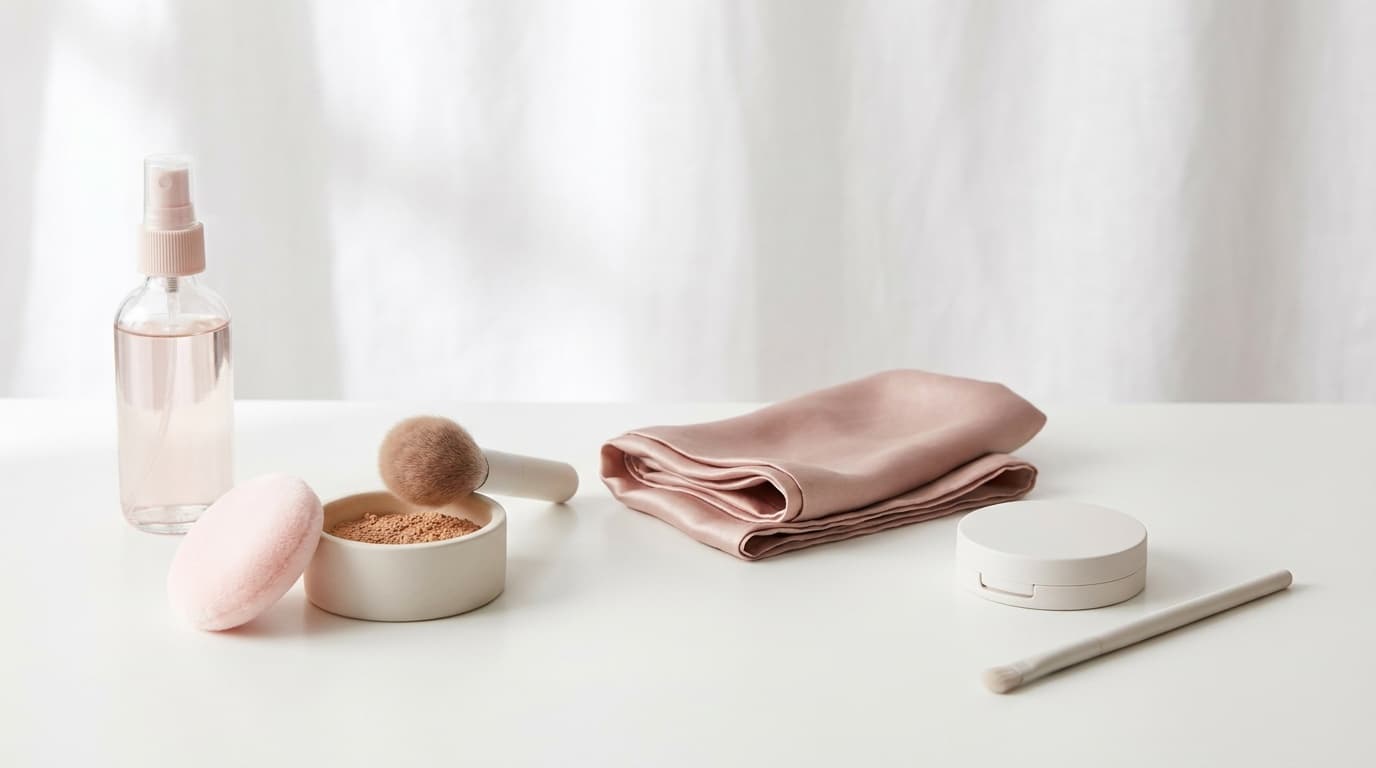
Setting spray vs setting powder comes down to skin type: oily skin needs the powder, dry skin needs the spray, and a long, hot day needs both, powder first. Powder is an absorbent (talc, silica, starch or nylon) that soaks up oil and dries still-tacky foundation into a film that stops moving. A spray that holds is a solvent carrying a film-forming polymer, which briefly re-wets your layers so they merge, evaporates, and leaves a thin flexible coat on top.
Quick Takeaways
- Powder absorbs, spray films: Nothing in a spray soaks up sebum, so a "mattifying" spray cannot replace powder on oily skin.
- Not every spray sets: A spray that holds lists PVP, an acrylates copolymer or a VP/VA copolymer in its first four ingredients.
- Less powder, pressed in: Press it into still-tacky foundation, wait 60 seconds, and keep it to the T-zone unless you shine everywhere.
- Distance varies by bottle: Charlotte Tilbury and NYX say 6 to 8 inches, Urban Decay 8 to 10, L'Oreal about 10.
- All Nighter changed in 2025: The original Skindinavia formula now sells as MCoBeauty All Dayer, $19.99 for 3.9 fl oz.
What does setting powder actually do?
Laura Mercier's Translucent Loose Setting Powder ($43 for 1 oz, four shades, checked 2 September 2026) lists talc, magnesium myristate, nylon-12, two esters and corn starch. Talc, nylon-12 and starch do the absorbing. Pressed into still-sticky foundation, it forms what Beautyblender calls a wet-dry bond and dries into a film that no longer moves. Press, not sweep, because a brush stroke drags wet foundation around.
Absorption does not stop when the oil runs out. Glam's explainer on water-based powders is blunt: talc and silica can keep pulling natural oil until skin looks and feels dehydrated, so all-over powder is a bad trade on dry skin. Silica also causes flashback. Lab Muffin found fumed silica, titanium dioxide and zinc oxide bounce camera flash back as white cast, and "HD" powders are typically more than 90 percent silica. In her at-home test, the one powder with corn starch second on its list, Innisfree No Sebum, showed no obvious flashback. One powder is not a rule, so test with direct flash before an event.
What does setting spray do, and what doesn't it do?
Lab Muffin splits sprays into two groups. The first dissolves a film-forming polymer in a solvent, usually alcohol. The solvent briefly re-wets your makeup so the layers merge, then evaporates and leaves the polymer as a thin, slightly water-resistant film. Urban Decay All Nighter ($34 for 4 oz, $18 for 1 oz at Ulta) reads water, alcohol denat, PVP, glycerin, then an AMP-acrylates copolymer. Charlotte Tilbury Airbrush Flawless Setting Spray ($39 for 100 ml) puts the acrylates copolymer and PVP second and third with no alcohol in its top ten. L'Oreal's Infallible 3-Second Setting Spray ($13.99 for 1.76 fl oz) is an alcohol-first aerosol with its copolymer fourth.
The second group is humectant-led. MAC Prep + Prime Fix+ opens with water, glycerin and butylene glycol with no polymer near the top, so it softens a powdery finish and holds nothing. Allure Philippines' makeup artists call that kind a setting spray and the film-forming kind a fixing spray; bottles do not, so read the first four ingredients yourself.
Alcohol is the other line to read. The Cosmetic Ingredient Review judged alcohol denat safe as used in cosmetics; Curology's caveat is that dry, sensitive or easily irritated skin can find it drying. If that is you, skip All Nighter and the L'Oreal aerosol for Charlotte Tilbury's ($11.53 an ounce) or e.l.f. Makeup Mist & Set, which Curology names as alcohol-free and polymer-based; we have not priced it.
Setting spray vs setting powder by skin type
- Oily skin: Powder first, because no spray absorbs sebum. RCMA No-Color Powder ($14 for 3 oz) is the value buy; add a film-forming spray only for days that need transfer resistance.
- Dry or mature skin: Skip all-over powder. Set only where you crease, under the eyes and beside the nose, with e.l.f. Halo Glow Loose Setting Powder ($8 for 0.24 oz, talc-free), and get hold from a polymer spray with no alcohol up top.
- Combination skin: L'Oreal's split is powder on the oily zones, then spray over the whole face. Camille Styles' Jena Joyce puts combination skin in the spray camp outright; I would still powder the nose.
- Acne-prone skin: Curology's advice is an oil-free, non-comedogenic spray that films with polymer rather than heavy denatured alcohol, and no isopropyl myristate, coconut oil, cocoa butter or lanolin on the list.
Baking, loose powder left thick under the eyes for three to five minutes then dusted off, is powder at its extreme. Miami makeup artist Natalie Dresher told Ipsy it belongs to nighttime dramatic looks or very oily skin, and that anyone with fine lines, acne, scarring or dry skin should skip it.
Do you need both setting powder and setting spray?
Both, when the day is long or hot, or a camera is involved. Charlotte Tilbury's four-step sandwich is mist as primer, powder over foundation and creams, mist again to melt the residue, then more powder pressed in while the spray is damp. The brand calls it "not an either/or situation", which it would, since Airbrush Flawless Finish costs $50 for 8 g, about $177 an ounce. My read is that steps two and three do the work; step one is a job for an actual gripping primer and step four is for very oily skin or stage lighting.
On a normal day, one is enough: the powder if you are oily, the spray if you are dry.
Neither, when the base is a skin tint on skin that does not get oily. Live Tinted's guide powders only the T-zone, only on oily or combination skin, and keeps the cheekbones bare to protect the dewy finish. A serum skin tint on dry skin is the clearest case for leaving both products in the drawer.
What order do setting powder and setting spray go in?
- Primer, then every liquid and cream product: foundation, concealer, cream blush and bronzer.
- Press loose powder into foundation and concealer while they are still tacky. Huda Beauty and L'Oreal both blame over-application for cakiness.
- Wait about 60 seconds, per NYX.
- Powder blush, bronzer and eyeshadow go on now. L'Oreal warns that cream layered over powder causes patchiness and pilling, so anything creamy belongs before step two.
- Spray in an X and then a T from the distance the brand gives, 6 to 8 inches for Charlotte Tilbury and NYX, 8 to 10 for All Nighter, until the skin is slightly damp, not drenched. All Nighter's label asks for at least ten mists with eyes and mouth closed; L'Oreal's aerosol wants about 10 inches and a circular motion, no count given. Any closer and the droplets get large enough to run, per Lab Muffin.
- Mascara last, and never spray onto it wet. Let it dry fully before spraying (Lab Muffin) or add it after the spray has dried (Camille Styles).
Which setting spray and setting powder should you buy?
Prices were checked 29 August to 2 September 2026. Check the bottle before you rebuy: Urban Decay and Skindinavia ended a 15-year partnership in 2025 and All Nighter was reformulated in-house that July, trading the original 16-hour claim for a 24-hour one. Skindinavia's original formula is back as MCoBeauty All Dayer ($19.99 for 3.9 fl oz); the brands call it the same formula and the INCI agrees; nobody has lab-tested the two side by side. NYX The Face Glue ($10 for 2 fl oz), e.l.f. Stay All Night Micro-Fine Setting Mist ($11 for 2.7 fl oz) and Milani Make It Last Jumbo ($16.99 for 6 fl oz at Target) are all polymer-based; the Milani works out at $2.83 an ounce against All Nighter's $8.50. Our All Nighter dupe guide compares seven by formula, finish and wear.
For powder, Laura Mercier's classic jar is talc-first, and Wet n Wild Photo Focus Loose Setting Powder ($6.65 for 0.7 oz) shares its nylon-12, talc and corn starch, the closest cheap match in our Laura Mercier powder dupe guide. On medium-deep skin, where translucent powder reads as white cast, Maybelline Fit Me Loose Finishing Powder ($10.99 for 0.7 oz, eight tinted shades) is the safer buy. On talc, the FDA proposed per-batch asbestos testing in December 2024 under MoCRA, withdrew the proposal in November 2025 after comments challenged the test methods, the asbestos definition and the agency's authority, and says it will reissue one. Talc powders are legal and common; talc-free is a preference, not a safety verdict. Talc-free options are e.l.f. Halo Glow, L'Oreal Infallible Blur-Fection ($15.99, size not shown on L'Oreal's page) and Laura Mercier Ultra-Blur ($48).
The Bottom Line
Buy for your skin, not for the routine you saw filmed. Oily skin owns the powder first, RCMA No-Color at $14 for 3 oz, and adds a $10 NYX Face Glue for days that run past dinner. Dry skin skips all-over powder, sets the under-eye with a talc-free formula and buys one polymer-first spray with no alcohol in the top five. Combination skin gets both, powder held to the T-zone.
Want more tips and exclusive beauty deals delivered to your inbox? Pop your email in the box below and join thousands of insiders who save big every week.