
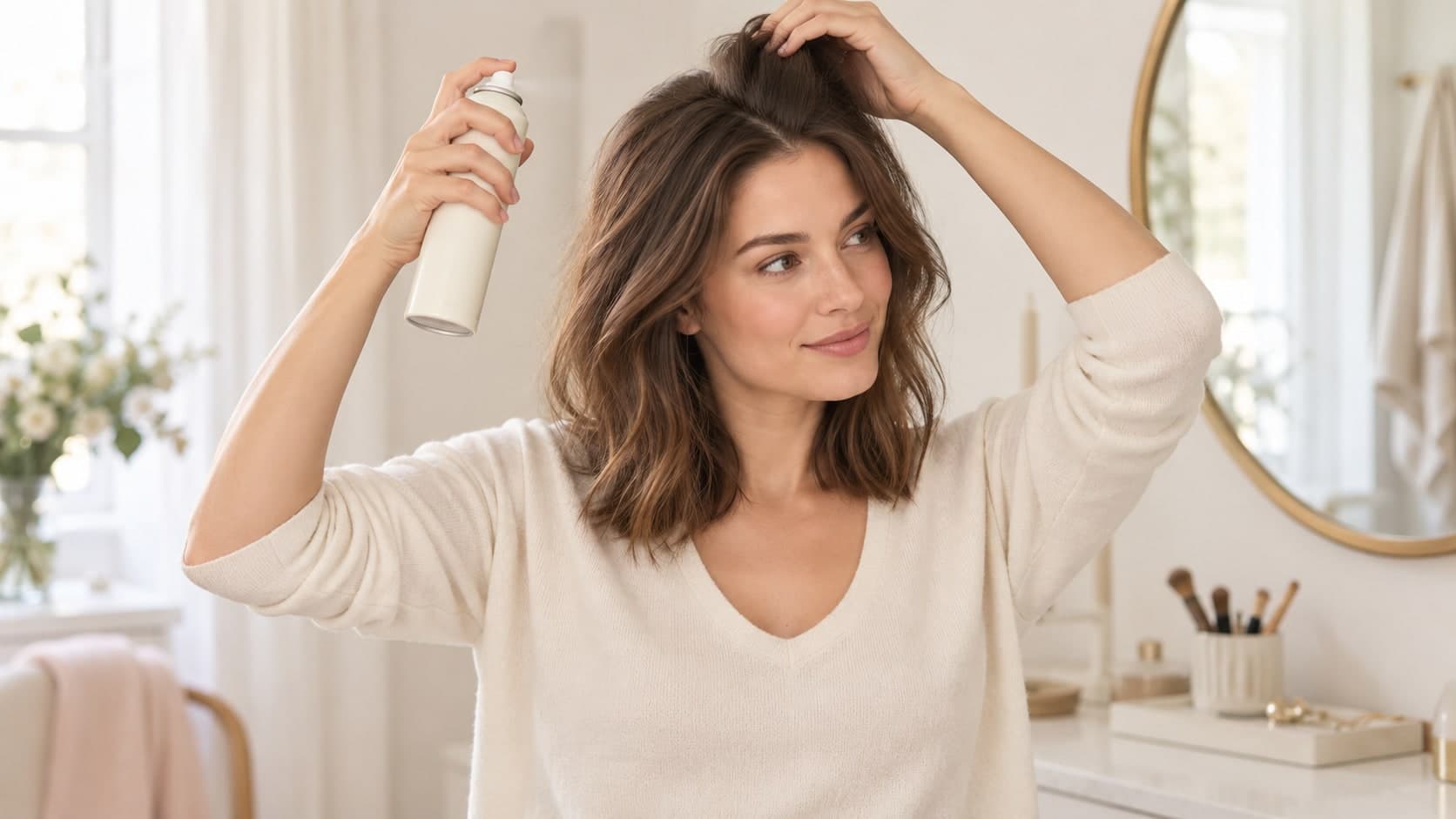
Use dry shampoo on the oily parts of your roots, in small amounts, and finish the removal step on the label before adding more. Keep regular wash days in the routine. Dry shampoo absorbs oil, but shampoo and water remove the product that accumulates on your hair and scalp. The American Academy of Dermatology (AAD) recommends washing after one or two dry-shampoo uses.
This guide draws on dermatology guidance and manufacturers' directions checked on October 1, 2026. We have not tested these products against one another.
Check the formula before you spray
The directions belong to the product in your hand. A spray distance you remember from an old bottle might be wrong for its replacement, and two versions from one brand can have different instructions. Read the can's safety and storage directions as well as its styling instructions.
For the aerosol examples below, start with dry hair. Batiste's FAQ specifically says to let sweaty, damp hair dry before applying its dry shampoo. That matters after exercise: feeling oily and still being wet are different starting points.
Check the removal method, too. If maintaining a curly style means you will not brush your hair, look for directions that accommodate that. Buying a product you cannot comfortably finish using is a poor shortcut.
Apply dry shampoo in five steps
1. Find the areas that need it
Part your hair and look at the roots before spraying. If only your fringe looks oily, begin there. If the crown also needs attention, lift sections to reach it. This gives you a way to judge each area instead of automatically coating your whole head.
2. Shake and section
Both products in the table below require shaking. Batiste also tells users to shake its Volumizing Dry Shampoo between sprays.
Lift the hair enough to reach the roots. Spraying over the surface of a finished style gives you less control over where the product lands. Batiste's application guide recommends sections and short bursts aimed at the root area.
3. Use the distance on your label
These two current directions illustrate why there is no single distance or waiting time to memorize.
| Product | Distance from hair | What the brand says to do next |
|---|---|---|
| Living Proof Perfect hair Day Dry Shampoo | 6 to 10 inches | Wait 30 seconds, then massage and shake out at the roots with fingers, or brush |
| Batiste Volumizing Dry Shampoo | 12 inches | Massage with fingertips, leave for one minute, then brush and style as usual |
Use your pack's instructions if they differ from a website. The table describes these specific products; it is not a ranking or a claim that one distance works better.
4. Finish before judging the result
Set a timer if you tend to rush. Living Proof's 30-second wait comes before its removal step; Batiste's Volumizing directions put massage before the one-minute pause. Keep the sequence attached to the formula.
Once you have completed it, put your hair back into its usual part. Check the fringe, the crown and any section you sprayed underneath. A finished style is easier to assess than hair held up halfway through application.
5. Add more only to an area that still needs it
Living Proof explicitly allows another application if needed, with another shake of the can first. That is different from repeating the whole routine because one patch still looks oily. Work on that patch, then reassess.
If the result already looks right, put the can away. There is no need to use the same amount every time merely because it worked on a previous wash cycle.
Fix a white cast before adding another layer
Visible powder calls for a check of your technique. Batiste advises massaging and brushing away excess to address white residue. Go back through the directions before deciding the product has failed.
On dark hair, a tinted formula is another option to consider. Batiste distinguishes its Brunette shade for lighter to medium brown hair from Dark Hair for deeper brown to black hair. Color choice helps with the appearance of the product; it does not remove the need to work it through.
Tint adds a practical consideration: Batiste's how-to guide notes that colored dry shampoo can get on your fingers and suggests using a brush instead. Check your hands before touching your face or clothes.
If a product repeatedly leaves a finish you dislike after you follow its directions, change the formula. You do not have to keep correcting the same mismatch every morning.
Adapt the finish to curls
For Perfect hair Day Dry Shampoo, Living Proof suggests a diffuser on low heat after the 30-second wait as an alternative to brushing or working through curls with fingers. That advice is specific to this product.
Wash out buildup and watch for irritation
On wash day, concentrate shampoo on your scalp. The AAD's hair-care guidance recommends this to remove accumulated product and oil without unnecessarily drying the lengths. Follow with conditioner suited to your hair: it suggests the ends for fine or straight hair, and the lengths for dry or curly hair.
Wash frequency depends on how quickly your hair gets dirty or oily. Our scalp-care routine covers the wider routine if you are revisiting what you use between washes.
Stop using dry shampoo if your scalp starts itching or burning. The AAD recommends seeing a dermatologist if irritation persists or worsens after stopping.
Cover image: AI-generated editorial illustration.
Get Insider Beauty's weekly email for more product comparisons and beauty deals.