
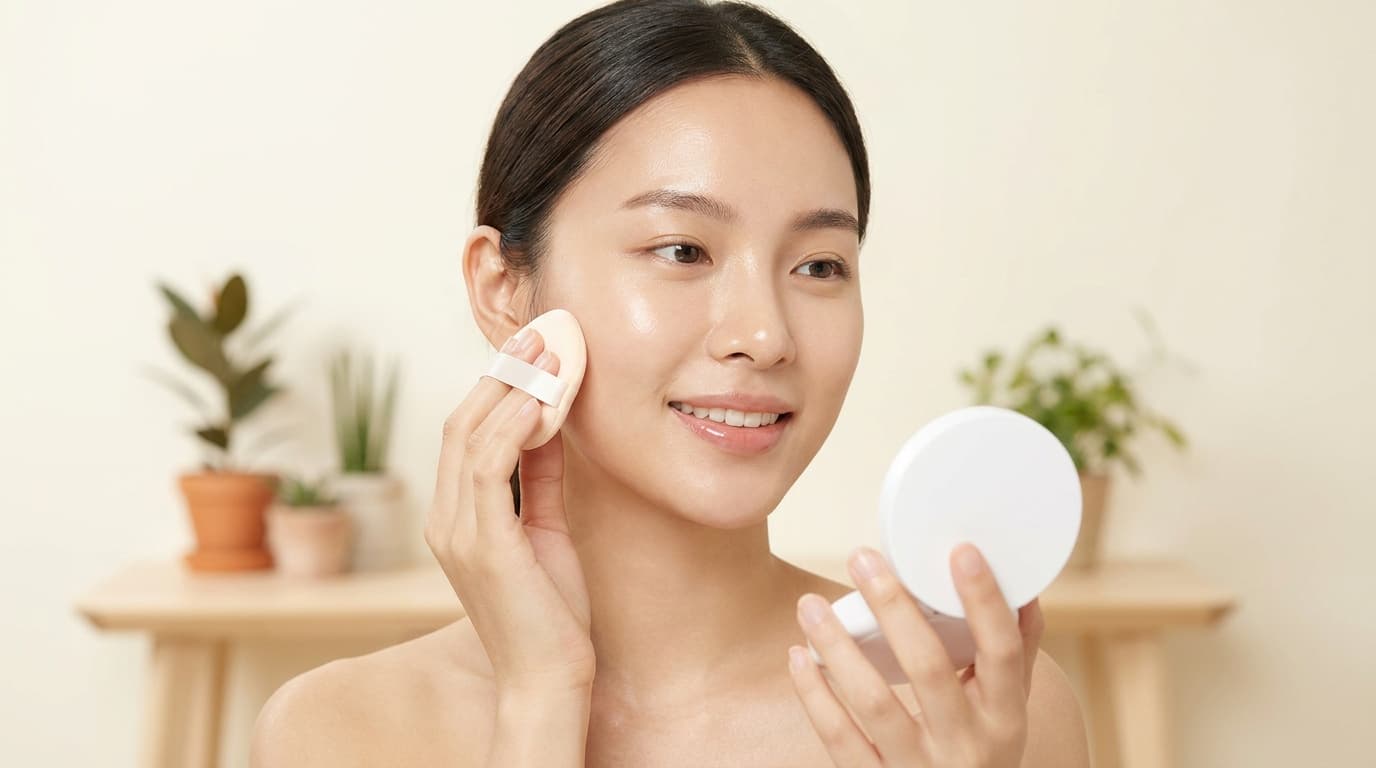
Reapply every two hours outdoors and straight after sweating, swimming or towelling off; that is the FDA label direction and the American Academy of Dermatology (AAD) rule, and foundation does not change it. The honest answer to how to reapply sunscreen over makeup is that one method most reliably delivers a full dose: pressing a light fluid sunscreen on with a dry cushion puff. Sticks come second, SPF cushion compacts third, and mists and powders are touch-ups that deliver a fraction of the SPF on the label.
Quick Takeaways
- The two-hour rule is about the film, not the filters: most modern UV filters are photostable; what fails is the layer thinning, clumping and rubbing off.
- A real face dose is about a quarter teaspoon: SPF is tested at 2 mg/cm2; on a face that is about 1.25 mL, and the AAD says at least a teaspoon.
- Press, do not rub: a light fluid patted on with a washable cushion puff in two thin layers is the most reliable over-makeup route to that dose.
- Powder is a touch-up: at the 85 mg average for face powder, an SPF 50 powder performs at about SPF 5.5.
- Indoors and away from windows, four to six hours is fine: one small study found indoor workers had lost only 16.3% of their sunscreen at two hours.
How often do you actually need to reapply sunscreen?
The Drug Facts panel on every US sunscreen says "reapply at least every 2 hours", and the AAD adds immediately after swimming or sweating. Water resistance is labelled for 40 or 80 minutes of swimming or heavy sweating, then reapply regardless of the clock.
Two hours means two hours since the sunscreen went on, not two hours of sun. Most modern filters are photostable; what degrades is the film, which thins, migrates into creases and gets wiped off by hands, phones and sweat. A higher SPF gives more protection while the film is intact, not for longer.
The indoor evidence is thin. A 2019 UV-photography study of 20 indoor workers found a 16.3% drop in sunscreen at two hours and 28.2% after eight. The Skin Cancer Foundation's Dr Elisabeth Richard allows four to six hours indoors, provided you are not near a window, since UVA passes through ordinary glass. A car side window is still a window; laminated windshields block almost all UV.
Your first reapplication should come early. A 2001 modelling study found that a second coat 20 minutes after going out cuts your UV dose to 60-85% of what a two-hour reapplication delivers, because the first coat is almost always too thin.
How much sunscreen counts as a real reapplication?
SPF is measured at 2 mg of product per square centimetre. Scaled to a face, cosmetic chemist Dr Michelle Wong (Lab Muffin) puts that at a quarter teaspoon, about 1.25 mL; the AAD's more generous rule is at least a teaspoon, about two finger-lengths. Real-world application runs 0.39-1.0 mg/cm2, and protection falls roughly in step with the shortfall.
Makeup shows the effect. Average foundation use is 0.54 g, which takes an SPF 50 foundation to about SPF 34; a single 0.2 g pump performs at about SPF 12.5. So the AAD says cosmetics with SPF still need the two-hour reapplication.
What is the best way to reapply sunscreen over makeup?
Press a light fluid sunscreen on with a dry, washable cushion puff. This is Dr Wong's method, and British Skin Foundation dermatologist Dr Rachel Abbott agrees it works if enough sunscreen goes on.
- Blot shine with a tissue first.
- Squeeze a quarter teaspoon of a lightweight fluid onto the back of your hand, plus a little extra for what the puff absorbs (a foam sponge soaks up more).
- Dab the puff into it and press a thin layer onto the skin-toned areas (forehead, nose, cheeks, chin). Do not swipe.
- Repeat for a second thin layer. In a 2018 PLOS One study of 31 volunteers, a second coat raised the film from a median 0.83 to 1.37 mg/cm2 and cut missed skin from 20% to 9%.
- Press lightly over blush, bronzer and contour last, once.
- Wash the puff afterwards.
It takes two to three minutes, and heavy creams lift foundation, so texture matters more than brand. The cheap option is Neutrogena Ultra Sheer Dry-Touch SPF 55 ($12.99 / 3 oz; all prices US, checked 2 September 2026), a lightweight lotion and the top pick in our Unseen dupes. For a sweaty day, La Roche-Posay Anthelios Melt-In Milk SPF 60 ($25.99 / 90 mL) carries an 80-minute water-resistance claim, though our review notes reports of pilling, so keep the layers thin. Beauty of Joseon Relief Sun SPF 50+ PA++++ ($12-22 / 50 mL by importer) is #3 on our Beauty 100, but our review calls it creamy and notes it has no water-resistance claim, so press it on sparingly and keep it for commute-and-lunch days.
Supergoop Unseen Sunscreen (now SPF 50, $38 / 1.7 fl oz) is the wrong tool here; our review warns it cannot be patted over foundation. Keep it as the morning primer.
Do sunscreen sticks and SPF cushions work over makeup?
Sticks come second. The film is solid, nothing is lost to propellant, and they run easily over the nose, cheekbones, hairline and ears. The catch is the dose: the AAD says four passes back and forth over each area, then rub in, and the rubbing disturbs foundation. One swipe is not four passes. Three good ones are Beauty of Joseon Matte Sun Stick SPF 50+ ($13-21 / 18 g by importer), Shiseido Ultimate Sun Protector Clear Stick SPF 60+ ($33 / 20 g) and Supergoop Glow Stick SPF 50 ($32 / 0.70 oz).
An SPF cushion compact is the press-on method with the applicator built in. No trials exist; cosmetic chemists told NewBeauty a cushion protects as well as any sunscreen if enough goes on, but the puff holds some back and a 15 g pan is about a dozen doses, so wear a dedicated SPF underneath. Round Lab Birch Moisturizing Sun Cushion SPF 50+ ($27 / 15 g) is zinc oxide based with a tone-up cast.
Do SPF setting sprays actually protect you?
Mists do not disturb makeup, which is the appeal and why so little lands on your face. In Dr Wong's 2026 tests, between a fifth and a ninth of what was sprayed landed on the face, and she no longer recommends sprays for reapplication. Aerosols lose more, since only about 40-70% of the can is sunscreen, the rest propellant; a 2019 study of 59 people spraying indoors, with no wind, found roughly 57-61% of the product lost to the air. The AAD says never spray near the face: spray into your hands and apply from there, which defeats the point over makeup.
If you use one anyway, follow the label; the Kate Somerville UncompliKated SPF 50 can says hold it 8-10 inches from the face, eyes and mouth closed, spray in a clockwise motion, never in wind. That spray now appears discontinued, sold out at Nordstrom and Space NK and gone from the brand's site.
Does powder sunscreen work for reapplication?
Treat brush-on powder as a touch-up on a day you have already reapplied. People apply far less powder than the test quantity, and rarely in an even layer: at the 85 mg average for face powder, an SPF 50 powder works out near SPF 5.5.
Colorescience's own protocol shows the ceiling. Its Sunforgettable Total Protection Brush-On Shield SPF 50 ($69 / 6 g) says to brush for at least 60 seconds in multiple passes. When Dr Wong weighed the brush before and after a 60-second application, 0.24 g had left it: 0.65 mg/cm2 on a 360 cm2 face, a third of the test density. The brand also calls the 6 g brush a "90-day supply", which works out to 0.19 mg/cm2 a day.
Cleveland Clinic's Dr Christine Poblete-Lopez says powder should not replace a traditional sunscreen, and the FDA wants more data before it classes powders as safe and effective. Dr Wong's verdict covers the category: no sunscreen powder works well as people normally use it, so a cheaper one does not help.
Which reapplication method should you use today?
- Desk day, no window: a full dose in the morning from our best sunscreen roundup, then a powder or mist top-up after four to six hours.
- Window desk, or commute plus lunch outside: press on a fluid before you go out, or within the first hour, and again after two hours outdoors.
- Outdoor day or exercise: press on a water-resistant fluid or use a stick every two hours and after sweating; wear less makeup.
- Swimming: reapply after the 40 or 80 minutes on the label, and again after towelling off.
The Bottom Line
Buy a washable cushion puff and keep a light fluid sunscreen in your bag; that pairing is the over-makeup reapplication I trust to reach a full dose. Neutrogena Ultra Sheer at $12.99 for an ordinary day, Anthelios Melt-In Milk for a sweaty one, Relief Sun if you already own it. Add a stick for the nose and cheekbones, and use powder for shine, not SPF. Indoors and away from glass, reapply in the afternoon instead of at the two-hour mark.
Want more tips and exclusive beauty deals delivered to your inbox? Pop your email in the box below and join thousands of insiders who save big every week.