
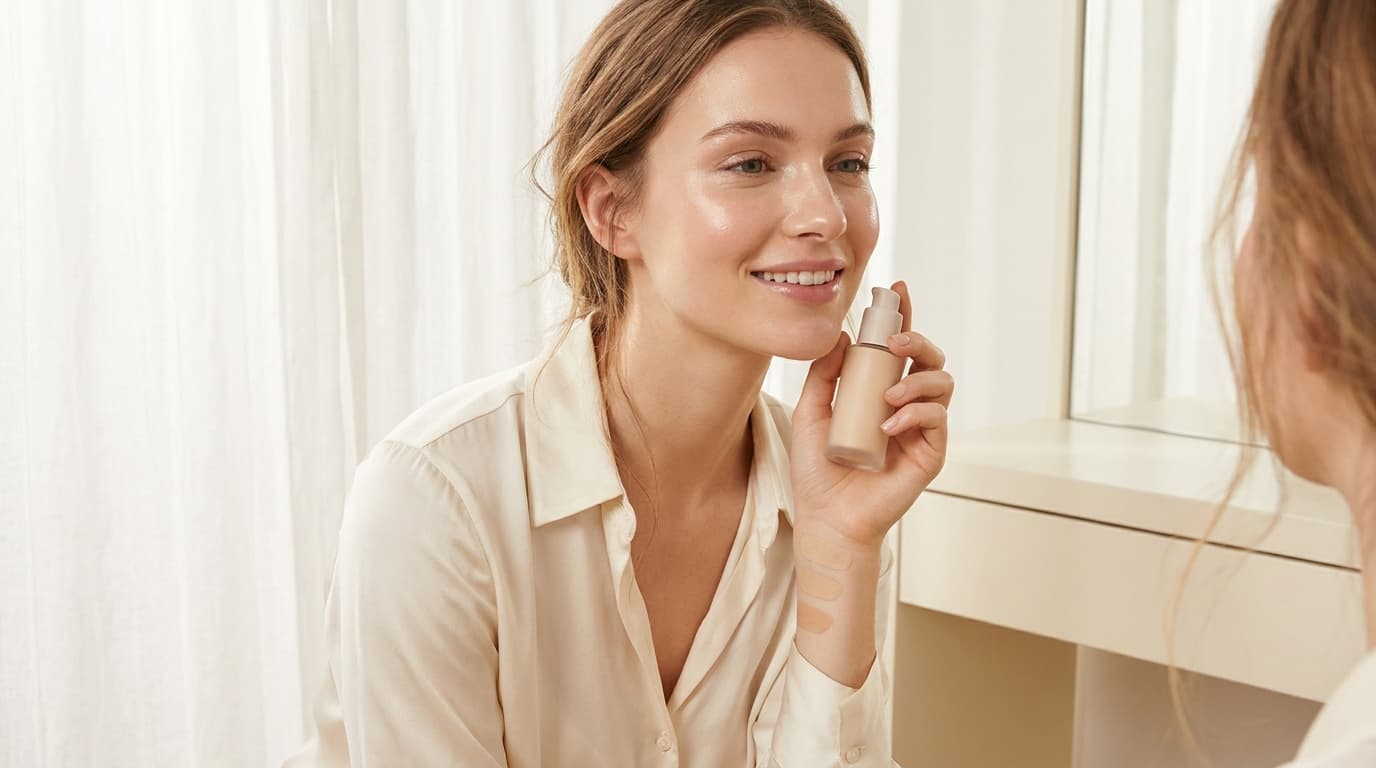
To find your foundation shade match, settle depth first, undertone second, and test on the jaw and neck, never the wrist. Stripe two or three candidate shades from cheek to neck, wait 5 to 10 minutes for the film to dry down, then judge by a window in daylight; the stripe that disappears is your shade. Most bad matches come from reading undertone off vein color and judging testers under shop lighting.
Quick Takeaways
- Depth and undertone are separate axes: brand codes run cool, neutral and warm letters through the whole depth range, so fair does not mean cool.
- Skip the vein test: vein color depends on how light scatters through your skin, not on the surface cast you are matching; use the white-versus-cream drape and the jewelry test instead.
- Swatch at the jaw, wait, then walk to a window: three vertical stripes from cheek to neck and a 5 to 10 minute dry-down before you judge.
- Orange is not always oxidation: a warm shade on cool skin reads orange from the first swatch, and some early darkening is just the product drying down.
- Only the number changes with a tan: keep your undertone letter year-round and move the depth digit.
What is the difference between skin tone and undertone?
Tone is depth, how light or deep your skin reads. Undertone is the color cast beneath it. A 2018 review in the International Journal of Molecular Sciences attributes skin color mainly to epidermal melanin, with smaller contributions from carotenoids and hemoglobin in dermal capillaries. Eumelanin gives brown and black, pheomelanin gives red and yellow, and the ratio between them sets your natural color.
Oxygen-rich hemoglobin near the surface adds the rosy cast we call cool. Pheomelanin and carotene, a yellow-orange pigment, push toward warm. Neutral is a balance of the two rather than an absence of either, which is why one brand's N can lean yellow while another's leans pink. Olive sits on its own axis, a green or gray cast layered over warm or neutral, which is why Fenty's new codes read 226W warm olive and 306N neutral olive.
How do you find your undertone without the vein test?
Makeup artist Terri Tomlinson, creator of the Flesh Tone Color Wheel, says of the vein test: "Not only does it not follow color theory, it doesn't follow logic." Undertone, by her definition, is the dominant color you see first in the skin; veins sit under it and are seen through it. Vein color also varies with skin thickness and the room's lighting, so the test favors light, translucent skin and misses anyone neutral or mixed.
Two tests hold up better; do both by a window with indirect light and no makeup on. For the drape test, lay pure white fabric over one shoulder and cream over the other: cream flattering you means warm, white cool, no difference neutral. For the jewelry test, Healthline's medically reviewed guide reads gold as warm, silver or platinum as cool, and both equally as neutral.
Olive has its own tells: an ashen or gray cast at the jaw, standard shades that look too yellow or too pink at the right depth, and looking equally good in gold and silver.
Where should you test foundation shades?
Not the back of the hand. Hands get different sun exposure from the face and rarely share its undertone, so every professional source we read tests at the jaw and down the neck. bareMinerals' method, echoed by working artists:
- Pick three candidate shades, your best guess and one either side.
- Paint each in a vertical stripe from the cheek over the jawline and slightly onto the neck.
- Wait 5 to 10 minutes; Elise Brill says color keeps shifting for about 15 minutes on oily skin.
- Judge by a bright window or a white-balanced LED mirror. The stripe you cannot find is the match.
Incandescent bulbs run about 2,400 to 2,550 K and warm-white LEDs 2,700 to 3,000 K, both push yellow-orange, so a shade that looks right under store spotlights reads a step too warm outside. Daylight sits between 5,000 and 6,500 K. A north-facing window under clear sky runs 15,000 K and up and pushes everything blue; pick indirect light.
Karol Young Moses says the neck normally runs slightly lighter than the face, so she matches the chest, as does Liz Fuller whenever it will show. If face and neck differ, match the lower one and bring the face up with bronzer.
Why does foundation turn orange or darker?
Two different things get called oxidation. Cosmetic chemist Rhonda M. Davis separates true oxidation, driven by trace metals, some natural oils, a lack of antioxidants, poor storage, and the wearer's sebum and skin pH, from the darkening you see as a product dries. That second effect she pins on hydrocarbons, resins and a high water percentage in the formula. That is what the 5 to 10 minute wait is for.
L'Oreal Paris lists three causes for an orange cast: air oxidizing the formula, skin oils mixing with it, and a shade too dark or too warm for a cool or neutral undertone. If a shade reads orange the instant it goes on, I'd try the same depth one letter cooler before blaming the formula. Some formulas do settle darker: our Fenty Pro Filt'r Soft Matte review notes it can deepen as it sets, so swatch the next-lighter number in your undertone family too.
If your base reliably darkens by lunchtime, Davis suggests a formula with antioxidants, a bottle that stays sealed, a primer or powder between skin and pigment, and lower-pH skincare underneath.
How do you read foundation shade codes?
The shade name usually encodes depth and undertone, so reading it cuts a 50-shade wall to three candidates. Most brands use the same letters; MAC does not. Prices were checked on 2 September 2026.
- Estee Lauder Double Wear (US$52.00 for 1.0 fl oz, 57 shades) reads depth digit, undertone letter, refinement digit: 2N1 Desert Beige is depth 2, neutral; 6W1 Sandalwood is deep warm. Depth runs 0 to 8, and by Estee Lauder's own labels 0 to 2 is lightest through light-medium, 3 and 4 medium and medium tan, 5 to 8 deep through deepest; the last digit refines within a family. More in our Double Wear review.
- L'Oreal True Match (US$13.99 for 1 fl oz, 47 shades) puts the letter first: W3 Nude Beige is warm at depth 3, C5 Classic Beige cool at depth 5. Numbers run 0.5 to 12, banded a little differently per family: roughly 0.5 to 2 light, 2.5 to 4.5 light-medium, 5 to 6.5 medium, 7 to 9 medium-deep, 9.5 up deep, though C9 and N9 already count as deep. The 47 split 16 cool, 14 neutral and 17 warm, and our True Match review has it at rank eight on the Beauty 100.
- Fenty Pro Filt'r is mid-switch. The retiring Soft Matte (US$40 for 32 mL, US$20 while stock lasts) uses bare three-digit codes, 100s to 400s for depth, with undertone only in the description. The Fluid Flex replacement (US$48 for 30 mL, 50 shades, launching 4 September 2026) adds the letter and names olive outright: 226W is light-medium warm olive, 116C light cool rosy.
- MAC runs backwards. NC is the yellow and golden family, NW is pink and rose, and the number is depth, so NW15 is lighter than NW30.
Which foundation shade finder tools measure your skin?
Most do not. Ulta's shade-to-shade finder, Findation and Temptalia's Foundation Matrix all translate a shade you already know into other brands, so they are only as good as the match you feed them. Findation covers over 11,000 products and 106,000 shades and asks you to enter only shades that genuinely matched. Temptalia's gets more accurate with every known match you add, and can also start from undertone and depth alone.
Sephora's in-store Color iQ is free and actually measures your skin rather than translating a shade. Relaunched in September 2021 with a computer-vision lens trained on more than 10,000 skin tones, it reads saturation as a third axis alongside depth and undertone.
Do you need a different foundation shade in summer?
A different number, not a different letter. Makeup artist Dion Xu, in IPSY's seasonal guide, says skin tone changes with the seasons but undertone does not; L'Oreal's True Match advice is to move the number by one and keep the letter. Jouer founder Christina Zilber keeps two shades through the transition months, and L'Oreal Paris suggests mixing the two until one is right. If you can only buy one, L'Oreal's rule is that bronzer darkens a light shade more easily than anything lightens a dark one, so go lighter.
The Bottom Line
If you have never had a shade that worked, get a Color iQ scan at Sephora, then swatch the top three suggestions at your jaw and walk to a window before paying. Own one good match already, and Findation plus the brand's code means you only swatch the right letter. At a drugstore price I'd start with True Match's 47 coded shades at US$13.99 for 1 fl oz; for long wear, Double Wear's 57-shade code at US$52.00 for 1.0 fl oz is the easiest prestige range to translate into. Our best foundation guide ranks both.
Want more tips and exclusive beauty deals delivered to your inbox? Pop your email in the box below and join thousands of insiders who save big every week.