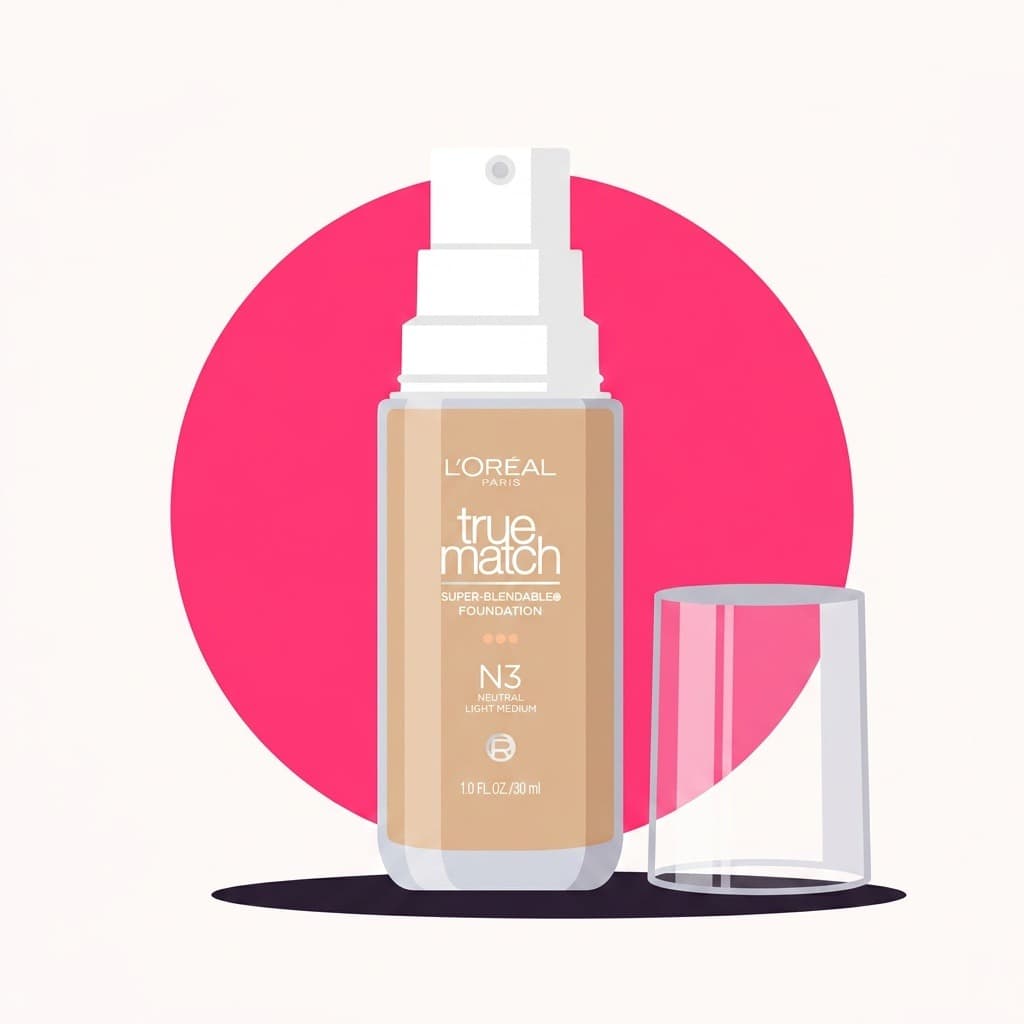
L'Oreal True Match Foundation Review 2026: Worth It?
Our L'Oreal True Match review covers its 47 shades, current formula, coverage, finish, hydration and wear claims, application, value and FAQs.
Evidence-led score using Insider Beauty’s published 100-point editorial rubric. How we score
- Rank
- #8
- Current price
- $13.99
- Listed size
- 1 oz
- Updated

Reviewed bySarah ChenBeauty Editor ·
Editor’s cut
At a glance
The current U.S. pump formula has 47 shades organized by cool, neutral and warm undertones.
It provides medium buildable coverage with a natural finish rather than a specialist matte, dewy or full-coverage result.
Glycerin and sodium hyaluronate support the hydration brief, but no independent finished-product trial verifies 24-hour hydration.
L'Oreal's 99% shade-match result came from a 312-woman consumer test whose full protocol is not published.
At $13.99 for one fluid ounce, it is strong value when one bottle matches without extra mixers or primers.
Community signal
Would you buy it again?
Live retailer check
Where to buy
Insider Beauty may earn a commission on purchases made through links in this article. See our disclosure.
Verdict
L'Oreal Paris True Match Super-Blendable Foundation takes rank eight in the founding Beauty 100 on range, usability and value. The current U.S. line has 47 shades split across cool, neutral and warm undertones, a pump bottle, medium buildable coverage and a natural finish for $13.99. That is a broad, practical foundation offer at a price that leaves room for the occasional wrong-shade return.
The formula is best for someone who wants skin to look more even without the flatness of a dedicated matte base or the shine of a dewy tint. It is fragrance-free, marketed as non-comedogenic, and uses a silicone-rich liquid base with glycerin and sodium hyaluronate. Dry skin still needs proper preparation, while very oily skin may want more targeted shine control.
Its evidence has a clear ceiling. L'Oreal says 99% of 312 women found a True Match and claims up to 24 hours of hydration and wear. The brand does not publish the complete consumer-test protocol or a peer-reviewed trial on this finished foundation. The 47-shade count is verifiable. A guaranteed perfect match, all-day finish or skincare transformation is not.
The exact True Match formula reviewed
This page covers the current U.S. True Match Super-Blendable Skincare Infused Foundation in the pump bottle. It is the 2023 reformulation with 47 shades, hyaluronic acid and up to six pigments per shade. It is not True Match Nude Hyaluronic Tinted Serum, True Match powder, an older SPF bottle or a formula sold in another country.
L'Oreal's reformulation announcement says the update added nine shades, taking the line from 38 to 47, and replaced the pour bottle with a pump. The formula is described as vegan, alcohol-free, oil-free and fragrance-free. Existing shade numbers and the cool, neutral and warm system remained in place.
This version control is important because retailer reviews can stretch back years. A complaint about a discontinued SPF version or a capless glass bottle may be genuine but does not describe the ranked product. Ingredient lists also vary by country. The U.S. formula code and current U.S. pages are the reference points for this review.
Coverage, finish and wear claims
The official brief is medium, buildable coverage with a lightweight, natural finish that is neither very matte nor very dewy. That makes True Match more flexible than a full-coverage long-wear base. One thin layer should even tone while leaving more natural variation visible; a second targeted layer can add coverage where it is needed.
L'Oreal now says the product delivers up to 24 hours of hydration and wear. The current official product page does not provide a sample size, comparison product, climate, application amount or scoring method for that claim. "Up to" also describes a best-case ceiling, not the result every wearer should expect.
No independent finished-product wear study was found. Oil production, skincare, sunscreen, application amount and powder can all change the result. Someone buying foundation for heat, sport, a wedding or a very long shift should test the complete routine before the event rather than treating 24 hours as a promise.
What is in the formula
Water comes first, followed by dimethicone, isododecane, cyclohexasiloxane and glycerin. Other silicones, glycols, film-formers and powders help the liquid spread, set and soften the look of texture. The shade pigments can include titanium dioxide, iron oxides, ultramarines and chromium oxide greens, depending on the bottle.
This is often called a silicone-based foundation because dimethicone and cyclohexasiloxane sit high in the list, although water is the first ingredient. The internet's water-versus-silicone binary is too crude to predict pilling. The sunscreen, moisturizer, application amount and drying time matter as much as the first few names on a label.
The skincare language needs similar restraint. Glycerin is fifth and is a well-established humectant in cosmetic formulas. Sodium hyaluronate, the salt form of hyaluronic acid, appears near the end of the list, and L'Oreal does not disclose its percentage or molecular weight. Panthenol, hydroxyethyl urea and aloe powder also appear. These can contribute to formula feel and hydration, but True Match is still makeup rather than a replacement for moisturizer.
A controlled study of four unspecified foundation products found lasting moisturization only in the formulas containing hygroscopic moisturizing ingredients. The study indexed on PubMed shows that hydrating foundation is a plausible category, not that True Match itself has independently proven 24-hour hydration.
The 47-shade system
The current U.S. range includes 16 cool shades, 14 neutral shades and 17 warm shades. Depth labels run from light through light medium, medium, medium deep and deep. The code combines undertone and depth: C for cool, N for neutral and W for warm, followed by a number.
That structure is more useful than a row of poetic shade names. It lets someone narrow the shelf before comparing adjacent depths. The six-pigment approach also permits blue or green colorants in some shades, which can help build undertones that are difficult to reach with red, yellow, black and white pigments alone.
L'Oreal has published research on why both depth and undertone matter. A company-authored study measured skin color in French and American Caucasian, Japanese, African-American and Hispanic-American groups. It found broad variation within groups and overlapping color spectra between groups. The paper on PubMed supports a continuous color approach rather than treating ethnicity as a shade. It was not a validation study of today's 47 True Match bottles.
Forty-seven is a strong count, but count alone cannot prove even spacing or an exact match for every complexion. The manufacturer's 312-person consumer test found that 99% selected a match. L'Oreal does not publish participant depth distribution, store lighting, who judged the result or the acceptance threshold. Treat that percentage as encouraging brand evidence, not a universal guarantee.
How to find a True Match shade
Start with the C, N or W family, then choose two or three neighboring depths. Undertone quizzes can narrow the options, but wrist veins are unreliable when used alone. Surface redness, tanning, hyperpigmentation and lighting can all distort the first impression.
Swatch a small amount along the jaw and toward the neck rather than relying on the hand. Check it in indirect daylight and ordinary indoor light. Let the swatches dry before deciding, because a wet foundation can change as volatile ingredients evaporate and it meets skin oil. The goal is the least visible boundary across the face, jaw and neck, not the shade that looks brightest in a store mirror.
If two shades are close, choose based on the area you prefer to match and the season in which the bottle will be used most. Mixing adjacent shades is possible, but it turns a $13.99 foundation into a $27.98 system and makes daily dosing less repeatable. A retailer with practical returns is valuable when no samples are available.
How to apply it
Shake the bottle well. The pigments and liquid base need to be evenly dispersed before the pump is pressed. L'Oreal recommends applying it with clean fingertips and blending with a damp sponge in outward motions. Ulta's current product listing also permits fingertips or a sponge and confirms the one fluid ounce size.
Begin with a small amount in the center of the face, where redness and unevenness are often more visible, then blend toward the perimeter. Add a second thin layer only where more coverage is wanted. Repeated heavy layers work against the skin-like finish and make settling around dry texture more likely.
Let skincare and sunscreen set before applying foundation. On dry skin, use enough moisturizer to smooth flakes without leaving a sliding film. On oily skin, keep rich preparation to the areas that need it and apply powder selectively rather than flattening the whole face. Makeup does not replace sunscreen. The current U.S. True Match bottle carries no SPF claim.
Who it is best for
True Match suits normal, combination and moderately dry skin looking for everyday medium coverage. Its natural finish also works for someone who dislikes choosing between a luminous skin tint and an oil-control matte foundation. The shade system is especially useful for buyers who already know whether they lean cool, neutral or warm.
Sensitive skin may appreciate the absence of added fragrance and denatured alcohol. L'Oreal says the foundation is dermatologist-tested and non-comedogenic. Those are helpful screening facts, not a tolerance guarantee. Patch testing on the jaw and wearing the complete routine for a day is more informative than an ingredient blacklist.
Acne-prone skin can use makeup, but True Match contains no acne treatment. Remove it thoroughly each evening and avoid sharing pumps, sponges or brushes. If breakouts follow one product consistently, stop using it rather than assuming that a non-comedogenic claim rules out an individual response.
Very oily skin, people who need full camouflage in one pass, and anyone prioritizing transfer resistance may prefer a foundation with a more explicit matte or long-wear design. Very dry, flaky skin may find a sheer hydrating tint more forgiving until the underlying dryness is controlled.
Does True Match oxidize?
"Oxidize" is the common word for foundation that looks darker, yellower or redder after application. Several processes can contribute, including evaporation, pigment wetting, interaction with sebum and the contrast created as the rest of the makeup sets. A bottle can behave differently on two routines.
A 2026 laboratory paper developed a dynamic sebum model because static tests did not represent color shift well. The study on PubMed confirms that formula, time and sebum conditions matter. It was conducted by Estée Lauder researchers and did not test True Match, so it cannot supply a True Match oxidation rate.
The practical answer is to wait for a jaw swatch to dry and check it again after a few hours over the skincare normally worn. If the shade repeatedly deepens beyond an acceptable match, a lighter bottle is not always the best fix because the undertone may also have shifted. Changing the underlying product or choosing another formula can be more reliable.
Price and value
The official and Ulta prices were both $13.99 for one fluid ounce on August 29, 2026. That is about $0.47 per milliliter. The pump helps control waste, and the shade range gives the product an advantage over similarly priced lines with fewer undertone options.
Value drops quickly when a buyer needs two bottles to mix a shade or a separate primer and powder to make the finish last. It improves when one shade works year-round and a light layer gives enough coverage. The base price is low enough to justify a careful trial, but the best value foundation is still the one that matches without repair work.
Drawbacks and reasons to skip it
The biggest drawback is the distance between verifiable facts and expansive copy. Forty-seven shades, a pump and the ingredient list are concrete. "Virtually guaranteed" matching, visible long-term improvement and 24-hour performance depend on brand testing that is not fully published.
The range also creates shopping friction. Two adjacent numbers can look similar in a bottle, while the same shade can photograph differently across retailer screens. Online matching tools are a starting point, not a replacement for a dry swatch in useful light.
The natural finish is deliberately middle-of-the-road. That is why True Match works for many people and why it may disappoint anyone seeking glassy radiance, aggressive oil control or opaque coverage. Sodium hyaluronate in the list does not make a dry patch disappear, and an oil-free claim does not make the product self-setting on oily skin.
Skip it if fragrance-free medium coverage is not the actual brief. A specialist finish will usually outperform a versatile foundation at its own narrow job.
Sources and methodology
This is an evidence-led editorial review, not a claim of staff wear testing. Insider Beauty checked the current U.S. formula, size, price, shade map and application directions against brand and retailer pages. Manufacturer consumer results are labeled as such. Peer-reviewed studies are used only to explain foundation hydration, skin-color measurement and color shift in context; none is presented as an independent trial of True Match.
Sources used for this review:
- L'Oreal Paris True Match official U.S. product page
- L'Oreal Paris 2023 True Match reformulation announcement
- Ulta True Match Super-Blendable Foundation listing
- Controlled foundation moisturization study
- L'Oreal-authored study of skin color and makeup strategies
- Laboratory foundation color-shift model
Useful details
Frequently asked questions
Is L'Oreal True Match Foundation good?
It is a strong everyday option for medium buildable coverage, a natural finish and a broad undertone-coded range at $13.99. It is less suited to someone who needs one-pass full coverage, a very matte finish or documented transfer resistance.
Is True Match Foundation full coverage?
No. L'Oreal describes it as medium and buildable. Thin layers can add coverage, but repeated heavy application works against the lightweight, skin-like finish.
Is L'Oreal True Match good for dry skin?
The formula contains glycerin, sodium hyaluronate and other humectant ingredients, and the finish is not aggressively matte. Dry or flaky skin still needs suitable preparation. The brand's 24-hour hydration claim has no fully published independent protocol.
Is L'Oreal True Match good for oily or acne-prone skin?
L'Oreal markets it as oil-free and non-comedogenic, but it is not a dedicated oil-control or acne-treatment product. Oily skin may need selective powder, while acne-prone users should remove it thoroughly and stop if a repeatable reaction occurs.
How do I find my L'Oreal True Match shade?
Choose the cool, neutral or warm family, then swatch two or three neighboring depths along the jaw. Let them dry and check them in indirect daylight and indoor light. The best match has the least visible boundary across face, jaw and neck.
Does L'Oreal True Match oxidize?
No direct independent study provides a True Match oxidation rate. Foundation color can shift as volatile ingredients evaporate and the formula meets skin oil. Test a dry jaw swatch over the skincare normally worn and check it again after a few hours.
Is True Match water-based or silicone-based?
Water is first, but dimethicone and other silicones sit high in the ingredient list. Calling it silicone-rich is more useful than forcing it into one category. Pilling depends on the complete skincare and sunscreen routine, amount and drying time.
Does L'Oreal True Match Foundation have SPF?
The current U.S. Super-Blendable pump formula carries no SPF claim. Pigments such as titanium dioxide in a color-cosmetic ingredient list do not turn the product into tested sunscreen. Use a properly labeled sunscreen underneath.
Did L'Oreal change the True Match Foundation formula?
Yes. The ranked product is the current U.S. pump version introduced in 2023, with a vegan, fragrance-free formula and a 47-shade range. Reviews of older pour bottles, SPF variants or non-U.S. formulas may not describe it.