Best makeup brushes: the small kit I'd buy first
 Published · Prices checked
Insider Beauty may earn a commission on purchases made through links in this article. See our disclosure.
My verdict: I'd start with Real Techniques Expert Face RT 200 for foundation, e.l.f. Putty Blush Brush for cream color, and Real Techniques Setting RT 402 for powder where you need it. Together, they're $24.50 at the checked prices. Add a concealer or eye brush for a job those three can't do. The catch: this kit favors controlled placement over fast, all-over powdering.
Jump to a section
Five quick takeawaysThe brushes at a glanceReal Techniques Expert Face RT 200: my first buy for foundatione.l.f. Putty Blush Brush: the $6 cream-color pickReal Techniques Setting RT 402: powder exactly where you want itSephora Collection PRO Concealer #71: a useful specialistMAC 217 Synthetic Blending Brush: the optional eye upgradee.l.f. Eyeshadow “C” Brush: inexpensive color placementHow I'd build the kit without buying all sixFAQsFive quick takeaways
- Start with three face brushes for $24.50: RT 200, e.l.f. Putty Blush and RT 402 cover liquid foundation, cream blush and targeted powder.
- Buy a shape for the task: a dense foundation dome, tapered blush head and small powder brush give you three useful choices.
- Spend $24 on Sephora #71 only if you want more precise concealer application: fingers may already do everything you need.
- Keep eye placement and blending separate: the $6 e.l.f. Eyeshadow “C” Brush is the inexpensive starting point; MAC's $32 blender is an optional addition.
- Check the exact brush number: today's synthetic MAC 217 is different from the older natural-hair version discussed in many reviews.
The brushes at a glance
| Brush | US price, one brush | I'd use it for | Main limitation |
|---|---|---|---|
| Real Techniques Expert Face RT 200 | $10 | Liquid or cream foundation | Too broad for pinpoint concealer |
| e.l.f. Putty Blush, 84115 | $6 | Controlled cream blush | Small for all-over base |
| Real Techniques Setting RT 402 | $8.50 | Targeted setting powder | Slow for powdering the whole face |
| Sephora Collection PRO Concealer #71 | $24 | Under-eyes and nose contours | A costly extra if fingers suffice |
| MAC 217 Synthetic Blending Brush | $32 | Softening powder shadow edges | Dense; use restraint with strong color |
| e.l.f. Eyeshadow “C”, 84008 | $6 | Placing color on the lid | Broad for fine liner or tiny details |
Prices checked October 29, 2026, before tax and shipping. Real Techniques prices are from Ulta; the other prices are from the brands' US sites. All six have synthetic bristles. Each was available to order at its checked retailer; availability can change.
Real Techniques Expert Face RT 200: my first buy for foundation
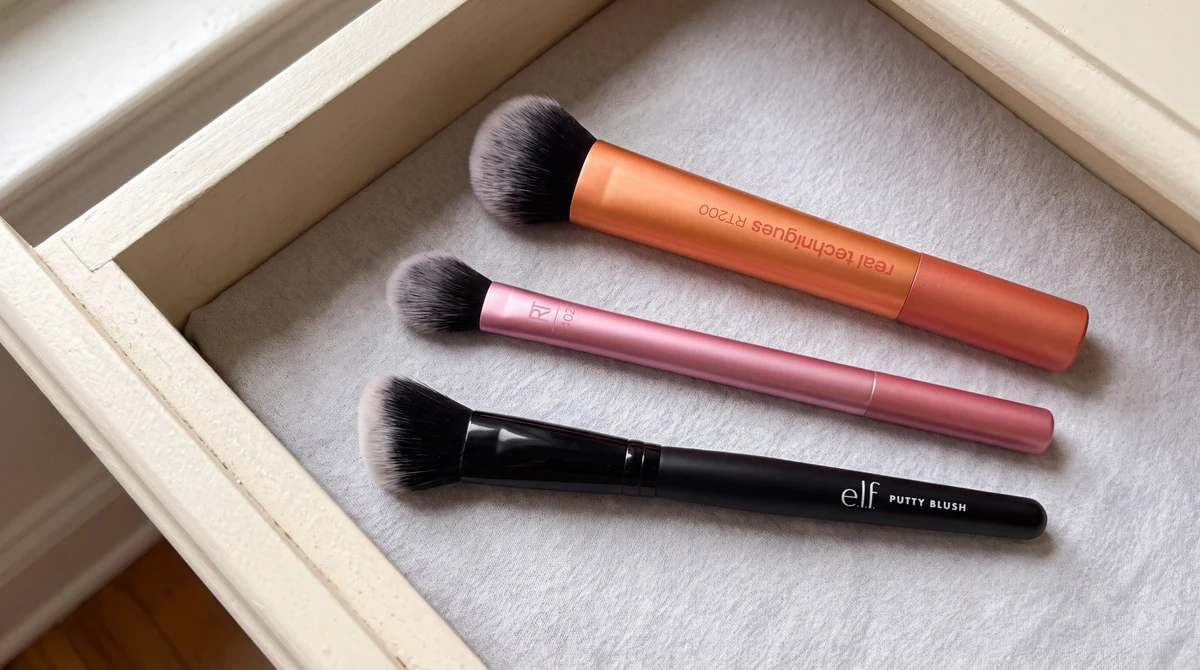
The Expert Face has a dense, domed head intended for liquid and cream foundation. That's the shape I'd choose for someone who wants to move beyond fingers without buying an expensive base brush. The rounded surface gives you room to work across cheeks, while its edges offer more control around the nose than a large powder head. Real Techniques specifies RT 200; Ulta lists the single brush at $10.
I'd start with a small amount of foundation on the face and use light buffing motions, adding more only where coverage is missing. Keep that first layer thin.
Its limitation is precision. A dome sized for foundation is an awkward choice for a tiny blemish or the inner corner of the eye. If that's where your base needs work, the Sephora brush below serves a different purpose. If your routine is skin tint blended with fingers, you may not need RT 200 at all.
Shop the single Expert Face brush on Amazon.
e.l.f. Putty Blush Brush: the $6 cream-color pick
I like the logic of giving cream blush its own smaller brush. The e.l.f. Putty Blush Brush has a tapered, duo-fiber head designed for cream and putty blush or bronzer. Both fibers are synthetic; “duo-fiber” here doesn't mean a mixture of animal hair and synthetic bristles. The current brush is SKU 84115 and costs $6.
For concentrated cheek color, I'd put a little product on the tips, then tap it onto the cheek before blending the edges. The brand also recommends stippling. That gives you a deliberate starting point instead of spreading a large dollop and trying to remove the excess.
I'd choose this over using the foundation brush for everything. Keeping the tools separate makes it easier to avoid mixing leftover foundation into a fresh blush color. You still need to wash both.
The small head is the compromise. It makes sense for cheeks, but I wouldn't buy it to cover my entire face with foundation. Nor does its Putty name mean you need to own e.l.f.'s matching blush; the relevant part is the cream texture.
Real Techniques Setting RT 402: powder exactly where you want it
A large powder brush is useful for a broad sweep. I'd choose the Real Techniques Setting Brush RT 402 when the goal is smaller: setting the sides of the nose, a little under-eye concealer or the middle of the forehead while leaving other areas alone. Its tapered head gives that job more control. The single brush is $8.50 at Ulta.
Real Techniques also lists powder and cream highlighter among its uses. I would keep a powder-setting brush free of cream residue during the same application, rather than expect one head to switch between the two without cleaning.
The trade-off is speed. If you wear powder foundation across your whole face, this is too small to be my only powder brush. For a routine built around liquid base with powder in selected areas, its size is the reason to buy it. Take a little powder, remove the excess, then build only if that area needs more.
Sephora Collection PRO Concealer #71: a useful specialist
The PRO Concealer Brush #71 is the first optional purchase I'd consider if concealer does more work than foundation in your routine. Its synthetic head has a tapered, fingertip-like shape, and Sephora recommends it for liquid and cream concealer. The current US item is 2290278, priced at $24.
That shape appeals to me for the curve beside the nose and under-eye placement, where a foundation brush can feel oversized. I'd apply a thin amount, then tap around the edge instead of repeatedly sweeping through the center of the coverage.
There is professional support for this specific pick: makeup artist Al-Amin told Who What Wear that its density balances coverage with blending, and described using it for under-eye and spot work.
At $24, though, this brush alone costs almost as much as the entire three-brush face kit. I wouldn't make it a compulsory purchase for someone happy with fingertip application. And for a very small mark that needs a precise dot of concealer, I'd still look for a finer tip rather than assume every “concealer brush” does the same job.
MAC 217 Synthetic Blending Brush: the optional eye upgrade
The current MAC 217 Synthetic Blending Brush costs $32 and has a dense oval head for powder or cream products. You'll also see it called 217S. I'd consider it for someone who regularly wears powder eyeshadow and wants a separate brush for softening the edge after placing the color.
Be careful with the version. The older natural-hair 217 has a reputation of its own, and that doesn't establish how today's synthetic brush performs. In her comparison, Nikki From HR found the synthetic version denser and more rounded, depositing more color while still blending well. Her natural-hair comparison brushes were about six years old, a limitation she notes herself. She also questioned the synthetic brush's value at full price.
That makes my recommendation quite specific: consider it for its current shape, with a light hand around strongly pigmented shadow. Don't buy it expecting an exact replacement for a much-loved old 217. At $32, it would come after the basic face brushes in my shopping order, and after the $6 lid brush below if you mostly wear one shade.
e.l.f. Eyeshadow “C” Brush: inexpensive color placement
The e.l.f. Eyeshadow “C” Brush is $6, SKU 84008. Its curved, medium-size synthetic head works with wet or dry products. I'd give it the straightforward job of placing shadow on the lid and building color at the outer corner.
Press color where you want it, then turn the brush to work with its edge. For a simple wash of shadow, I would buy this before a premium blending brush.
Its size is also why I'd skip it for a narrow line along the lashes or a tiny inner-corner highlight. It isn't the detail brush for every eye shape. And although e.l.f. describes it as a blending brush too, my preference for a more elaborate eye look is to keep a second brush clean for the final edges. That avoids carrying the same concentrated color farther out while trying to soften it.
How I'd build the kit without buying all six
For liquid foundation, cream blush and a little setting powder, the first three are the $24.50 starting kit. Add the e.l.f. eye brush and the total is $30.50. That's where I'd stop until the routine reveals a missing tool.
If you use fingers for base, leave out RT 200 and put that $10 toward the brush you'll use more often. If you skip powder, leave out RT 402. Someone who wears only concealer and blush has different needs from someone doing a full powder eye look.
I'd compare sets using the cost of the brushes I actually want. A six-piece set at $30 isn't automatically cheaper than two $10 brushes if four of the set's shapes will stay in the bag. Check brush numbers too: a similarly named brush bundled in a set isn't necessarily the same head as the individual version.
For the makeup itself, our best makeup guide can help you match the formulas to the tools you need.
FAQs
Are expensive makeup brushes worth it?
Sometimes, when the shape solves a problem your current brush doesn't. I'd pay for better access around the nose or an eye brush that fits my lid before paying simply for a matching handle. Price alone doesn't establish softness, shedding resistance or how a brush will hold up through years of washing. The $6 and $10 options here keep the basic kit inexpensive; the two pricier brushes are specialist choices.
Should I choose synthetic or natural bristles?
I'd start with synthetic bristles for this liquid-and-cream-heavy kit. Every brush here is synthetic and has a stated use that suits its assigned task. Natural hair isn't required to apply powder either, as RT 402 illustrates. Look at density, head shape and the formula you want to apply before treating material as a quality ranking.
How often should I clean makeup brushes?
The American Academy of Dermatology recommends washing brushes every seven to ten days. Rinse and clean the tips without soaking the whole head, then dry brushes flat with their tips hanging over an edge. Our at-home brush-cleaning guide covers the routine; the brushes and sponges guide covers both types of tool. Leave enough drying time before your next application.
Spotted a changed brush number, price or discontinued shape? Tell us through our contact page, including the exact product name so we can check it.