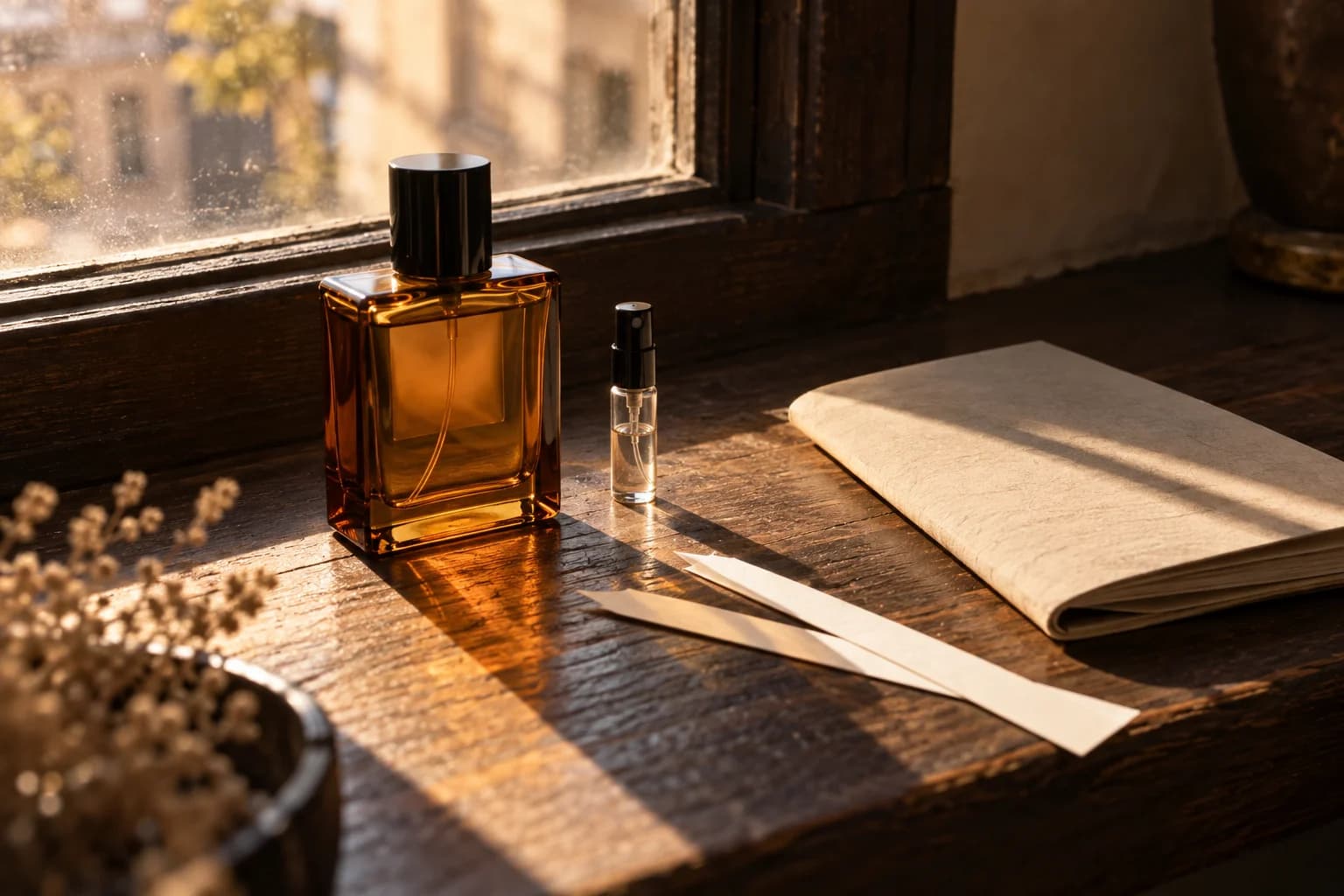
Where we’d start
Sample contrasting scent directions, keep the exact version name and choose bottle size only after deciding what you enjoy wearing.
Start with a preference you can explain
Think about smells you already enjoy: citrus peel, herbs, wood, flowers or warm spices. You do not need to know perfumery vocabulary to give someone at a counter a useful starting point. Mention things you dislike too; that can narrow the choice more quickly than asking for something nice.
Jo Malone's fragrance guide recommends learning the notes you enjoy and trying scents on skin. I'd use that approach without assuming that a note list predicts the whole perfume. A description is a way to select candidates; it is not a substitute for smelling the finished fragrance.
There is no reason to stay on a strictly men's shelf if another scent interests you. A marketing category does not have to decide what you enjoy. The practical question is whether you want to wear it, rather than whether the bottle's styling matches an expected idea of masculinity.
Source: Jo Malone London: a guide to choosing fragrance (opens in a new tab)
Give the first sampling session a clear contrast
I'd choose two different descriptions rather than try a long row of bottles with nearly identical briefs. Original Montblanc Explorer offers a woody, aromatic and leathery direction. If that sounded appealing, I'd use it as one candidate and look for a distinctly different second option.
The aim is to learn a preference you can describe afterwards. Did the woody direction interest you, or would you rather have something more citrus-led or aquatic? That information helps with the next sample even if neither first choice becomes the bottle you buy.
Write the full name on each blotter and photograph the bottle. A description such as the dark one with the silver cap is not enough for ordering later. The retailer's job is easier too if you can identify what you tried and what you liked about it.
Source: Montblanc: original Explorer EDP description (opens in a new tab)
Keep the full version name
Concentration and range names matter because similar packaging can contain different fragrances. Prada Carbon is a useful current example. The Eau de Toilette reviewed in this edit has an aromatic-lavender and mineral-woody description. Prada's Carbon Eau de Parfum instead names lavender, liquorice and cypress and is classified as gourmand.
I'd therefore treat the EDP as a separate sample, rather than an automatic upgrade to the EDT. The same principle applies to versions called Intense, Elixir or another range name: check the actual scent being sold before comparing the prices.
This is one of the easiest expensive mistakes to avoid. Save the full name, concentration and size while the sample is in front of you. When a retailer's offer appears later, compare those details before deciding it is a bargain.
Source: Prada: Carbon Eau de Parfum's different scent brief (opens in a new tab)
Wear a candidate before buying the full bottle
If a sample or skin trial is available, I'd give a candidate its own day. Notice the first impression and return to it later, once the initial excitement of choosing something new has passed. I want to know whether I keep enjoying it, not just whether the opening is impressive.
Keep that trial close to the intended use. A fragrance for an ordinary workday needs to fit the commute and shared space as well as the first few minutes at home. An evening fragrance may answer a different preference. There is no requirement that the first bottle do every possible occasion.
If I wanted someone else's view, I'd ask directly. I wouldn't use a general reputation for compliments as a promise, or assume everyone nearby wanted to experience a strong application. My own enjoyment matters, and so does consideration for the space.
Source: Jo Malone: trying fragrance on skin (opens in a new tab)
Strength is not the same as value
I'd resist choosing by an online wear-time league table. Different reviewers use different amounts, settings and methods, and their experience is not a guarantee for another person. A scent that lasts a long time but becomes unpleasant to you is poor value as a personal purchase.
The concentration label is useful identification, but it does not provide a controlled comparison between unrelated perfumes. Jo Malone, for example, explains that its use of cologne does not simply mean the same strength or trail across every product. Naming conventions need the individual product's context.
My preference would be a scent I enjoyed at a level that suited its use. If I needed stronger performance for a particular reason, I'd test that during sampling. I wouldn't let strength become the default measure of quality before deciding what I wanted to smell like.
Source: Jo Malone: fragrance naming and concentration context (opens in a new tab)
Choose the bottle size after choosing the scent
Set a total budget before comparing price per millilitre. A larger bottle can offer better unit value and still be the wrong amount for a first purchase. The smaller size may cost more per millilitre while leaving less money tied up in a preference that is still developing.
Carbon EDT illustrates the decision. Scentstore's prices checked on 29 October 2026 were £75 for 50ml and £97 for 100ml, before delivery. Another £22 doubles the quantity. That is appealing for an established favourite, but it remains another £22 spent if you are unsure how often you will wear it.
Gift sets deserve the same calculation. A shower gel and miniature add value if you actually want them. They should not distract from whether the fragrance itself is the right one. Compare the exact contents rather than the size of the box or the discount percentage.
Source: Scentstore: Carbon EDT size-specific UK prices (opens in a new tab)
A first bottle does not need to become a collection
I'd choose one fragrance I liked and let using it teach me what I wanted next. You may discover a preference for a lighter citrus direction, a woodier base or a different scent for another occasion. That is useful information gained through use, rather than a reason to buy several bottles immediately.
If neither sample convinced me, I'd leave without a bottle. That is a successful result when the alternative is spending a substantial amount on a scent I only half like. A shortlist should reduce the cost of a mistake, not make a purchase feel compulsory.
Keep the sample details and a few ordinary notes: the full name, what you enjoyed, what you disliked and where you imagined wearing it. Those are better prompts for the next counter visit than trying to remember which bottle an online ranking placed first.
Research behind this guide
This guide uses brand guidance, exact product examples and dated retailer prices reviewed on 29 October 2026. These are editorial sampling recommendations. We have not measured longevity or projection in a controlled wear test.
Sources checked 29 October 2026.