
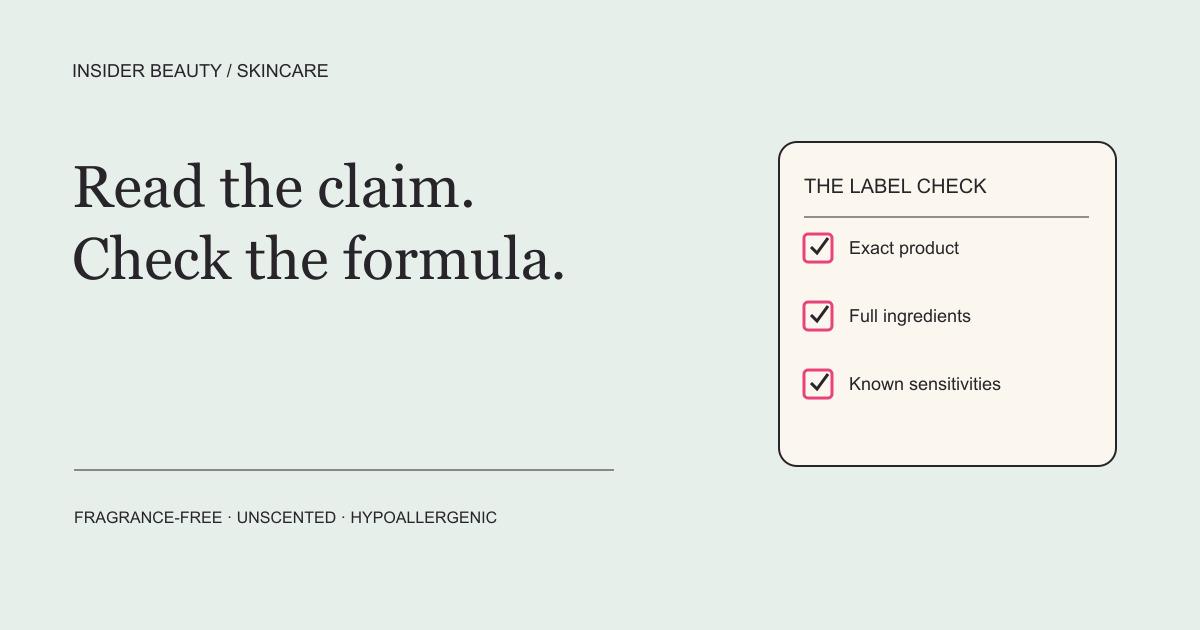
If I wanted to avoid added fragrance, I'd start with a fragrance-free product and read its full ingredient list. “Unscented” and “hypoallergenic” would not be enough on their own. For a known allergy, the useful question is whether the exact formula contains your trigger, regardless of how reassuring the front of the bottle sounds.
Aveeno Calm + Restore, Neutrogena Hydro Boost Water Gel and Vanicream illustrate three different ways these claims appear when you shop. The examples below were checked on 15 November 2026 and refer to the specified regional products.
What the three labels mean for a purchase
| Claim | What I'd use it for | What it does not settle |
|---|---|---|
| Fragrance-free | A starting point when avoiding added fragrance | Whether every ingredient suits you or whether the product has any natural smell |
| Unscented | A description that needs checking against the formula | Whether fragrance ingredients were used to mask another smell |
| Hypoallergenic | A prompt to look for the brand's explanation and testing | A guarantee that you cannot have an allergic reaction |
| No synthetic fragrance | A narrower claim about one category of fragrance | Whether essential oils or other fragrance ingredients are present |
| Dermatologist tested | A statement that some testing took place | The protocol, participants, results or suitability for your particular allergy |
Le FDA explains that some unscented products contain fragrance ingredients to mask the smell of the base formula. A product can therefore lack an obvious perfume smell without being the choice you wanted for fragrance avoidance.
The reverse can also be true: a fragrance-free product may have a noticeable smell from its other ingredients. Smelling a tester is not a substitute for reading its label.
The US and UK claims context differs
For US cosmetics, the FDA says there is no federal standard or definition for “hypoallergenic”. The word on its own does not tell you what testing was performed or how the product compares with another formula.
Great Britain has general requirements for cosmetic claims to be truthful and supported by adequate, verifiable evidence. Government guidance explains those requirements. That is different from saying every product bearing a reassuring claim has been approved for your skin.
The UK trade association CTPA's claims guidance says fragrance-free, perfume-free and similar claims should not be used when fragrance compounds are included to perfume the product. This is industry guidance on applying claims criteria, not a personal allergy clearance. The Great Britain guidance covers England, Scotland and Wales; Northern Ireland has a separate regulatory framework.
For shopping, I would still use the same sequence: exact product, regional label, complete ingredients, then any relevant explanation of the testing. A global slogan can conceal differences between the actual products sold in different places.
Four real labels worth reading closely
| Product or listing | What it says or shows | How I'd interpret it |
|---|---|---|
| Aveeno Calm + Restore Oat Gel Moisturizer, US | The brand describes it as hypoallergenic and formulated without fragrance | Useful for narrowing the search; still check the oat, feverfew and other ingredients against any known allergy |
| Neutrogena Hydro Boost Water Gel with Signature Fragrance, US | Fragrance appears in both the product name and ingredient list | This exact Water Gel is not a fragrance-free choice |
| Vanicream Moisturizing Cream, Target US listing | “Unscented” appears in the retailer's title; the brand publishes the full formula | Read the manufacturer and pack information rather than inferring the formula from the retailer's scent field |
| Weleda Skin Food Original Ultra-Rich Cream, US | The list includes Fragrance (Parfum), limonene, linalool and other named fragrance components | Plant-based positioning is not a fragrance-free claim |
Sources: Aveeno US, Neutrogena US, Target's Vanicream listing, Vanicream's formula, et Weleda US.
The Vanicream example matters because “unscented” is not automatically a reason to reject a product either. The word leaves a question open; the fuller product information helps answer it. Its Moisturizing Cream ingredient list does not list parfum, fragrance or essential oils, but it does contain other ingredients that may matter for a particular person, including propylene glycol.
Read an ingredient list for a specific reason
Look for “fragrance,” “parfum” or “aroma,” then review named ingredients relevant to the avoidance advice you've been given. Don't assume that removing the word parfum from your search also removes every fragrant plant oil or every possible allergen.
An ingredient such as limonene or linalool can appear in a natural fragrance as well as elsewhere. Its presence does not mean everybody will react. If it is on your clinician's avoidance list, however, a natural-origin claim is not a reason to ignore it. The British Society for Cutaneous Allergy's fragrance advice is written for people whose fragrance allergy has been identified.
Ingredient lists are particularly useful when you know what you need to avoid. They are much less useful as a way to predict a stranger's skin response by counting entries. Ten ingredients are not automatically safer than twenty. The identity of an ingredient, the finished formulation and your own history matter; the count is not an allergy-risk calculation.
For the same reason, I'd keep screenshots of the exact product and region when saving a recommendation. Our UK and US formula comparison shows why an ingredient list attached to the same familiar name may not be the one on your next purchase.
Trying a new product is different from allergy patch testing
Le American Academy of Dermatology recommends testing a new skincare product on a small area before adding it to your routine. Its general method uses a small spot twice daily for seven to ten days, with rinse-off products used according to their instructions. Follow the product's own directions; a known allergen is not something to deliberately try again at home.
This kind of limited-use check can reveal a reaction to that product. It cannot diagnose which ingredient caused it or guarantee that full-face use will be uneventful.
Clinical patch testing is a medical investigation for contact allergy. The British Association of Dermatologists explains the process, which uses selected substances and timed readings. If products keep causing a rash, ask a clinician about assessment instead of buying successive bottles labelled “sensitive.” Stop using a product that causes a reaction and seek advice if symptoms persist or are severe.
Choose a product without rebuilding the whole routine
I'd keep a product that already suits me rather than replace it because another brand has a longer list of ingredients it excludes. When a change is needed, make one purchase with a defined job: a cleanser, a moisturiser or another specific step. That makes the result easier to judge.
For a known contact allergy, start with the avoidance advice you've received and verify the current pack. For a preference to avoid perfume, use fragrance-free as a filter and examine the formula. For an unexplained recurring reaction, the next useful step may be assessment rather than a different marketing claim.
You can compare two commonly considered options in our CeraVe vs Vanicream guide. If you are choosing on wider brand values, our clean-beauty buying guide separates those preferences from product safety and personal tolerability.