
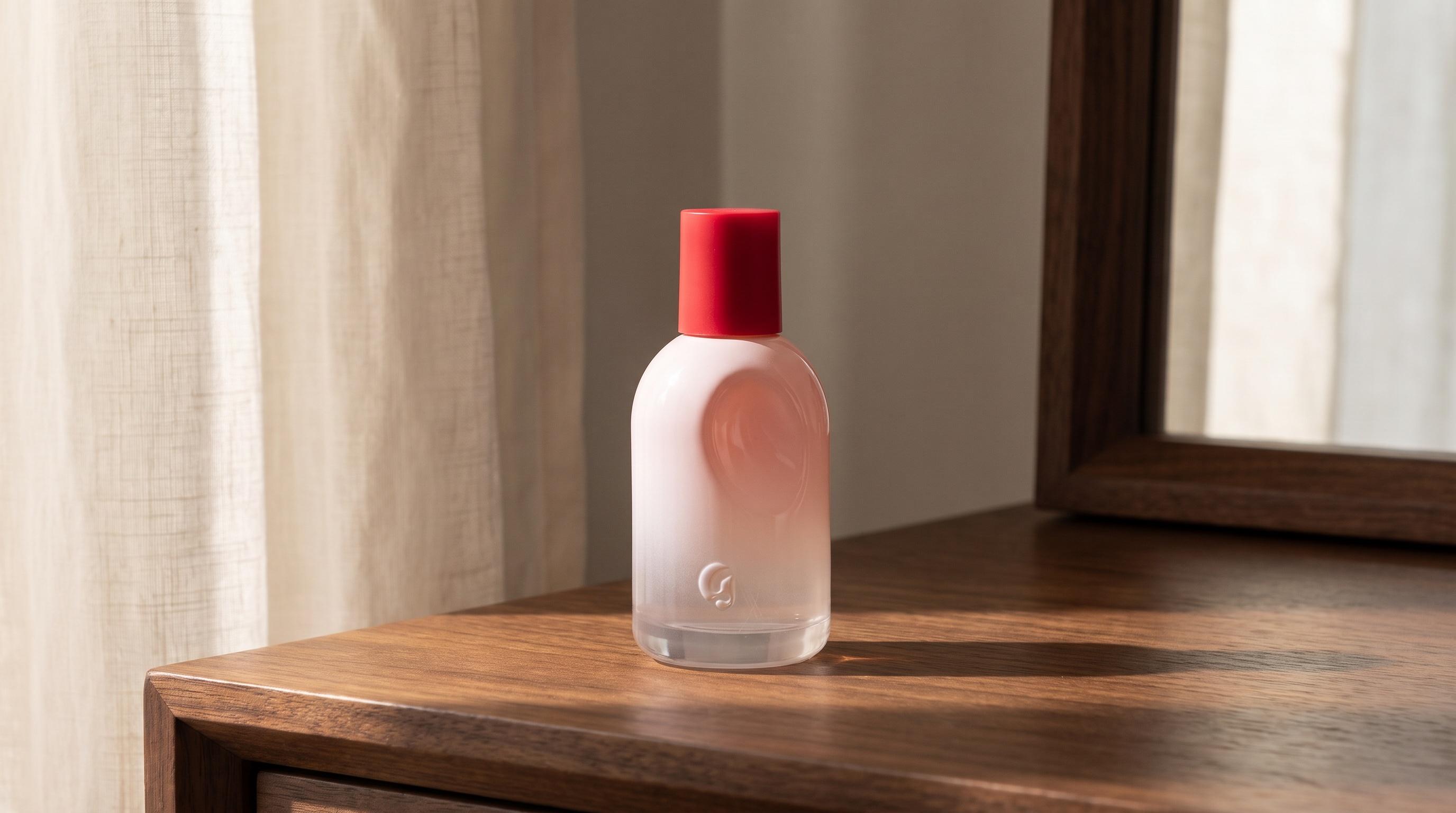
A 50 mL perfume bottle gives you about 125 wears at four sprays per wear, if each spray dispenses 0.10 mL. That works out to roughly four months of daily use, or 42 weeks if you wear it three times a week. The spray volume is an assumption, not a measurement of your bottle.
I'd choose 50 mL for a scent I already know I'll reach for regularly. For an unfamiliar perfume, I'd start with a sample or travel size. The lower price per milliliter on a big bottle only helps if you want to use the extra perfume.
Calculate wears before counting months
Start with the amount of perfume, the volume of each spray and the number of sprays you use. The calculation is:
Wears = bottle volume ÷ (volume per spray × sprays per wear).
For our 50 mL example, four sprays at 0.10 mL use 0.40 mL. Divide 50 by 0.40 and you get 125 wears. This assumes all 50 mL is available to spray; it doesn't allow for liquid you cannot get out of the bottle or perfume used outside your normal routine.
Count any top-ups. Two sprays before work and two before dinner use the same four-spray allowance as four in the morning. If you start with four and add another two later, use the six-spray column below. The numbers describe consumption, not how many sprays you should apply.
How 30, 50 and 100 mL compare
These are approximate wears, rounded to the nearest whole number. Every cell assumes 0.10 mL per spray and the full stated bottle volume. No particular brand's atomizer was measured for this table.
| Bottle size | 2 sprays per wear | 4 sprays per wear | 6 sprays per wear |
|---|---|---|---|
| 30 mL | 150 wears | 75 wears | 50 wears |
| 50 mL | 250 wears | 125 wears | 83 wears |
| 100 mL | 500 wears | 250 wears | 167 wears |
At four sprays, moving from 30 to 50 mL adds about 50 wears under the same assumptions. Moving from 50 to 100 mL doubles the estimate. A larger bottle of a different perfume might have a different spray output, so size alone cannot tell you how its wear count compares.
Your perfume rotation changes the calendar
Take the estimated wears and divide by how often you use that particular bottle each week. For the 125-wear example:
- Every day: about 18 weeks, or 125 days.
- Three times a week: about 42 weeks.
- Twice a week: about 63 weeks.
That last number is a consumption estimate, not a promise about how long the fragrance will keep. It also assumes your routine stays the same throughout.
If you alternate equally between two bottles while wearing perfume every day, each gets about three and a half wears per week. Our 50 mL example would then last about 36 weeks. Buying a second scent can lengthen the time your first bottle sits on the shelf without changing how much it holds.
For a more useful estimate, jot down each day's sprays for a fortnight, including evening top-ups. Count the sprays from the bottle you're considering replacing, then divide that total by two for a weekly average. At an assumed 0.10 mL per spray, 28 sprays a week use 2.8 mL; a full 50 mL bottle would provide roughly 18 weeks. Keep the spray-volume assumption visible in your notes.
Why a spray count is always an estimate
Sprayers do not all dispense the same volume. Packaging manufacturer Aptar lists 70, 100 and 140 microliter dosage options for its VP4 fragrance pump. Those convert to 0.07, 0.10 and 0.14 mL. They are three options for that pump, not the smallest and largest doses used across all perfumes.
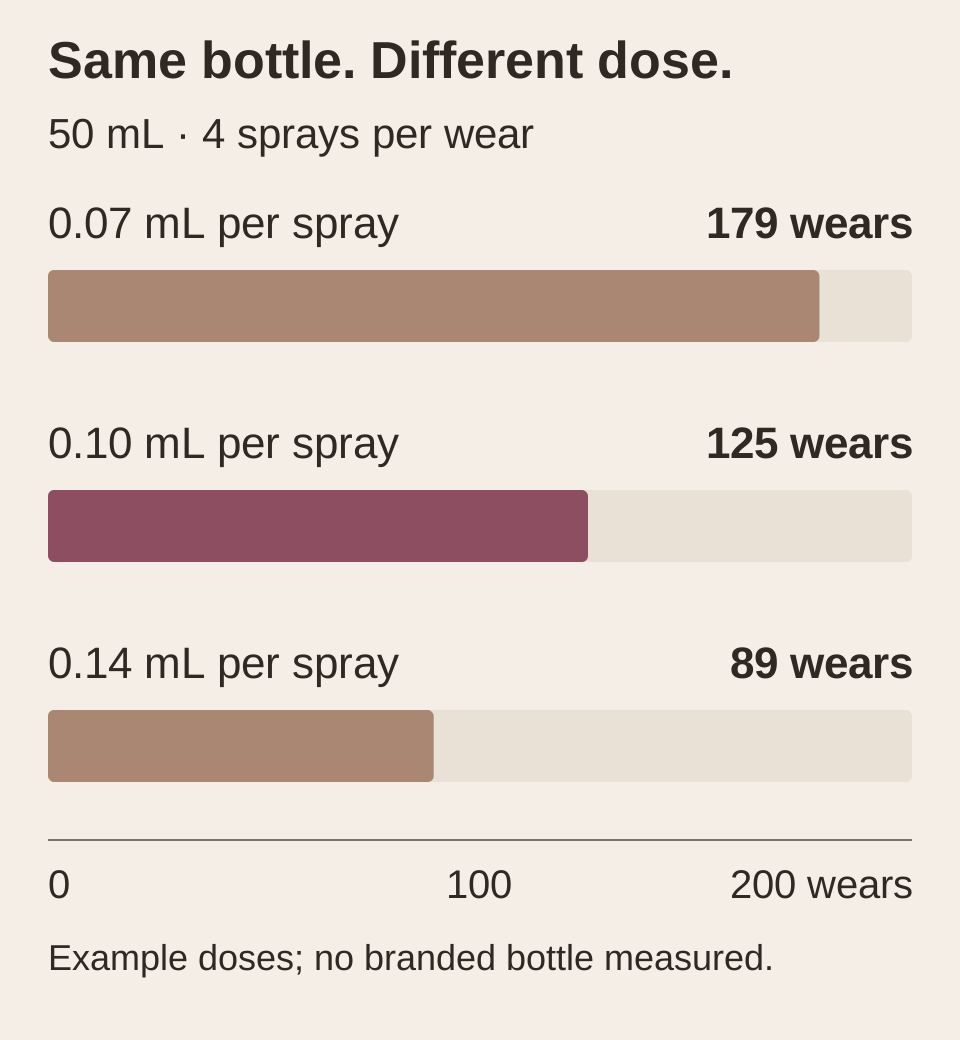
Holding the bottle volume and spray count steady, those example doses give about 179, 125 and 89 wears respectively. We haven't established that Glossier You, pictured here, uses any of those pumps or doses. The chart shows why a universal “500 sprays in every 50 mL bottle” claim would be too precise.
A partial press also needn't match a full spray, and the final liquid may be difficult to dispense. I would use the calculation to compare possible purchase sizes, then look at my own use before setting a replacement date. A bottle that seems to empty faster isn't automatically underfilled; the assumed spray volume or frequency may simply be wrong.
What the size choice costs in practice
The original Glossier You eau de parfum offers a useful price comparison. On 14 November 2026, its US one-time prices were $32 for 8 mL, $82 for 50 mL und $116 for 100 mL. All three were listed as available. These figures exclude subscription savings, engraving, delivery and any tax added at checkout.
| Glossier You size | US-Preis | Price per mL |
|---|---|---|
| 8 mL travel spray | $32 | $4.00 |
| 50 mL bottle | $82 | $1.64 |
| 100 mL bottle | $116 | $1.16 |
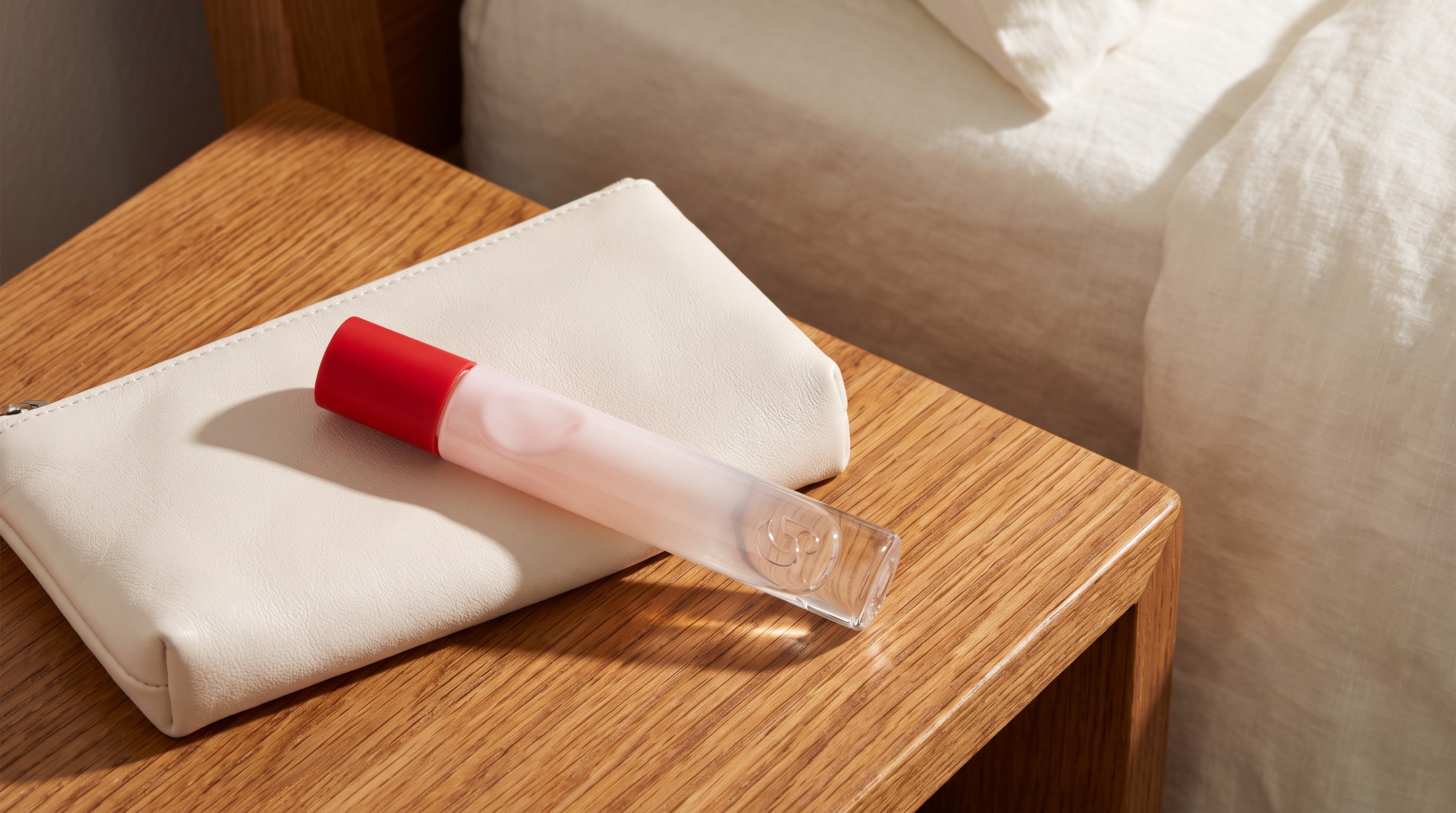
I'd pay the higher unit price of the travel spray to try an unfamiliar scent before spending $82. For someone already finishing the 50 mL regularly, the 100 mL costs $34 more for twice the perfume. For an occasional wearer, I'd keep that $34 until there is a reason to buy more. A lower unit price doesn't make unused perfume a saving.
If the full-size price is the problem, our Glossier You alternatives compare other scents. Their prices and spray outputs need separate consideration.
An empty bottle and a fading scent are different questions
This calculation estimates when you'll run out of liquid. It doesn't measure how many hours the scent lasts on skin or establish an expiry date. Treat those as separate buying questions. If you top up because you want more scent later, include those extra sprays in your count; if you save the bottle for weekends, use your weekend frequency instead of seven wears a week.
Möchtest du weitere Tipps und exklusive Beauty-Angebote per E-Mail? Trage unten deine Adresse ein und schließe dich Tausenden Insidern an, die jede Woche kräftig sparen.