epres vs K18: which treatment fits your wash routine?
 October 30, 2026
Insider Beauty may earn a commission on purchases made through links in this article. See our disclosure.
I'd choose epres if I wanted a treatment before washing and preferred to keep my usual shampoo-and-conditioner sequence. I'd choose K18 if I wanted a ready-to-use leave-in and could follow its four-minute wait after shampooing. The meaningful difference is the routine you will actually repeat. The sources checked do not establish that one produces better repair than the other in a direct comparison.
Jump to a section
Five quick takeawaysThe practical comparisonepres: make room before the showerK18: follow the order after shampooingThe order of use, at a glanceFirst purchase versus refill costWhat the evidence can establishWho can skip bothThe first purchase also changes the decision. The standard epres starter kit is $50, while K18's 50 mL mask is $75. K18 has a $29 mini, so it offers the lower entry price even though the full-size bottle costs more. Those prices describe different quantities and formats, not equivalent courses of treatment.
Five quick takeaways
- Keep your usual wash-and-condition order: epres goes on dry, unwashed hair before the wash routine.
- Avoid mixing concentrate: K18 is ready to apply after shampooing and towel-drying.
- Different waits: epres calls for at least ten minutes; K18 calls for four minutes before continuing.
- Compare entry and repeat costs separately: epres has $34 standard refills; K18's 15 mL mini costs $29 and its 50 mL bottle costs $75.
- No established head-to-head winner: different technologies, patents and brand claims do not by themselves settle comparative performance.
The practical comparison
| Decision | epres Bond Repair Treatment | K18 Leave-In Molecular Repair Hair Mask |
|---|---|---|
| Product compared | At-home spray made from concentrate | Leave-in mask, not K18 oil or conditioner |
| Standard first purchase | $50, spray bottle and two concentrate vials | $75, 50 mL mask |
| Lower entry or repeat option | $34 standard two-vial refill pack once you own the bottle | $29, 15 mL mini |
| Hair at application | Dry and unwashed | Shampooed and thoroughly towel-dried |
| Preparation | Dilute one vial as directed and shake | Dispense the appropriate amount |
| Waiting time | At least ten minutes | Four minutes |
| Wash sequence | Treatment, then normal washing and conditioning | Shampoo, skip conditioner before the mask, apply mask, wait; do not rinse the mask out |
| Main inconvenience | Mixing, saturating and allowing time before washing | Changing the order of conditioning and respecting the wait |
US one-time purchase prices were checked on 30 October 2026 at epres, its refill page and K18. Subscriptions, promotions, tax and shipping are excluded. This comparison uses the current brand instructions and published information, rather than a personal treatment trial.
epres: make room before the shower
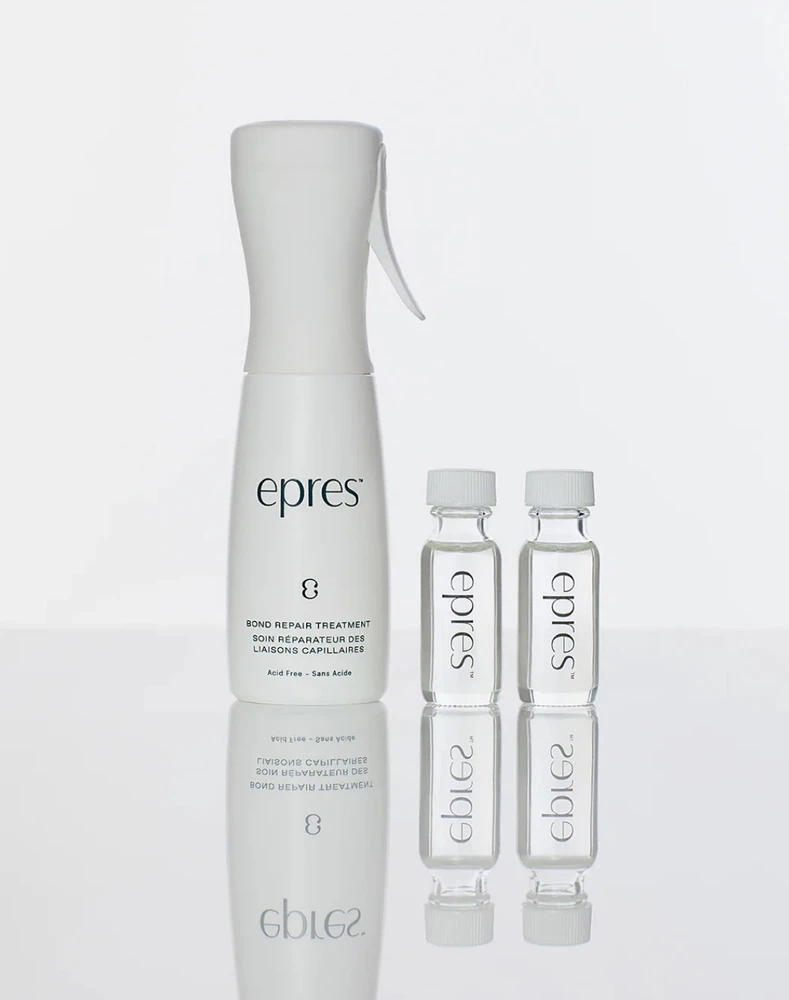
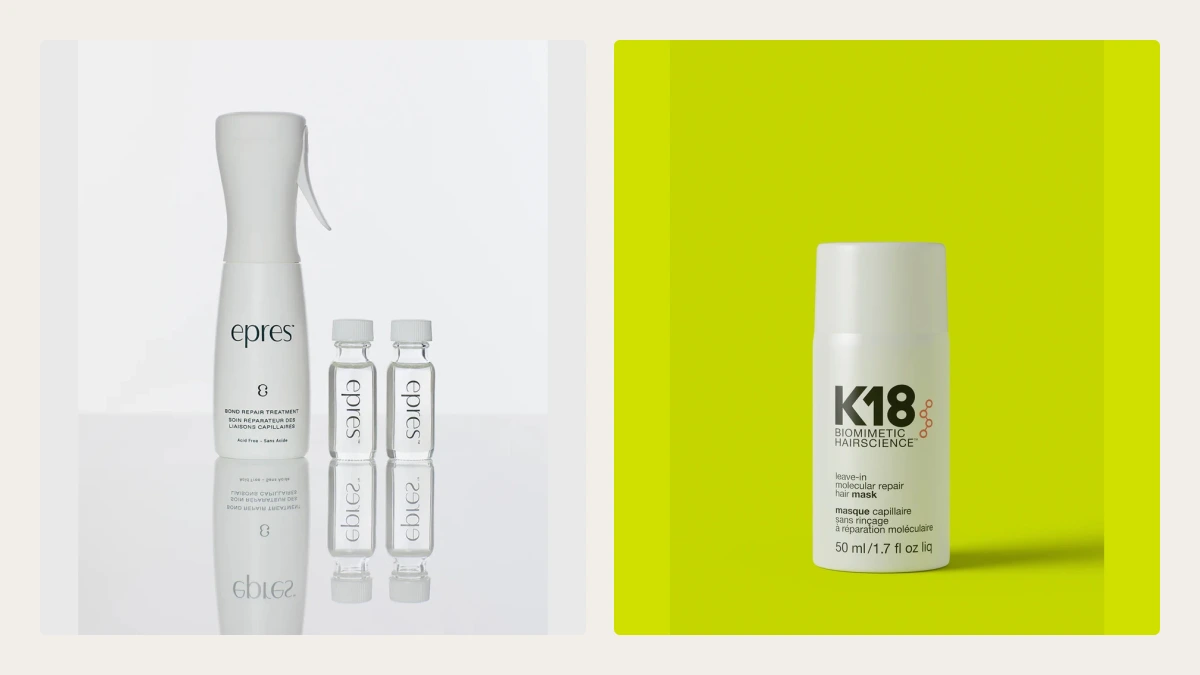
The standard epres kit gives you a reusable spray bottle and two vials. The brand's treatment directions tell you to mix a vial with water in the bottle, shake, and saturate dry, unwashed hair. Leave it for at least ten minutes before your normal cleansing routine.
I'd choose this approach if applying a treatment before getting into the shower feels easier than changing what I do afterwards. It also keeps ordinary conditioning in a familiar place. The preparation is the compromise: a concentrate kit asks more of you than opening a ready-to-use bottle.
This is the at-home treatment, not epres's professional colour-service product. If you are comparing prices, make sure both listings refer to the same kit and number of vials. Our epres brand guide covers the wider range.
K18: follow the order after shampooing
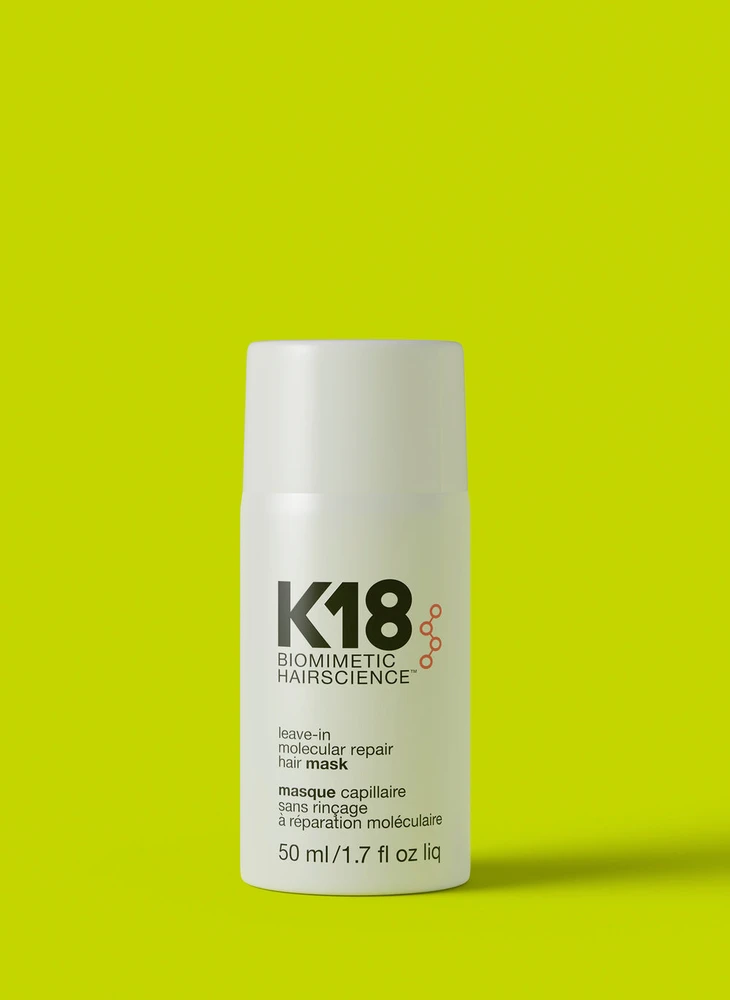
K18's current instructions say to shampoo without conditioning first, towel-dry thoroughly, apply the mask and wait four minutes. The mask stays in. The brand recommends starting with four to six washes, then using it as needed.
I'd choose it if I wanted to avoid mixing and preferred a treatment that stays in the hair. The shorter stated wait can be useful, although it happens at a different point in the wash routine. Four minutes after towel-drying is not the same scheduling decision as ten minutes before a shower.
There is a small dosing detail worth catching. The current guide gives one to three pumps for the full-size mask, depending on hair length and density, but three to nine pumps for the 15 mL mini. The pumps are not interchangeable measures. Start with the instructions for the bottle you bought, rather than copying someone else's pump count.
The order of use, at a glance
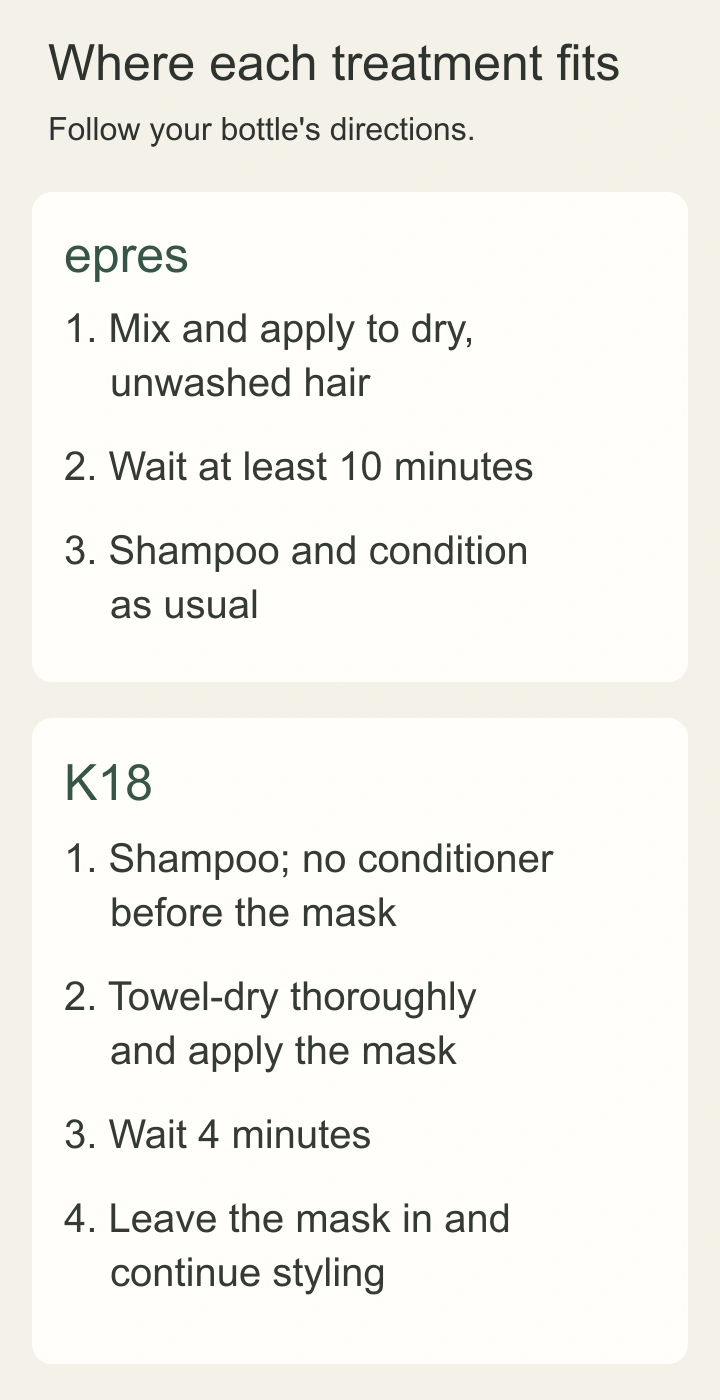
I'd decide between these routines by looking at the step I am most likely to forget. With epres, that might be applying the spray before washing. With K18, it might be automatically reaching for conditioner before the mask. A treatment that consistently gets used in the wrong order is a poor purchase however appealing its claims sound.
If you already use one successfully and can follow its directions, I would not add the other just to own both. Trying one at a time also makes it easier to notice whether a change is useful. Record the product amount, wash frequency and the changes you actually observe, rather than judging from a single unusually good hair day.
First purchase versus refill cost
The epres FAQ estimates three to four applications per vial, or six to eight per standard starter kit, depending on hair length. Using that manufacturer estimate, the $50 starter works out at approximately $6.25 to $8.33 per application. A $34 two-vial refill works out at approximately $4.25 to $5.67. These are calculated ranges, not measured consumption in our testing.
Your actual cost can differ with the amount needed to saturate your hair. epres also says to use the mixed solution within two months. Buying a refill only saves money when you use what you prepare; making a large batch to leave unused does not improve value.
For K18, the current mask listing offers 15 mL for $29, 50 mL for $75 and 100 mL for $120. The larger sizes cost less per millilitre within that same product. I would still choose the mini first if fit were uncertain and the lower initial outlay mattered more than unit price.
I have not assigned K18 a universal cost per application. Hair length, density and dose change consumption, and comparing a diluted spray's millilitres with a concentrated cream's millilitres would produce a misleading value ranking.
What the evidence can establish
The product pages establish the formats, instructions, prices and what each brand claims. They do not provide the kind of direct, independent comparison needed to declare one universally better at repairing damage than the other. A patent describes protected technology; it does not by itself answer which bottle you should buy.
I would want a comparison using similar starting damage, clearly stated doses and meaningful measures over time before ranking repair performance. Images from unrelated brand demonstrations cannot supply that missing comparison. This article therefore gives a routine-and-cost judgment, with performance superiority left unproven.
For a different pre-wash comparison, see K18 versus Olaplex. Our K18 alternatives guide covers more options, while keeping the distinction between a similar purpose and the same formula.
Who can skip both
I would skip a new bond treatment if I could not name the problem I wanted it to address. If the main complaint is oily roots, an awkward wash schedule or a conditioner that feels too heavy, I would sort out that routine before spending $29 to $75 on a separate treatment.
Buy the smaller commitment that fits the way you care for your hair, then decide whether it earns a repeat purchase. Keep your first bottle's directions and a note of how much you used; that gives the next buying decision something more useful than an advertised bottle size.