The best skin tints for a lighter everyday base
 Published · Prices checked
Insider Beauty may earn a commission on purchases made through links in this article. See our disclosure.
Fenty Eaze Drop would be my first choice for light coverage without an especially dewy finish. For the smallest spend, I'd start with e.l.f. Halo Glow Skin Tint SPF 50; for dry skin and a softer wash of color, I'd consider Hourglass Veil. The deciding question is how much you want to cover. A tint that leaves freckles visible can also leave a blemish visible.
Jump to a section
Five quick takeawaysThe shortlist at a glanceHow I narrowed the choicesFenty Eaze Drop: my first choice for less shinee.l.f. Halo Glow Skin Tint: the $14 starting pointHourglass Veil: the sheer option I'd consider for dry skinILIA Super Serum Skin Tint: for glow and more shade optionsGlossier Perfecting Skin Tint: for the least coverageL'Oréal True Match Nude: for a little more coverage under $25Three questions before you buyFive quick takeaways
- Fenty Eaze Drop is my starting point for a blurred, natural finish, particularly if extra shine is unwelcome.
- e.l.f. Halo Glow Skin Tint SPF 50 is the $14 pick for light, dewy coverage. It is a different product from Halo Glow Liquid Filter.
- Hourglass Veil earns its place for sheer coverage and hydration. I'd only spend $49 if its finish and shade worked better than a cheaper option.
- Glossier Perfecting Skin Tint is the sheerest proposition here; ILIA Super Serum and L'Oréal True Match Nude make more sense when you want coverage you can build.
- An SPF number does not make a thin makeup application enough sun protection. Keep your sunscreen routine and follow the product's application directions.
The shortlist at a glance
US prices checked October 29, 2026, before tax and shipping. These are one-time purchase prices, excluding subscription discounts.
| Skin tint | Price / size | Coverage | Finish |
|---|---|---|---|
| Fenty Eaze Drop | $41 / 32 ml | Light to medium | Natural, blurred |
| e.l.f. Halo Glow Skin Tint | $14 / 1 fl oz | Light, buildable | Dewy |
| Hourglass Veil | $49 / 35 ml | Sheer | Dewy |
| ILIA Super Serum Skin Tint | $48 / 1 oz, 28 g | Light to medium | Dewy |
| Glossier Perfecting Skin Tint | $30 / 30 ml | Very sheer | Dewy |
| L'Oréal True Match Nude | $20.99 / 1 fl oz | Sheer to medium | Luminous |
How I narrowed the choices
I wanted bases that make sense for an everyday light layer. That includes a tinted serum you can build toward medium coverage, but leaves out full-coverage foundations and products whose main job is highlighting. If covering most discoloration matters more than keeping the base sheer, start with our best foundations.
Fenty Eaze Drop: my first choice for less shine
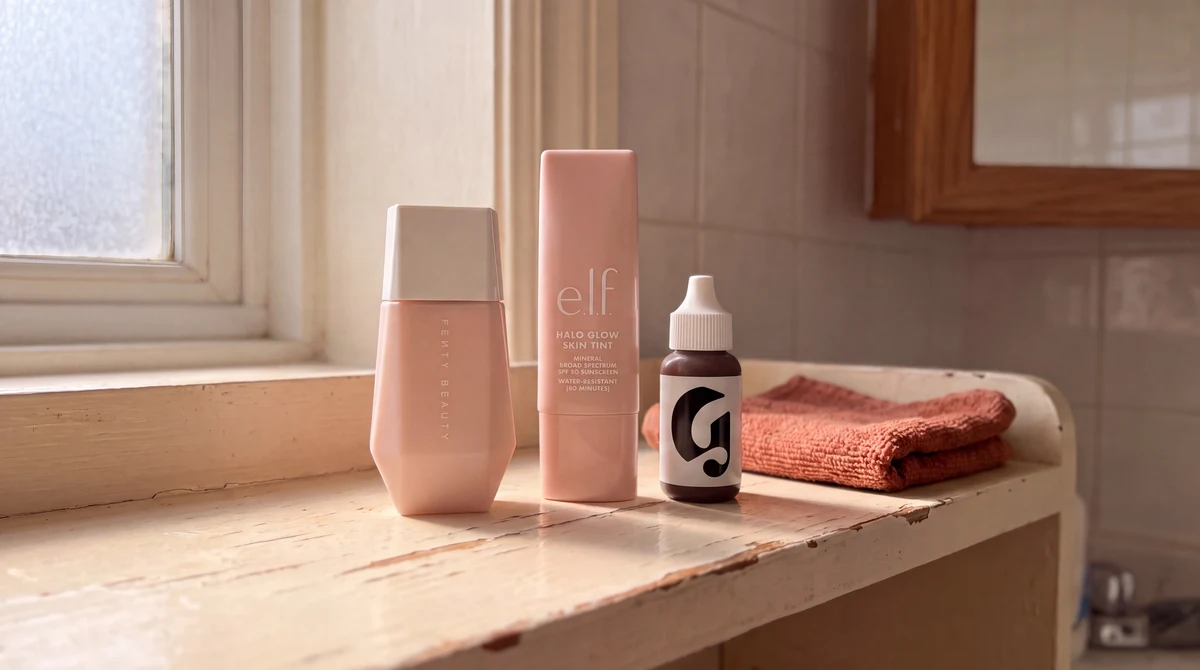
Eaze Drop is where I'd start if a dewy tint usually makes me reach straight for powder. Its natural finish gives it a different role from the glowier options here, while the light-to-medium coverage offers room to add a little more where needed. There are 25 shades, and the $41 squeeze bottle contains 32 ml. Fenty's current product details
The bottle is another point in its favor: I'd choose a squeeze dispenser over a glass pipette for a travel makeup bag. Make sure you're buying the liquid Eaze Drop, rather than the foundation stick or Eaze Drop'Lit glow enhancer.
Dry areas are the reservation. In Glamour's 2021 comparison, Erin Parker preferred its less dewy appearance, while Michella Ore, who described dehydrated combination skin, disliked the cast it left after drying. Those are individual, historical experiences, but they give me a good reason to check the dried finish on my own face before committing.
I'd shortlist it for oily or combination skin; I wouldn't promise that it controls oil all day. If the cheeks already feel dry, compare it with Hourglass rather than assuming every lightweight base will be comfortable.
e.l.f. Halo Glow Skin Tint: the $14 starting point
At $14 for 1 fl oz, e.l.f. is the lowest-priced choice here. Its 18-shade range is divided into six depth families with cool, neutral and warm options. The brand describes light, buildable coverage and a dewy finish, with broad-spectrum mineral SPF 50. e.l.f.'s formula and shade details
I'd choose it when the aim is a quick, luminous base and the budget matters more than a prestige bottle. The shade structure is helpful, although having three undertones in a depth group still doesn't guarantee a match. Check the color around the jaw once it has settled, rather than picking the closest-looking product photo.
Its glow is also the compromise. Who What Wear's Alyssa Brascia liked its light feel but flagged the finish for oily skin and preferred a richer tinted moisturizer for winter dryness. That puts it in a useful middle position: affordable light coverage, without making it my automatic choice for either very dry or very shiny skin.
Buy the pink Skin Tint SPF 50 bottle. The doe-foot Liquid Filter is a glow booster with a different purpose. Our Halo Glow Liquid Filter versus Skin Tint comparison explains which one belongs in your routine.
Hourglass Veil: the sheer option I'd consider for dry skin
Hourglass would be my first premium shortlist choice for dry skin when the desired result is a soft wash of color. It has 18 shades, costs $49 for 35 ml, and combines sheer coverage with ingredients including squalane, meadowfoam seed oil and hyaluronic acid. Hourglass's product details
In her April 2026 review, Grace Lindsay liked its lightweight, blurred appearance but found that overapplying could look a little cakey later. I'd take that as a reason to keep the layer modest and use concealer on an isolated mark, rather than build the whole face until everything disappears.
The price is the obstacle. You get more product than in a typical 30 ml bottle, but this is still $35 more upfront than e.l.f. I would need a convincing shade and finish advantage to pay it. Hydrating claims alone wouldn't settle that decision.
ILIA Super Serum Skin Tint: for glow and more shade options
ILIA is the one I'd compare when a narrow tint range keeps missing my undertone. Its 30 shades include explicit olive options, and the current US description puts coverage at light to medium. The $48 formula combines a dewy finish with broad-spectrum mineral SPF 40; zinc oxide is listed at 12%. ILIA's US formula and shade guide
The practical detail I'd follow is its shade-checking instruction: allow about a minute before judging the color. ILIA says it initially appears lighter, and also advises shaking the bottle and allowing skincare underneath to absorb. That's more useful than rejecting a shade the instant it leaves the pipette.
It would not be my first pick for someone who wants to keep shine down. Powder can change the finished look, but I'd rather start with Fenty if a natural finish is the goal. Fragrance-free also does not mean odorless: Allure's review noted an earthy smell during application, so scent-sensitive shoppers have a reason to try it before ordering.
If you like this direction but not the price, our ILIA Super Serum Skin Tint alternatives compare the compromises in cheaper options.
Glossier Perfecting Skin Tint: for the least coverage
Glossier's appeal is how little coverage it promises. At $30 for 30 ml, with 12 shades, it's a thin wash of color designed to leave skin visible. The formula includes glycerin and diamond powder, and the brand describes the finish as dewy. Glossier's product details
I'd choose it for someone who wants a small change in how even their skin looks, and who is happy to use a dab of concealer elsewhere. I wouldn't buy it hoping that another layer will turn it into a foundation that covers a breakout.
That distinction comes through in Kaleigh Fasanella's Allure review: she liked a hint of coverage that did not conceal the skin underneath, and noted the glowy result. My reservation is value. If that subtle effect is exactly what you want, it has a clear job. If you want an obvious coverage change, $30 is a frustrating amount to spend on the wrong brief.
L'Oréal True Match Nude: for a little more coverage under $25
L'Oréal calls this a tinted serum foundation, which is a useful description of where it sits. The brand puts coverage between sheer and medium, with a luminous finish, 14 shades and 1% hyaluronic acid. Its listed US price is $20.99 for 1 fl oz. L'Oréal's formula and instructions
I'd choose it over Glossier when I want a light first layer with more room to build. The saving is $9.01, and you don't have to pay ILIA's price to explore the tinted-serum format.
The shade range needs attention. Each shade covers a band of depths, but the undertones differ: Light 2-3 is listed as warm, while Light Medium 3-4 is cool. Moving up a number may change more than how deep the color looks.
I also wouldn't pick it solely because the bottle says hyaluronic acid. Alcohol denat. appears near the beginning of the ingredient list; if you already know that this type of formula disagrees with your skin, that matters more than the featured ingredient. The pipette takes more care than Fenty's squeeze bottle, too. Follow the brand's direction to shake it and remove excess from the dropper before dispensing.
Shopping on Amazon? This True Match Nude listing is for Very Light 0.5-2, 1 fl oz. Choose the shade you need before ordering.
Three questions before you buy
Which skin tint is best for oily skin?
Fenty Eaze Drop is my first candidate here because its natural, blurred finish is less focused on dewiness. That is a finish preference, not a guarantee against shine or breakouts. Check the dried result around the nose and on any drier areas; combination skin can need different treatment in different places.
Does skin tint with SPF replace sunscreen?
I wouldn't rely on the thin layer used for makeup. Johns Hopkins dermatologist Anna Chien explains that typical makeup amounts fall short of those needed for the labeled SPF. Use sunscreen as directed. The American Academy of Dermatology recommends broad-spectrum, water-resistant SPF 30 or higher, reapplied every two hours outdoors and after swimming or sweating.
Can I use skin tint instead of foundation every day?
Yes, if its coverage does what you want. I'd apply a light layer, look at the result in daylight and use concealer only where more coverage is wanted. If you keep adding tint across the entire face to hide discoloration, a more pigmented foundation may get you there with less product.