The clarifying shampoos I'd choose for color-treated hair
 Published · Prices checked
Insider Beauty may earn a commission on purchases made through links in this article. See our disclosure.
My verdict: I'd start with Living Proof Clarifying Detox for an occasional deeper cleanse, or OUAI Detox when hard-water deposits are a concern. K18 PEPTIDE PREP fits a K18 treatment routine. Olaplex No.4C is worth considering for permanent color, but the brand says to wait at least two weeks after coloring. The right timing matters as much as the bottle.
Jump to a section
Five quick takeawaysThe quick comparisonClarifying and chelating solve different parts of the problemLiving Proof Clarifying Detox: my first general recommendationOUAI Detox: my choice when hard water is part of the pictureK18 PEPTIDE PREP Detox: the one I'd pair with a K18 treatmentOlaplex No.4C: useful, with a timing detail I'd take seriouslyWhy sulfate-free isn't enoughHow I'd fit a clarifier into a color-care routineFrequently asked questionsColor-treated hair can accumulate styling residue and still need careful handling. Those two facts aren't contradictory. The mistake is treating a clarifying shampoo as either forbidden forever or a compulsory weekly wash, regardless of how your hair feels.
I'd choose one for a specific problem: persistent product residue, hair that feels coated after washing, or mineral deposits your stylist has identified. If your usual shampoo leaves your hair comfortable and your color looks good, I wouldn't add a deeper cleanse just to complete a routine.
Five quick takeaways
- My first all-round choice: Living Proof Clarifying Detox, $38 for 8oz, for occasional buildup removal.
- For hard-water concerns: OUAI Detox has chelating ingredients and costs $34 for 10fl oz.
- For a K18 routine: choose PEPTIDE PREP Detox, not the separate Damage Shield shampoo or repair mask.
- For fresh permanent color: Olaplex advises waiting at least two weeks before using No.4C.
- Don't rely on “sulfate-free”: Malibu C explicitly says its sulfate-free Un-Do-Goo is not color-safe.
The quick comparison
| Shampoo | US price / size | Why I'd choose it | Main reservation |
|---|---|---|---|
| Living Proof Clarifying Detox | $38 / 8oz | Product and mineral buildup | More expensive per ounce than OUAI |
| OUAI Detox | $34 / 10fl oz | Hard-water deposits | Distinct rose fragrance |
| K18 PEPTIDE PREP Detox | $39 / 8.5oz | Preparing for a K18 treatment | Highest bottle price here |
| Olaplex No.4C | $34 / 250ml | Occasional deep cleansing | Two-week wait after permanent color |
Regular US one-time prices checked October 29, 2026, before tax. These are the individual full-size shampoos, excluding subscriptions and treatment bundles.
Clarifying and chelating solve different parts of the problem
Clarifying is the broad cleaning job: removing excess oil and accumulated styling products. Chelating means using ingredients that bind metal ions so they can be removed during rinsing. A shampoo can do both, but I wouldn't assume it does because “detox” appears on the bottle.
For example, Living Proof identifies a chelating agent separately from its cleansing and product-removal ingredients. OUAI also specifies chelating ingredients for deposits from hard water. That is more relevant to mineral concerns than choosing a shampoo simply because it contains charcoal or vinegar.
I would also avoid diagnosing every dull or rough patch as buildup. Overprocessed ends and an unwanted change in color may need a different response. If a wash doesn't improve the problem, repeatedly using a stronger cleanser isn't the next step I'd choose. Ask your colorist what they're seeing before escalating.
Living Proof Clarifying Detox: my first general recommendation
Living Proof Clarifying Detox Shampoo is $38 for 8oz. The brand describes removal of product buildup, excess oil and metals deposited from water, and states that it is suitable for color-treated hair.
I like it as an occasional option when the problem isn't neatly confined to one thing. You might use dry shampoo between washes, a styling cream through the lengths and a finishing spray on top. In that situation, I would want a shampoo with a clear cleansing purpose rather than adding another leave-in product to hair that already feels coated.
My reservation: it costs more for less shampoo than OUAI. I wouldn't pay that difference just for the word “detox.” I'd choose it if the broader buildup-removal brief suits the problem, then judge whether the finish works with the conditioner you already use.
Living Proof's directions are to lather into wet hair, wait one to two minutes, rinse and follow with conditioner or a mask. I would keep to that timing instead of leaving it on longer in the hope of getting a more thorough result.
OUAI Detox: my choice when hard water is part of the picture
OUAI Detox Shampoo costs $34 for 10fl oz / 300ml. It is the largest bottle in this comparison, which gives it a useful price advantage for regular occasional use.
The recognizable ingredient is apple cider vinegar, but the relevant detail for mineral buildup is the formula's chelating system. OUAI says it targets deposits from hard water, as well as product residue. In an official response on Ulta, the brand confirms that Detox is suitable for color-treated hair, while advising customers to check with their stylist.
I'd choose it when hair feels coated and water quality is a plausible contributor, particularly if your stylist has already recommended a clarifying wash with mineral-removal capability. I wouldn't treat it as proof that every shower filter or home remedy is unnecessary; those are separate questions about your water and routine.
My reservation: the Melrose Place rose fragrance is part of the formula. If fragranced hair products are a problem for you, I wouldn't assume that rinsing it out makes the scent irrelevant. It also contains hydrolyzed keratin, but that doesn't turn this cleansing step into a replacement for conditioner.
The current directions say to leave the lather on for one to three minutes, then rinse and condition. I'd begin with occasional use and reassess the need, rather than automatically applying it at every wash.
Shop OUAI Detox Shampoo, 10fl oz, at Amazon.
K18 PEPTIDE PREP Detox: the one I'd pair with a K18 treatment
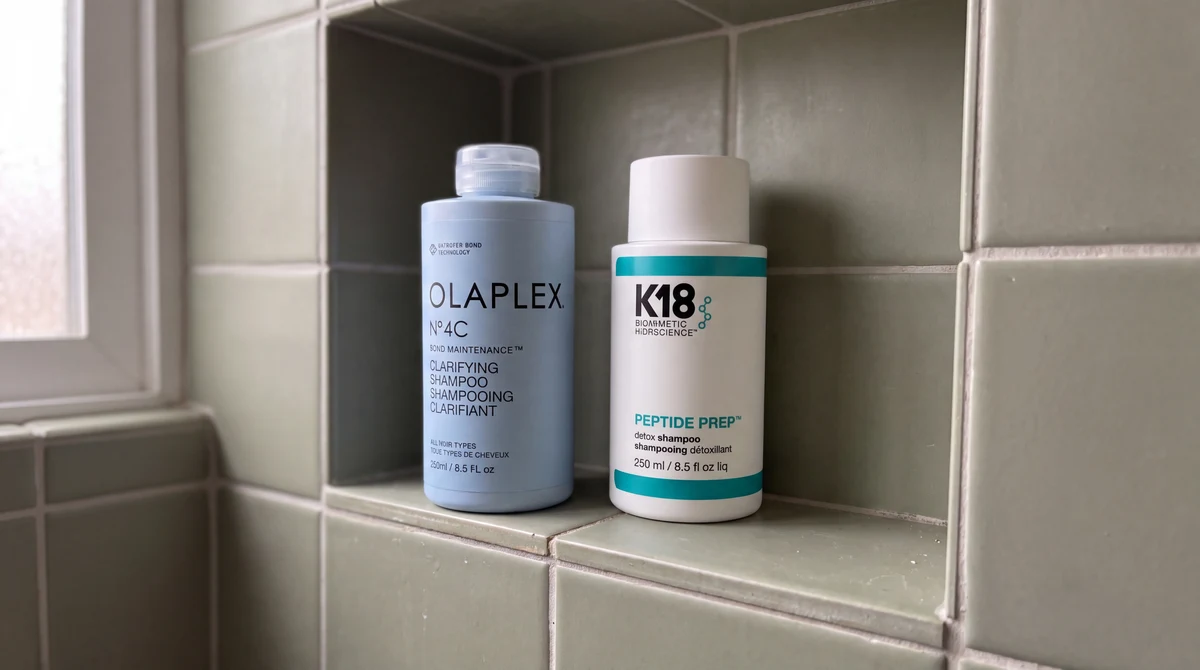
K18 PEPTIDE PREP Detox Shampoo costs $39 for 8.5oz / 250ml. This is the clarifying product, distinct from the brand's Damage Shield pH Protective Shampoo and its leave-in repair mask.
K18 gives the Detox formula a pH of 3.8–4.2, describes it as color-safe and recommends using it once a week or as needed. The formula contains charcoal, salicylic acid and the brand's peptide. I'd choose it when a deeper cleanse is needed before a K18 treatment, rather than buying it solely because I recognize the peptide name.
The distinction between shampoo and treatment is important. Removing residue before applying another product is useful preparation; it doesn't make the shampoo equivalent to the mask. If the main complaint is breakage or heavily processed ends, I wouldn't expect a cleanser to do the entire repair job.
My reservation: this has the highest upfront price in the shortlist. If you aren't using K18 treatments and already have a clarifier that suits your color, I don't see a reason to switch for brand matching alone.
If you are following with the K18 leave-in mask, use that product's specific sequence, including its instruction to skip conditioner beforehand. On a normal shampoo-and-conditioner wash, don't import the mask's special directions into your whole routine.
Olaplex No.4C: useful, with a timing detail I'd take seriously
Olaplex No.4C Bond Maintenance Clarifying Shampoo is $34 for 250ml. It's the clarifying version, not the regular No.4 shampoo.
The current FAQ is unusually specific: Olaplex says No.4C is safe for permanent hair color, recommends waiting at least two weeks after the color service, and advises checking with your stylist. It suggests using No.4C every one to two weeks, or as needed. I'd preserve those distinctions rather than reducing them to “safe for all color, any time.”
There is a professional recommendation behind the choice too. Cosmetologist Stanley Nolan recommends No.4C for color-treated clients in Who What Wear's clarifying-shampoo guide. That doesn't override Olaplex's own timing guidance.
My reservation: if your color appointment was last weekend, this isn't the bottle I'd suggest using now. I also wouldn't extend a statement about permanent color to a fresh toner or direct dye without checking. The shade you have and the service you received matter.
Olaplex's professional guide separates No.4C's cleansing role from its salon chelating treatment. If your colorist is addressing substantial mineral accumulation before another service, let them choose that process rather than trying to recreate it at home.
Why sulfate-free isn't enough
Malibu C's own Un-Do-Goo FAQ says the shampoo is not color-safe, even though its formula is sulfate-free. The brand explains that it can remove some color, particularly dyes sitting nearer the hair's surface.
That's why I haven't included it as a recommendation for preserving color. It may have a different job in a salon routine, but “sulfate-free clarifying shampoo” isn't sufficient evidence for this one.
I'd check the complete product guidance and the specific color situation before focusing on an ingredient exclusion. A reassuring word on the front of a bottle doesn't tell you when to use it after a service.
How I'd fit a clarifier into a color-care routine
First, keep an everyday shampoo that suits your hair. Our shampoos for color-treated hair guide covers that separate purchase. The clarifier should earn its place by resolving buildup, not replace a routine that is already working.
Wella's professional guidance recommends using clarifying shampoo only when needed, concentrating the cleanse at the roots and following with conditioner. I would use lukewarm water, follow the bottle's timing and avoid aggressively scrubbing fragile lengths.
Then assess the result. Hair that feels clean and moves more freely may not need another deep cleanse for a while. If it feels rougher, or the color changes in a way you don't want, pause and speak to your colorist. More frequent washing isn't a useful response to every hair problem.
Frequently asked questions
How soon after coloring can I use clarifying shampoo?
Follow the specific product and your colorist's advice. General recommendations for an ordinary wash aren't permission to clarify. Fresh glosses, toners and direct dyes deserve their own guidance; don't assume that advice for permanent color applies to every service.
How often should I clarify color-treated hair?
Only as often as the buildup warrants, within the product's directions. The weekly instructions on some bottles are a starting point, not a requirement to cleanse hair that doesn't need it. I wouldn't make a calendar reminder more important than how your hair and color respond.
Will clarifying shampoo remove unwanted hair dye?
It can contribute to fading, but it isn't a controlled color-correction service. I wouldn't repeatedly clarify to remove a shade you dislike, especially on already-processed hair. Let your colorist assess it so you don't turn an unwanted tone into a dryness problem as well.