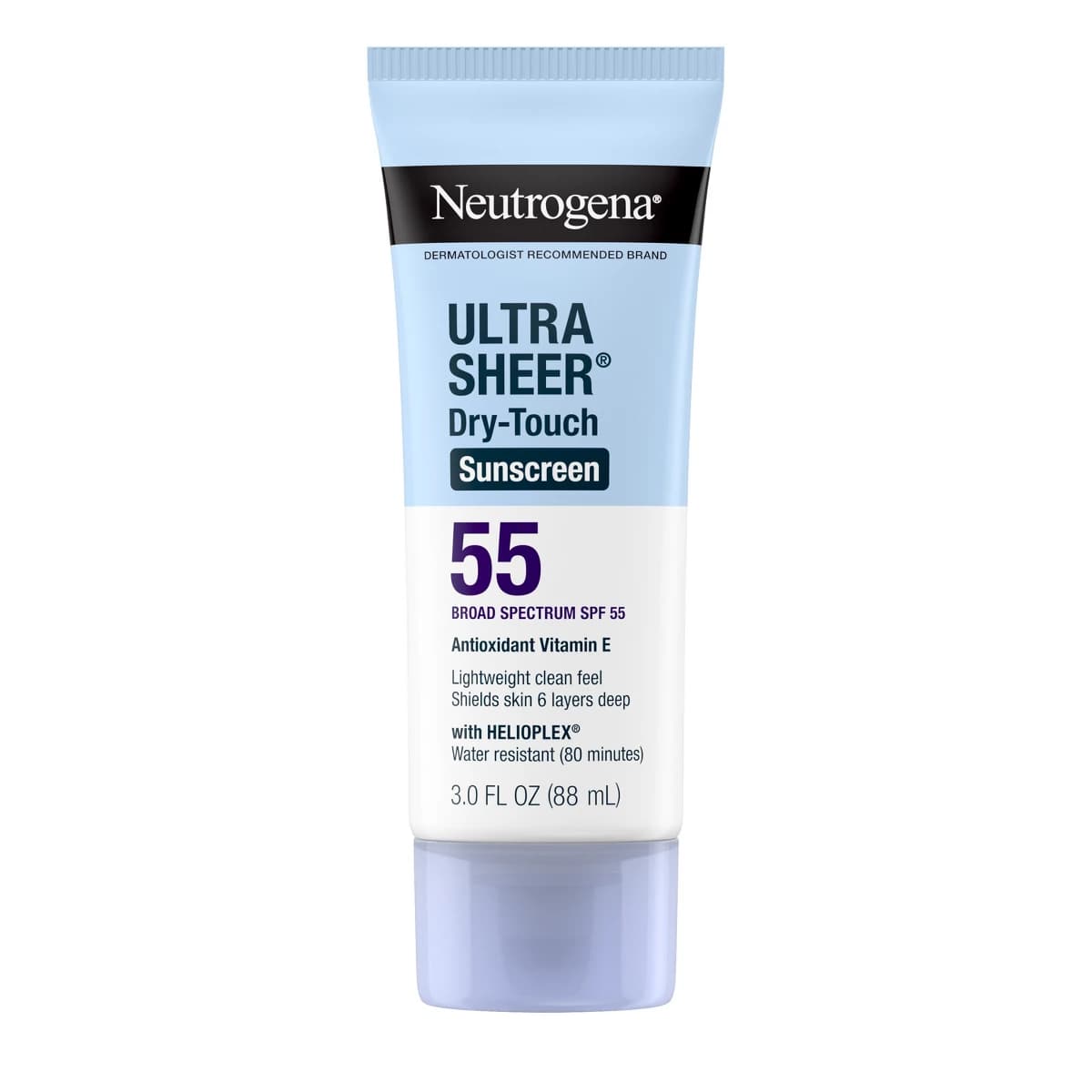
Neutrogena Ultra Sheer Dry-Touch SPF 55 Review
Neutrogena Ultra Sheer Dry-Touch Sunscreen SPF 55 is a solid drugstore buy for high SPF and lightweight wear, with a 4.3/5 rating from 24,100 reviews.
Evidence-led score using Insider Beauty’s published 100-point editorial rubric. How we score
- Rank
- #12
- Current price
- $9.89
- Listed size
- 3 oz
- Updated

Reviewed bySarah ChenBeauty Editor ·
Editor’s cut
At a glance
Neutrogena Ultra Sheer Dry-Touch Sunscreen SPF 55 costs $12.99 for 3 oz, which works out to $4.33 per ounce.
It has a 4.3/5 rating from 24,100 reviews and is best suited to shoppers who want lightweight, non-greasy chemical sun protection.
The formula uses avobenzone, homosalate, octisalate, and octocrylene, with EWG scores ranging from 3 to 4 for the active filters.
It's a strong drugstore value, but it's not cruelty-free, not clean, and may not suit very sensitive or mineral-only sunscreen users.
Community signal
Would you buy it again?
Neutrogena Ultra Sheer Dry-Touch Sunscreen SPF 55 is worth buying if you want affordable, high-SPF daily sun protection and don't mind a fully chemical sunscreen formula. At $12.99 for 3 oz ($4.33 per ounce), it delivers broad-spectrum protection in a lightweight, non-greasy texture, and its 4.3/5 rating from 24,100 reviews tells you it's worked well for a lot of people.
So, if you're searching for an honest Neutrogena Ultra Sheer Dry-Touch Sunscreen SPF 55 review, my take is simple: this is a strong drugstore option for body and everyday casual wear, especially if you prioritize texture and price over a mineral-only formula or cruelty-free credentials.
Neutrogena Ultra Sheer Dry-Touch Sunscreen SPF 55 review: quick verdict
Product: Neutrogena Ultra Sheer Dry-Touch Sunscreen SPF 55
Category: Sunscreen
Brand: Neutrogena
Price: $12.99
Size: 3 oz
Price per oz: $4.33
Rating: 4.3/5
Review count: 24,100
Best for: All skin types
Targets: Sun protection
Claims: Dry-touch, non-greasy, SPF 55
Formula type: Chemical sunscreen with Helioplex technology
Clean: False
Cruelty-free: False
Price tier: Drugstore
Current prices:
- Amazon: $12.95
- CVS: $12.99
- Target: $12.99
- Ulta: $12.99
- Walmart: $13.06
What is Neutrogena Ultra Sheer Dry-Touch Sunscreen SPF 55?
Neutrogena Ultra Sheer Dry-Touch Sunscreen SPF 55 is a lightweight chemical sunscreen designed to give high-level UV protection without the heavy, slick finish that makes a lot of people skip sunscreen in the first place. The brand describes it as non-greasy and dry-touch, and that tracks with the formula structure here: it uses classic organic UV filters plus silicone and texture agents to help it spread easily and set down more smoothly than richer beach sunscreens.
This sunscreen is made for all skin types, which feels fair on paper because the texture is lighter than many traditional body sunscreens. That said, “all skin types” doesn't always mean “all preferences.” Oily skin types will probably appreciate the less greasy finish most. Normal skin will likely find it easy to wear. Dry skin may want moisturizer underneath, since lightweight sunscreens can sometimes cling to dry patches. Sensitive skin is where I'd be more cautious because several UV filters here carry moderate-risk EWG scores of 3 to 4, and chemical filters can sting around the eyes for some users.
Look, the real appeal is straightforward: high SPF 55, a familiar dermatologist-recommended brand, and a price that stays around $13 at most major retailers. For a lot of shoppers, that's exactly the sweet spot.
What ingredients are in Neutrogena Ultra Sheer Dry-Touch Sunscreen SPF 55?
The active UV filters are the heart of this formula, and there are 4 sunscreen actives doing most of the protective work:
Avobenzone (Butyl Methoxydibenzoylmethane)
- Benefit: UVA protection
- Safety: Moderate risk
- EWG score: 4
Homosalate
- Benefit: UVB protection
- Safety: Moderate risk
- EWG score: 4
Octisalate (Ethylhexyl Salicylate)
- Benefits: UVB protection, stabilizing
- Safety: Moderate risk
- EWG score: 3
Octocrylene
- Benefits: UV protection, stabilizing
- Safety: Moderate risk
- EWG score: 4
Together, these filters create the broad-spectrum profile people want in a daily sunscreen. Avobenzone covers UVA rays, which are linked to visible skin aging and long-term sun damage. Homosalate and octisalate support UVB coverage, which matters for sunburn prevention. Octocrylene helps with UV protection and also improves formula stability, which is especially relevant because avobenzone can be less stable on its own.
That brings us to Helioplex technology, one of Neutrogena's long-running sunscreen talking points. In practical terms, this refers to a stabilization system that helps keep avobenzone performing more reliably in the formula. For consumers, the takeaway is simple: this sunscreen is trying to solve a real formulation issue, not just add a flashy label.
Ingredient analysis: how good is the formula really?
Honestly, this isn't an ingredient list that's trying to impress you with trendy skincare extras. It's built to do one job first: sun protection. And for sunscreen, that's not a bad thing.
The UV filters: effective, but not ideal for everyone
If your main question is whether the filters are effective, the answer is yes, this is a standard, proven chemical sunscreen setup. The tradeoff is that all 4 UV filters listed here fall into the moderate-risk range, with EWG scores between 3 and 4.
That doesn't automatically mean the product is unsafe. It does mean ingredient-conscious shoppers who prefer mineral sunscreens or lower-EWG formulas may not love what they see here. If you're especially sensitive, reactive, or trying to avoid filters like octocrylene, this probably won't be your first pick.
The texture-supporting ingredients are well chosen
After the actives, the base is pretty practical:
- Water (Aqua): hydrating solvent, EWG 1
- Dimethicone: smoothing, protective emollient, EWG 1, comedogenic rating 1/5
- Glycerin: humectant and barrier-supporting hydrator, EWG 1
- Stearic Acid: emollient and thickener, EWG 1, comedogenic rating 2/5
- Vitamin E (Tocopherol): antioxidant and moisturizing ingredient, EWG 1, comedogenic rating 2/5
This mix explains why the sunscreen feels lighter and smoother than old-school greasy formulas. Dimethicone is doing a lot of the cosmetic heavy lifting here. It gives slip, helps reduce that tacky sunscreen feel, and creates a smoother finish on skin. With a comedogenic rating of 1/5, it's generally low risk for clogging pores.
Glycerin is another nice inclusion because it adds water-binding hydration, which can make a dry-touch sunscreen feel less harsh or chalky. And vitamin E brings a little antioxidant support, although I wouldn't buy this sunscreen for antioxidant benefits alone.
Preservatives and support ingredients
The rest of the formula is fairly standard:
- Disodium EDTA: chelating, stabilizing, EWG 1
- Phenoxyethanol: preservative, EWG 2
- Carbomer: thickening and stabilizing, EWG 1
- Sodium Hydroxide: pH adjuster, EWG 1
Nothing here jumps out as especially luxurious, but that's not the point. This is a drugstore sunscreen, and the support ingredients are doing what they need to do: keep the texture consistent, stable, and shelf-friendly.
Is it acne-friendly?
Mostly, yes for many people, but not universally. The formula includes:
- Dimethicone: comedogenic 1/5
- Stearic Acid: comedogenic 2/5
- Vitamin E: comedogenic 2/5
Those are relatively low numbers, so I wouldn't call this a highly pore-clogging formula based on the ingredient list alone. Still, acne-prone skin can react unpredictably to sunscreen, especially chemical formulas layered with sweat, makeup, or heavy moisturizer. If you're very breakout-prone, patch test first.
How does Neutrogena Ultra Sheer Dry-Touch Sunscreen SPF 55 perform?
Performance is where this sunscreen earns its popularity. A lot of affordable sunscreens hit the right SPF number but feel thick, shiny, or slippery. This one is clearly formulated to avoid that.
Texture and finish
The texture is lightweight and designed to feel dry-touch rather than greasy. That's a big part of its appeal. The presence of dimethicone, carbomer, and a water-based base suggests a formula that spreads easily and sets more quickly than oil-heavy sunscreens.
So what does that mean in real life? You get a sunscreen that should feel more comfortable for daily wear than the classic sticky beach lotion. It won't necessarily feel invisible on every skin type, but compared with richer drugstore SPF formulas, this one is aiming for a cleaner, smoother finish.
Absorption and wear
Because the formula is lightweight and silicone-supported, it should absorb relatively fast and leave less residue than heavier body SPFs. That's especially useful if you're applying sunscreen to arms, chest, and neck before getting dressed. Fewer transfer issues. Less of that damp sunscreen feeling.
That said, “dry-touch” doesn't mean “zero feel.” With 4 chemical UV filters plus emollients and stabilizers, you'll still know you're wearing sunscreen. If you're extremely sensitive to any film or if you prefer a dewy skincare-style SPF, this may feel more functional than elegant.
Protection level
SPF 55 is a strong number for day-to-day use and outdoor exposure, assuming you're applying enough. Many people under-apply sunscreen, so a higher SPF can offer a bit more margin for error in real life. That's one reason formulas like this remain so popular.
And with UVA and UVB filters working together, the protection profile is more complete than a UVB-focused formula would be. For preventing sunburn and helping reduce cumulative UV damage, the formula checks the right boxes.
Who will like the finish most?
Based on the formula, this sunscreen will likely work best for:
- Normal skin that wants a straightforward daily SPF
- Combination skin that dislikes greasy residue
- Oily skin that prefers a drier finish
- People shopping on a budget who still want high SPF
It may be less ideal for:
- Very dry skin that prefers richer, creamier sunscreens
- Very sensitive skin that reacts to chemical filters
- People who want mineral sunscreen only
Is Neutrogena Ultra Sheer Dry-Touch Sunscreen SPF 55 good value?
Yes, this is one of the stronger value picks in the drugstore sunscreen category.
At $12.99 for 3 oz, you're paying $4.33 per ounce. That's a fair price for a recognizable dermatologist-recommended brand, especially one with 24,100 reviews and a 4.3/5 average rating. You're not paying prestige pricing, but you're also not getting a bargain-bin formula with a questionable finish.
Where is it cheapest right now?
Here are the current prices:
- Amazon: $12.95
- CVS: $12.99
- Target: $12.99
- Ulta: $12.99
- Walmart: $13.06
The spread is tiny, just $0.11 between the lowest and highest listed prices. So this isn't a product where retailer hunting makes a huge difference. Amazon is currently the cheapest at $12.95, but CVS, Target, and Ulta are essentially tied at $12.99.
Is the price justified?
I think so. You're getting:
- SPF 55 broad-spectrum protection
- A lightweight, non-greasy texture focus
- A formula backed by Helioplex technology
- A strong public track record with 24,100 reviews
- A drugstore price tier
Look, there are cheaper sunscreens. But once you factor in finish, usability, and retailer accessibility, $4.33 per ounce is still very reasonable.
Pros and cons of Neutrogena Ultra Sheer Dry-Touch Sunscreen SPF 55
Pros
- Affordable at $12.99 for 3 oz
- Strong SPF 55 for daily use and outdoor wear
- Lightweight, dry-touch, non-greasy positioning is a real selling point
- Uses UVA and UVB filters for broad-spectrum coverage
- Helioplex technology helps support avobenzone stability
- Includes skin-conditioning ingredients like glycerin, dimethicone, and vitamin E
- Widely available at Amazon, CVS, Target, Ulta, and Walmart
- Backed by a 4.3/5 rating from 24,100 reviews
- Suitable for all skin types in a general-use sense
Cons
- Uses 4 chemical sunscreen filters, which won't suit mineral-only shoppers
- Active filters have EWG scores of 3 to 4, so ingredient-conscious users may hesitate
- Not cruelty-free
- Not clean by the provided brand standard
- May sting or feel irritating on very sensitive skin, especially around the eyes
- Dry-touch formulas can feel less comfortable on very dry skin
- A few supporting ingredients have low but present comedogenic ratings, including stearic acid 2/5 and vitamin E 2/5
Who should buy Neutrogena Ultra Sheer Dry-Touch Sunscreen SPF 55?
This sunscreen makes the most sense for a specific kind of shopper.
Buy it if you want:
- A budget-friendly sunscreen from a familiar drugstore brand
- High SPF 55 instead of SPF 30 or 40
- A lightweight, non-greasy finish
- A sunscreen for casual daily use, commuting, walks, errands, and outdoor time
- A formula that works for normal, combination, or oily skin
- Something easy to repurchase at multiple retailers
Skip it if you want:
- A mineral sunscreen with zinc oxide or titanium dioxide
- A formula with stronger “clean beauty” positioning
- A cruelty-free sunscreen
- The gentlest possible option for very reactive skin
- A richer sunscreen for very dry skin
Honestly, this is one of those products where expectations matter. If you want a practical, affordable sunscreen that feels lighter than many drugstore competitors, you'll probably be happy. If you're screening every formula for EWG scores, filter type, or cruelty-free status, you'll likely move on.
Is Neutrogena Ultra Sheer Dry-Touch Sunscreen SPF 55 good for all skin types?
The brand says all skin types, and I think that's mostly fair in broad terms, but here's the more useful breakdown:
- Oily skin: Likely a good match because of the dry-touch, non-greasy finish
- Combination skin: Usually a strong fit, especially for warmer weather
- Normal skin: Easy everyday option
- Dry skin: Can work, but better with moisturizer underneath
- Sensitive skin: Proceed carefully due to avobenzone, homosalate, octisalate, and octocrylene
- Acne-prone skin: Potentially fine, but patch test because sunscreen reactions are very individual
So yes, it can work across many skin types. No, it won't be every skin type's ideal sunscreen.
The verdict: should you buy Neutrogena Ultra Sheer Dry-Touch Sunscreen SPF 55?
Yes, Neutrogena Ultra Sheer Dry-Touch Sunscreen SPF 55 is a good drugstore sunscreen for the price, especially if your top priorities are high SPF, lightweight texture, and easy availability. The numbers support that verdict: $12.99, $4.33 per ounce, and a 4.3/5 rating from 24,100 reviews is a solid profile for an everyday SPF.
Where it loses points is ingredient preference. This is a chemical sunscreen, not a mineral one. Its active filters carry moderate-risk EWG scores, and the brand is not cruelty-free and not clean by the provided standards. For some shoppers, those are dealbreakers.
But if your goal is simple, effective, wearable sun protection from a dermatologist-recommended drugstore brand, this one still earns a recommendation.
My rating: 4.2/5
That's just a touch below the public 4.3/5 average, mainly because while the texture and value are strong, the formula won't satisfy shoppers looking for mineral filters, lower-EWG actives, or cruelty-free credentials.
FAQs
Is Neutrogena Ultra Sheer Dry-Touch Sunscreen SPF 55 worth the price?
Yes. At $12.99 for 3 oz, or $4.33 per ounce, it sits in a very reasonable drugstore range. You also get SPF 55, a lightweight non-greasy texture, and a 4.3/5 rating from 24,100 reviews, which makes the value proposition pretty convincing.
What are the key ingredients in Neutrogena Ultra Sheer Dry-Touch Sunscreen SPF 55?
The main sunscreen filters are avobenzone, homosalate, octisalate, and octocrylene. Avobenzone provides UVA protection, while homosalate and octisalate help with UVB protection. Octocrylene adds UV protection and stabilization. Support ingredients like dimethicone, glycerin, and vitamin E help improve feel and add light hydration.
Is Neutrogena Ultra Sheer Dry-Touch Sunscreen SPF 55 greasy?
It's specifically marketed as dry-touch and non-greasy, and the ingredient list supports that claim. Ingredients like dimethicone and carbomer help create a lighter, smoother finish than traditional greasy sunscreen lotions. Most oily and combination skin types will likely find it more comfortable than heavier formulas.
Is Neutrogena Ultra Sheer Dry-Touch Sunscreen SPF 55 good for sensitive skin?
It depends on your sensitivity triggers. While many of the base ingredients are low risk, the 4 active sunscreen filters have EWG scores ranging from 3 to 4, and chemical filters can bother some sensitive users. If your skin reacts easily or your eyes sting with sunscreen, patch testing is a smart idea.
Where can you buy Neutrogena Ultra Sheer Dry-Touch Sunscreen SPF 55?
It's widely available. Current listed prices are Amazon $12.95, CVS $12.99, Target $12.99, Ulta $12.99, and Walmart $13.06. Amazon is the lowest by a small margin, but the price difference across retailers is only $0.11.
Formula index
Ingredients
13 indexed ingredients