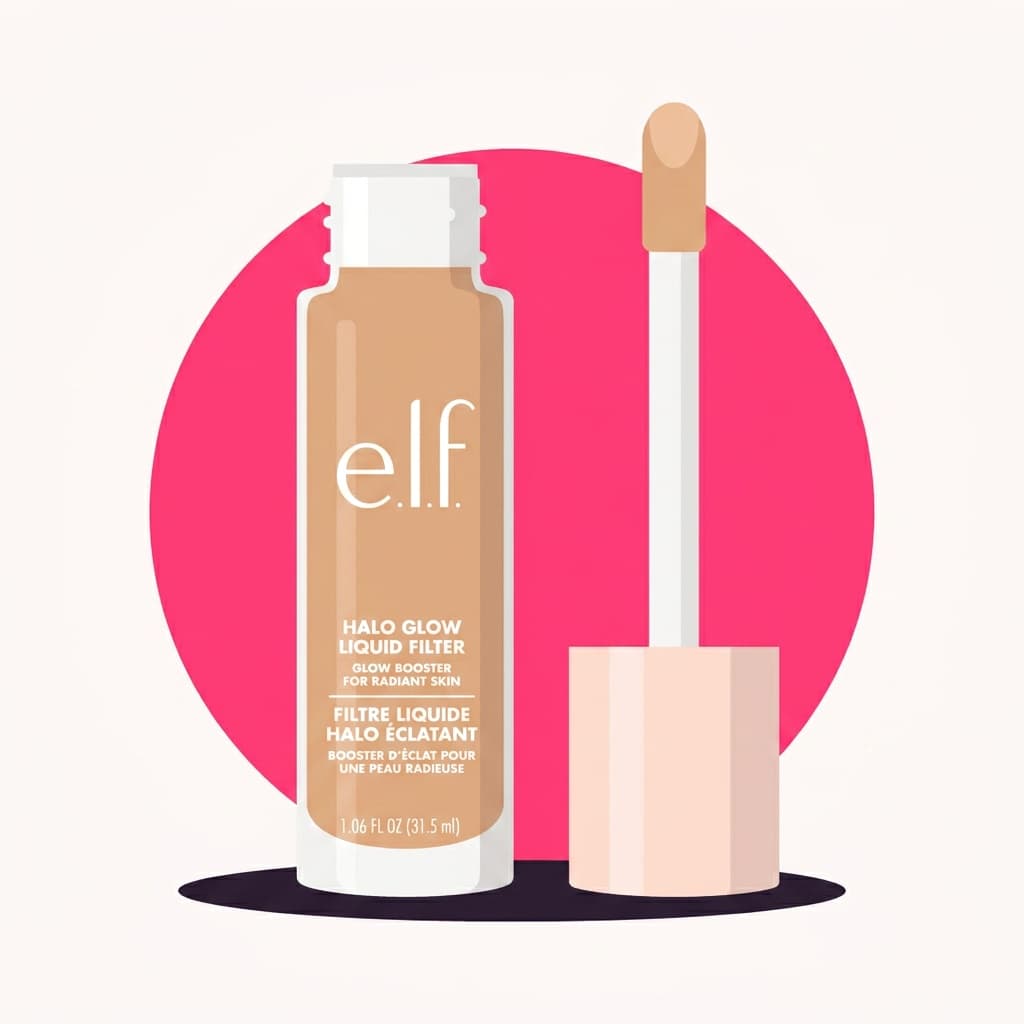
e.l.f. Halo Glow Liquid Filter Review
e.l.f. Halo Glow Liquid Filter is a $14 glow booster that delivers dewy radiance and hydration, with a solid 4.3/5 rating from 24,300 reviews.
Evidence-led score using Insider Beauty’s published 100-point editorial rubric. How we score
- Rank
- #43
- Current price
- $15.00
- Listed size
- 1.06 oz
- Updated

Reviewed byDr. Lisa ParkContributing Dermatologist ·
Editor’s cut
At a glance
e.l.f. Halo Glow Liquid Filter is a $14 complexion booster with a dewy, radiant finish and a 4.3/5 rating from 24,300 reviews.
The formula includes glycerin, squalane, sodium hyaluronate, and niacinamide, with most ingredients rated EWG 1.
It works best as a skin-tint style glow product for dullness and dryness rather than a full-coverage foundation.
CVS, Target, and Ulta currently match the lowest listed price at $14.00, while Walmart is highest at $14.40.
Community signal
Would you buy it again?
e.l.f. Halo Glow Liquid Filter is worth buying if you want affordable glow-first complexion makeup. At $14, with a 4.3/5 rating from 24,300 reviews, it delivers a dewy, radiant finish that flatters dry, dull, and normal skin especially well, though oily skin types may find it a little too luminous on its own.
So if you're wondering whether the Halo Glow Liquid Filter lives up to the hype, my short answer is yes—for the right person. It's not a full-coverage foundation, and it doesn't pretend to be. It's a skin-tint style complexion booster that gives skin a smoother, more hydrated, light-reflective look with a formula backed by squalane, hyaluronic acid, glycerin, and niacinamide.
e.l.f. Halo Glow Liquid Filter review: quick summary
- Product: e.l.f. Cosmetics Halo Glow Liquid Filter
- Category: Foundation
- Subcategory: Skin-tint
- Price: $14.00
- Brand: e.l.f. Cosmetics
- Brand positioning: Drugstore, quality beauty at accessible prices
- Rating: 4.3/5
- Review count: 24,300
- What it is: Complexion booster for a dewy, radiant finish
- Claims: Dewy finish, squalane, hyaluronic acid
- Targets: Dullness, dryness
- Best for skin types: All skin types
- Cruelty-free: Yes
- Vegan: Yes
- Clean: True
Current price check
- CVS: $14.00
- Target: $14.00
- Ulta: $14.00
- Amazon: $14.06
- Walmart: $14.40
If you're price shopping, CVS, Target, and Ulta are tied for the best listed price at $14.00. Amazon is only $0.06 more, while Walmart is $0.40 more.
What is e.l.f. Halo Glow Liquid Filter?
The Halo Glow Liquid Filter is best described as a radiant skin tint-meets-complexion booster. It sits in that in-between category: not exactly a traditional foundation, not exactly a primer, and not exactly a liquid highlighter either. Instead, it's designed to give skin an all-over filtered effect with sheer tint, light-reflecting pigments, and a notably dewy finish.
Look, the name tells you what you're getting. This is about glow, not coverage. If your goal is to neutralize every spot of redness or fully conceal acne, this won't do that alone. But if you want your skin to look more even, more hydrated, and more luminous in a single step, this formula makes a strong case for itself.
Who is it best for?
Based on the formula and finish, I'd recommend it most for:
- Dry skin, because it contains multiple humectants and emollients
- Dull skin, since mica and pigments create immediate radiance
- Normal skin, because it balances slip, hydration, and cosmetic blur nicely
- Combination skin, especially if you use it strategically on high points or under foundation
- Anyone wanting a no-makeup makeup glow on a drugstore budget
Who may like it less?
- Very oily skin types who dislike shine
- People who prefer a natural-matte or soft-matte finish
- Anyone wanting medium to full coverage from one product
What ingredients are in Halo Glow Liquid Filter?
Honestly, the ingredient list is better thought out than you'd expect from a $14 drugstore complexion product. The formula combines classic hydrators, smoothing silicones, barrier-supportive ingredients, and light-reflecting pigments. Nearly every listed ingredient has a low EWG score of 1, with phenoxyethanol at 2, which is still considered low risk.
Here is the ingredient list in order, which matters because ingredients are generally listed from highest to lowest concentration:
- Water (Aqua) – hydrating solvent, EWG 1
- Glycerin – humectant, barrier support, EWG 1
- Dimethicone – smoothing emollient, EWG 1, comedogenic 1/5
- Squalane – emollient, antioxidant, non-comedogenic, EWG 1, comedogenic 1/5
- Sodium Hyaluronate – form of hyaluronic acid, EWG 1
- Niacinamide – brightening, barrier support, oil balancing, EWG 1
- Mica (CI 77019) – shimmer and light reflection, EWG 1
- Titanium Dioxide (CI 77891) – colorant/opacifier, EWG 1
- Iron Oxides (CI 77491, CI 77492, CI 77499) – pigment, EWG 1
- Dimethicone Crosspolymer – blurring texture enhancer, EWG 1
- Carbomer – stabilizer, EWG 1
- Phenoxyethanol – preservative, EWG 2
- Sodium Hydroxide – pH adjuster, EWG 1
Ingredient analysis: what does each key ingredient actually do?
1. Glycerin for immediate hydration
Glycerin is the second ingredient, which is a big plus. That tells me hydration isn't just a marketing afterthought. As a humectant, glycerin pulls water into the upper layers of the skin, which can make the complexion look fresher and slightly fuller. In makeup formulas, that often translates to less tightness and less obvious dry patch cling.
For anyone with dryness, this matters. A lot of glow products rely heavily on shimmer alone. This one also uses actual hydrating support.
2. Dimethicone for slip and smoothing
Dimethicone is the third ingredient, and that explains the silky spreadability people tend to notice with products like this. It forms a lightweight protective layer, helps makeup glide on more evenly, and can visually soften texture.
From a dermatology perspective, dimethicone has a very good safety profile here: EWG 1 and a comedogenic rating of 1/5, which is low. So while no complexion product is universally breakout-proof, this specific silicone isn't a red flag for most acne-prone users.
3. Squalane for softness without heaviness
Squalane is the fourth ingredient, which is impressive at this price point. It's one of my favorite emollients because it helps reduce transepidermal water loss and leaves skin supple without the greasy feel some plant oils can create.
It also has a comedogenic rating of 1/5, so it's considered low risk for clogging pores. If your skin gets flaky under makeup, squalane is one of the reasons the Halo Glow Liquid Filter wears more comfortably than many shimmer-heavy formulas.
4. Hyaluronic acid for plumping
The formula includes sodium hyaluronate, the salt form of hyaluronic acid, as the fifth ingredient. That's relatively high in the list, and it supports the product's hydration claim well. Hyaluronic acid helps bind water, which can temporarily make skin look smoother and more plump.
That said, this isn't a treatment serum. You're getting cosmetic hydration support, not a replacement for your dedicated skincare routine. Still, in a complexion product, this is a smart addition.
5. Niacinamide for brightening and barrier support
Niacinamide appears as the sixth ingredient, which is another standout. It can help with barrier-strengthening, brightening, anti-inflammatory support, and oil control. In practical terms, niacinamide may help the formula feel a bit more balanced than a typical glow booster, especially for combination skin.
I like seeing niacinamide here because it supports the product's target concerns of dullness and dryness while adding a little extra skin-friendly credibility.
6. Mica and pigments for the filtered finish
The visible glow comes largely from mica, plus titanium dioxide and iron oxides. Mica is what gives that reflective sheen. This is the ingredient that creates the "lit-from-within" effect people are shopping for.
So yes, the radiance is partly skincare-supported—but it's also absolutely a makeup illusion. That's not a criticism. It's the point.
Is Halo Glow Liquid Filter safe for sensitive or acne-prone skin?
From a formula safety standpoint, the ingredient profile is reassuring. 12 of the 13 listed ingredients have an EWG score of 1, and the remaining preservative, phenoxyethanol, is EWG 2. That's still low risk.
For acne-prone skin, the two ingredients people tend to ask about most here are dimethicone and squalane, and both have a comedogenic rating of 1/5. That's considered low. The formula is also free of heavier pore-clogging oils in the provided list.
That said, any glowing complexion product can emphasize active breakouts simply because reflective finishes draw light to texture. So the issue may be visual rather than truly pore-clogging.
How does Halo Glow Liquid Filter perform on skin?
This is where the product earns its popularity. The Halo Glow Liquid Filter gives immediate payoff. Skin looks more radiant right away, and the formula's mix of humectants, silicones, and light-reflecting pigments helps create that smoother, healthier-looking surface effect.
Texture and feel
The texture is best described as fluid, silky, and lightly cushioned. Because dimethicone and dimethicone crosspolymer are both in the formula, it should spread easily and leave behind a soft, blurred slip rather than a sticky finish.
I also like that the ingredient list doesn't suggest a heavy waxy base. That usually means easier blending and less likelihood of the product sitting in obvious streaks, especially when applied over moisturizer.
Finish
The finish is clearly dewy. Not satin. Not soft matte. Dewy.
If your skin is dry or dull, that can be incredibly flattering because it adds dimension and bounce. If your skin gets shiny by noon, you may want to use it more selectively—under foundation, mixed with foundation, or only on the high points of the face.
Coverage level
This is not a true full-coverage foundation despite being categorized under foundation. The subcategory, skin-tint, is the more accurate expectation. Think:
- Sheer tint
- Light evening-out effect
- More glow than coverage
- Soft blurring from silicones and reflective pigments
If you have redness, melasma, or active blemishes, you'll likely still want concealer or a higher-coverage base on top.
Results over time
Because this is makeup, the most obvious result is immediate radiance. But over repeated wear, ingredients like glycerin, squalane, sodium hyaluronate, and niacinamide may help the product feel less drying than many other glow bases.
Honestly, that's one of the biggest reasons people stick with it. A lot of luminous products look pretty for 30 minutes and then start catching on dry patches. This formula has enough hydration support built in to reduce that risk for many users.
How should you use Halo Glow Liquid Filter?
One reason the Halo Glow Liquid Filter has such broad appeal is that it's flexible. You can wear it several ways depending on how much glow you want.
Best ways to apply it
- Alone as a skin tint for sheer, radiant coverage
- Under foundation as a glow-boosting primer
- Mixed with foundation to make fuller-coverage formulas look less flat
- On high points only as a liquid illuminator
For dry skin, wearing it alone or under a light concealer makes a lot of sense. For oily skin, I usually think it works best mixed with foundation or placed strategically rather than all over.
Is Halo Glow Liquid Filter good for dry skin?
Yes, this is one of the stronger affordable options for dry skin if you like a luminous finish. The combination of glycerin, squalane, and hyaluronic acid directly supports hydration, and the formula specifically targets dryness and dullness.
The dewy finish also visually counteracts the flat, tight look dry skin can have under makeup. So from both a formulation and cosmetic standpoint, it's well suited to that skin type.
Is Halo Glow Liquid Filter good for oily skin?
It can be, but with caveats. Niacinamide may help balance things somewhat, and the lightweight silicones keep the texture from feeling overly greasy. Still, the finish is intentionally radiant, and that can read as too shiny on oily skin.
If you're oily and interested in this product, I wouldn't write it off. I'd just use it differently:
- Apply a thin layer only where you want glow
- Pair it with a more natural or matte foundation
- Set the T-zone with powder
Price and value: is Halo Glow Liquid Filter worth $14?
At $14.00, this product is very competitively priced. In the current retailer list, the range is $14.00 to $14.40, so there isn't much price variation. That's nice because you don't have to hunt excessively for a deal.
Price comparison by retailer
- CVS: $14.00
- Target: $14.00
- Ulta: $14.00
- Amazon: $14.06
- Walmart: $14.40
The difference between the lowest and highest listed price is only $0.40.
Value assessment
For $14, you're getting:
- A complexion product with 24,300 reviews
- A strong aggregate rating of 4.3/5
- A formula with multiple low-risk hydrating ingredients
- Cruelty-free and vegan status
- A finish that mimics far pricier glow boosters
Look, in drugstore beauty, value isn't just about low cost. It's about whether the formula, finish, and flexibility justify the purchase. Here, I think they do. The review volume alone—24,300 ratings—suggests this isn't a niche fluke. Plenty of people have tried it, and a 4.3/5 average at that scale is genuinely solid.
Pros and cons of Halo Glow Liquid Filter
Pros
- Affordable at $14.00
- 4.3/5 rating from a massive 24,300 reviews
- Gives a dewy, radiant finish immediately
- Contains glycerin, squalane, hyaluronic acid, and niacinamide
- Targets dullness and dryness effectively from both skincare and cosmetic angles
- Cruelty-free and vegan
- Works in multiple ways: alone, under foundation, mixed in, or as a highlighter
- Ingredient safety profile is reassuring, with mostly EWG 1 scores
- Low comedogenic profile for key emollients like dimethicone and squalane at 1/5
Cons
- Coverage is sheer, so it won't replace foundation for everyone
- The finish may be too luminous for very oily skin
- Reflective pigments can emphasize active texture visually
- If you dislike shimmer or visible radiance, this won't be your style
- Walmart's listed price is $14.40, which is a bit higher than the $14.00 at CVS, Target, and Ulta
Who should buy Halo Glow Liquid Filter?
You should consider buying this if:
- You want a skin-tint style product rather than full coverage
- Your main concerns are dullness and dryness
- You prefer a dewy finish over matte makeup
- You want skincare-adjacent ingredients in your complexion product
- You shop drugstore and want strong value at $14
- You care that your makeup is vegan and cruelty-free
Who should skip Halo Glow Liquid Filter?
You may want to skip it if:
- You need medium or full coverage
- You have very oily skin and hate shine
- You prefer a blurred matte or long-wear matte base
- You don't enjoy luminous, light-reflective makeup
The verdict: should you buy e.l.f. Halo Glow Liquid Filter?
Yes, I think the Halo Glow Liquid Filter is a smart buy for most people who want glow, hydration, and flexibility without spending more than $14. The formula backs up its marketing with glycerin, squalane, sodium hyaluronate, and niacinamide, and the consumer response—4.3/5 stars from 24,300 reviews—is strong enough to inspire confidence.
So would I recommend it? Yes, with one clear caveat: buy it for radiance, not coverage. If that's what you're after, this e.l.f. product punches well above its price tier and remains one of the more compelling drugstore options for a dewy complexion.
FAQs about Halo Glow Liquid Filter
Is Halo Glow Liquid Filter worth the price?
Yes. At $14.00, with a 4.3/5 rating from 24,300 reviews, it offers strong value. You get a flexible complexion booster with hydrating ingredients like glycerin, squalane, and hyaluronic acid, plus niacinamide, in a vegan and cruelty-free formula.
What are the key ingredients in Halo Glow Liquid Filter?
The standout ingredients are glycerin, dimethicone, squalane, sodium hyaluronate, and niacinamide. Glycerin and hyaluronic acid hydrate, squalane softens and supports moisture retention, dimethicone smooths texture, and niacinamide helps with barrier support and brightening. Most ingredients have an EWG score of 1, and phenoxyethanol is EWG 2.
Is Halo Glow Liquid Filter a foundation or a skin tint?
Technically it's categorized under foundation, but in practice it behaves more like a skin tint/complexion booster. Coverage is sheer, and the focus is much more on radiance and smoothing than on concealing imperfections.
Is Halo Glow Liquid Filter good for dry skin?
Yes. It specifically targets dryness and dullness, and it includes glycerin, squalane, and hyaluronic acid, which all support hydration. The dewy finish is especially flattering on dry skin because it helps the complexion look fresher and less flat.
Where is Halo Glow Liquid Filter cheapest right now?
Based on the current prices provided, CVS, Target, and Ulta are the cheapest at $14.00. Amazon is $14.06, and Walmart is the highest listed price at $14.40.
Formula index
Ingredients
13 indexed ingredients